
Japan Tightens Rules for Power Banks on Flights: What Travelers Need to Know
From April 24, 2026, Japan limits power banks on flights: two per passenger, maximum 160Wh, cabin-only and no onboard charging. Travel tips and safety rules.
Travelers flying into, out of, or within Japan must follow new restrictions on power banks that took effect in April 2026, affecting how mobile batteries are carried and used on aircraft. The updated rules require passengers to carry no more than two power banks per person, each rated at 160 watt-hours or less, and prohibit using or charging those power banks during the flight. Airlines and airport security staff across Japan have begun enforcing these measures in line with international safety recommendations, meaning passengers should prepare differently before they board.
The regulatory change directly affects common travel practices because passengers often rely on spare batteries to keep phones, tablets and other devices powered during long journeys. With the keyword power bank now central to pre-flight checklists, travelers must understand both the technical limits and the practical steps needed to comply. The following guide explains the new restrictions, the safety rationale behind them, what can and cannot be brought onboard, and practical alternatives for keeping devices charged.
New rules for power banks on flights to and from Japan
The fundamental change introduced in April 2026 limits each passenger to carrying a maximum of two mobile batteries, commonly referred to as power banks, aboard an aircraft. Each battery must have a capacity of 160 watt-hours (Wh) or less; batteries with higher ratings are not permitted in either carry-on or checked baggage. Importantly, the new rules prohibit using a power bank to charge devices during the flight and also forbid charging the power bank itself while on board.
Airports and carriers enforce additional handling instructions: power banks must be carried in the cabin and may not be placed in checked luggage under any circumstance. Passengers are also required to keep power banks stored at their feet or in the seat pocket in front of them, and they are not permitted to stow these batteries in overhead bins. Airlines operating in Japan have begun updating their safety briefings and baggage rules to reflect these requirements.
These measures align with updated international guidance that aims to reduce the risk of thermal runaway and other battery-related incidents on aircraft. The regulations are intended to limit the number and size of lithium-ion batteries aboard a single flight and to ensure that any incident is easier to detect and contain.
How the rules will be enforced at airports and by airlines
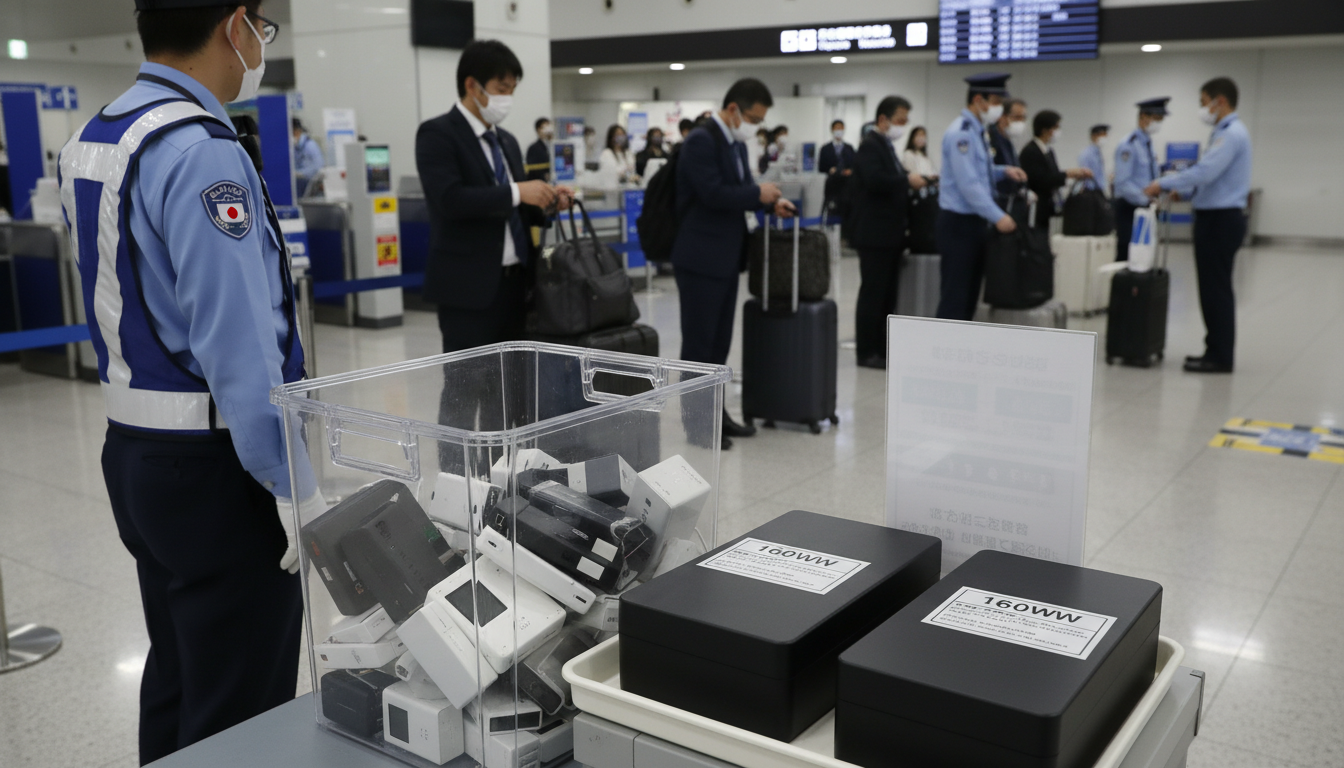
Airport security officers and airline staff will be checking power banks during carry-on screening and at boarding gates, with some carriers adding targeted checks for battery capacity labeling. Passengers whose devices exceed the permitted limit or who present more than the allowed number of power banks may be asked to remove the items, leave them behind, or make other arrangements before boarding. In many cases, non-compliant batteries will be confiscated to protect the safety of other passengers and the aircraft.
Airlines have discretion to apply additional restrictions, and travelers should expect to see variable enforcement practices between carriers and airports. Staff are trained to identify capacity markings and to ask passengers questions about spare batteries, but travelers can avoid delays by preparing documentation or packaging that clearly shows watt-hour ratings. If there is uncertainty at the screening point, passengers will be advised by security staff on the safest course of action, which could include returning the item to checked luggage—although checked carriage of power banks remains prohibited under the new rules.
Passengers should factor potential additional screening time into their airport arrival plans, particularly during busy travel periods, and keep power banks easily accessible for inspection. Proper labeling and having product specifications on hand—either printed or on a device page—can speed the process and reduce the risk of confusion.
Practical steps travelers should take before departure
Before leaving for the airport, travelers should inventory the batteries they intend to carry and verify the watt-hour rating on each item; the rating is usually printed on the product casing or provided in the manufacturer specifications. If the capacity is listed in milliamp-hours (mAh), passengers can convert to watt-hours using the formula Wh = (mAh × V) / 1000, where V is the nominal voltage (commonly 3.7V for lithium-ion cells). Carry only the batteries that are within the 160Wh limit and keep the total number to two or fewer per passenger.
Charge devices and fully power any essential electronics before arriving at the airport so that reliance on spare power banks is minimized. Many travelers will find it helpful to use airport charging stations, onboard USB ports, or a laptop to recharge phones when permitted, rather than relying on a separate power bank. Pack power banks in a way that keeps them accessible for inspection, avoid tape or modifications to labels, and carry receipts or specification pages if the capacity marking is unclear or absent.
Travelers with batteries that exceed 160Wh should check with their airline for alternatives; in most cases, oversized batteries cannot be transported by passenger aircraft and may require special handling or shipping via cargo services. Where commercially viable, replacing high-capacity batteries with compliant models for a single trip can be simpler and less costly than attempting to arrange special transport.
What devices are still allowed and how to charge them on board
Devices such as laptops, tablets, digital cameras and handheld gaming consoles remain permitted in carry-on luggage and can be used during flights, subject to standard airline rules about electronic device operation. These devices typically contain internal batteries that meet regulatory standards and are designed for safe carriage in the cabin. Passengers may continue to bring these items without restriction beyond the general cabin baggage allowances.
If passengers need to charge their phone or another personal device during a flight, they may use the aircraft’s seat power outlets or USB ports where provided, and they may also charge devices from a laptop or tablet. Airline-provided power remains allowable because it supplies regulated current through the aircraft’s electrical system rather than via loose lithium batteries. However, using a power bank to charge devices in flight is explicitly forbidden under the new Japan rules and should not be attempted.
Where in-seat power is unavailable, passengers can conserve battery by switching devices to airplane mode, lowering screen brightness, and closing unnecessary apps. Planning ahead to arrive with fully charged devices and knowing where charging infrastructure will be available during transit can reduce the likelihood of inconvenient battery depletion.
Safety rationale: why regulators changed the rules
The updated restrictions on power banks reflect broader international concerns about the fire risk posed by lithium-ion batteries when they fail or are damaged. Incidents of battery fires and thermal runaway, though rare, can have catastrophic consequences on aircraft where containment and firefighting resources are limited. To reduce these risks, the International Civil Aviation Organization (ICAO) issued guidance in March 2026 recommending standardized measures for carriage limits, storage, and usage of spare lithium batteries on passenger aircraft.
Japan’s adoption of these measures aims to harmonize national aviation safety practices with that global guidance, prioritizing passenger safety and operational risk reduction. Authorities emphasize that limiting the size and number of spare batteries carried in the cabin reduces the likelihood of a severe incident and makes any potential event easier to manage. Public safety notices and airline communications cite the ICAO guidance and national aviation authorities as the basis for the changes and urge compliance.
For travelers, the result is straightforward: fewer, smaller spare batteries in the cabin and stricter limits on their use during flights. The policy is preventive in nature and seeks to address a known hazard by reducing exposure to it across the commercial fleet.
Alternatives and travel tips for staying connected without a power bank
To minimize reliance on a power bank, travelers should charge devices before departure and use onboard power where available. Many airports now offer charging stations in lounges and at gates, and some carriers provide seat power or USB ports even on short-haul flights; checking a flight’s amenities in advance can help travelers plan. If battery life is a particular concern for a long journey, consider carrying a fully charged spare device—such as a secondary phone or tablet—instead of an extra battery.
Another practical option is to make use of local connectivity and digital planning to reduce power consumption, for example by downloading maps, boarding passes and entertainment for offline use before boarding. For international visitors, eSIMs and local SIM cards can provide internet access without needing to keep devices active searching for networks, which conserves battery. Travelers who frequently require extended off-grid power for work or photography should evaluate higher-capacity equipment that remains within the 160Wh limit, or plan for recharging opportunities at layover points.
Carrying a compact AC power adapter and a small multiport charging hub in your carry-on can also be useful where airport or lounge power is available; these accessories are allowed and can charge multiple devices from a single available outlet. Always confirm that any accessory complies with airline rules and that wires and adapters are stowed safely during taxi, takeoff and landing.
What to expect if a power bank is non-compliant or confiscated
If a power bank does not meet the new rules, security personnel generally follow standardized procedures which can include refusing to allow the item onboard and, in some cases, confiscating it. Because checked baggage is not an option for spare batteries, passengers may need to arrange to return the item to their accommodation, discard it before entering the secure area, or seek to ship it by authorized cargo channels. Confiscation reduces the risk to the aircraft but can be disruptive to travelers who are unprepared.
Airlines and airports aim to reduce passenger inconvenience by providing clear instructions and by allowing time for remediation when possible, but ultimate authority rests with security officers and the airline’s safety policies. Travelers who believe a battery has been incorrectly assessed should ask politely for clarification and for written guidance on next steps, and they may follow up with the carrier’s customer service after the flight. To avoid any such complications, the safest approach is to verify battery capacity and to carry only compliant spares.
Passengers with medical devices that require external batteries or specific power supplies should notify their airline in advance and obtain written confirmation of permitted carriage to avoid issues at the security checkpoint. Medical exemptions and special handling provisions may apply, but they usually require prior notification and documentation.
Backing up claims: authority and reporting on the rule change
The change in practice in Japan follows international discussions led by aviation safety organizations and has been publicly reported by national tourism and industry outlets. Japan’s tourism and travel authorities issued guidance ahead of the April 2026 effective date, and travel industry reporting has summarized the practical consequences for passengers. The regulatory shift is based on the ICAO’s March 2026 advice regarding lithium battery carriage, and national agencies have issued their own advisories to ensure consistent implementation.
Travelers should consult both their airline and the airport they will use for the most up-to-date procedural details before traveling, because local implementation can vary and additional carrier-specific restrictions may apply. The JE table of allowed devices has not fundamentally changed—laptops, tablets and cameras remain permitted—but the handling and in-flight use of spare batteries have tightened. For authoritative clarification, official airline notices and national aviation authority guidance remain the primary sources.
Final preparations for travel may include updating device lists, reducing the number of spare batteries carried, and confirming the presence of in-seat power on the specific aircraft type scheduled for the flight. Those steps typically eliminate surprises at the gate and make the journey smoother for passengers and crew alike.
If you are planning travel to or within Japan, remember to place power banks where they can be inspected, limit yourself to two units under 160Wh each, and avoid using them on board. These precautions safeguard both personal devices and the broader safety of flight operations, and they reflect an international move toward tighter control of lithium battery carriage on passenger aircraft.

