
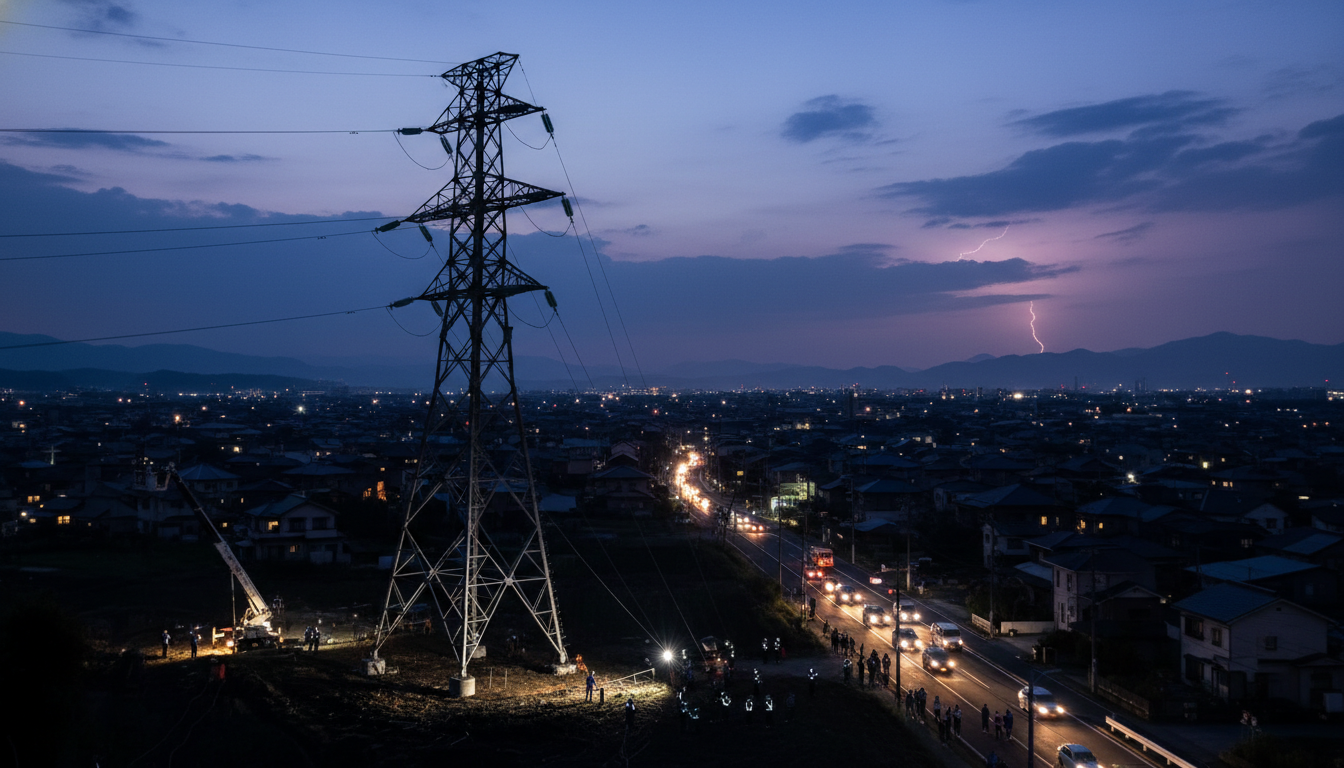
Lightning Causes Major Nagano Power Outage, Leaving Nearly 480,000 Households Without Power
Lightning triggered a Nagano power outage on May 12, 2026, cutting electricity to up to 478,320 households and disrupting Hokuriku Shinkansen services.
A widespread power outage struck large parts of Nagano Prefecture on the evening of May 12, 2026, after a lightning strike, officials said. The blackout began at about 6:20 p.m. Japan Standard Time and affected cities including Nagano, Ueda, Omachi and Azumino. Chubu Electric Power Grid reported the incident and said the outage reached a maximum of roughly 478,320 households, with some areas remaining without power for as long as 1 hour and 46 minutes.
Widespread outage affected major cities
Chubu Electric Power Grid identified the hardest-hit municipalities as Nagano City, Ueda City, Omachi City and Azumino City, among others in the prefecture. Company officials said the outage peak involved approximately 478,320 households, reflecting the broad geographic impact across urban and rural districts. Restoration work proceeded through the night, with the utility mobilizing crews to isolate the fault and reclose circuits where it was safe to do so.
The scale of the blackout covered both residential neighborhoods and sections of critical infrastructure, according to the utility’s initial account. While most customers had power restored within the stated maximum interruption time, Chubu Electric cautioned that complete checks and targeted repairs could extend work in some locations. The company attributed the failure directly to a lightning strike that affected distribution equipment.
Chubu Electric Power Grid response and restoration
Chubu Electric Power Grid dispatched field crews immediately after the outage was detected and began systematic checks of substations and feeder lines. Engineers focused first on identifying equipment damaged by the lightning and on re-energizing lines that could be safely returned to service. The firm reported that the longest outages lasted up to 1 hour 46 minutes, reflecting variable damage and the need for manual interventions in some spots.
Officials said public reporting channels were open for customers to notify the utility of lingering outages and malfunctions. Chubu Electric also indicated it would carry out follow-up inspections to ensure the integrity of affected lines and to assess any longer-term repairs that might be necessary. The company plans to issue a fuller incident report after completing on-site evaluations.
Rail services halted on Hokuriku Shinkansen
East Japan Railway Company (JR East) confirmed that the Nagano power outage affected rail operations on the Hokuriku Shinkansen. Services were temporarily suspended between Karuizawa and Toyama while operators verified trackside power supplies and signalling systems. JR East said the suspension was precautionary to ensure passenger safety while power and control systems were checked.
Train services resumed once power and signalling integrity were confirmed along the affected segment, though JR East warned that residual delays and schedule adjustments could persist as operators normalized operations. The company urged passengers traveling on the Hokuriku Shinkansen on the evening of May 12 to check service notices and allow extra time for their journeys.
Meteorological conditions and lightning attribution
The Japan Meteorological Agency (JMA) said Nagano Prefecture was under the influence of colder air aloft combined with moist, unstable air at lower levels on May 12, creating conditions favorable for localized thunderstorms. The agency reported that the weather pattern produced intense, localized lightning activity in parts of the prefecture during the evening. Meteorologists said such atmospheric setups can produce powerful cloud-to-ground strikes that pose a direct threat to electrical distribution equipment.
JMA noted that thunderstorms on May 12 were patchy but intense where they occurred, a pattern that can result in concentrated damage along narrow corridors. The agency advised that lightning strikes remain a frequent cause of sudden service interruptions during spring and early summer transitions, particularly when upper-level cold pools move over warm, humid low-level air.
Local impacts on households and services
Residents in affected areas reported sudden loss of lighting and electrical appliances when the outage hit, and some households relied on emergency lighting or portable battery power until service was restored. Local governments and community centers prepared to assist vulnerable residents during the interruption, while businesses in the affected zone experienced temporary closures or limited operations. Photographs and local media coverage showed darkened streets and unlit commercial areas during the outage’s peak.
While no widespread reports of injuries or prolonged life-support interruptions were immediately reported, utilities and municipal authorities emphasized the need for contingency planning. Community advisory notices underscored the importance of checking emergency supplies and verifying the status of essential equipment following lightning-related outages.
Aftermath and steps to reduce future risk
Chubu Electric Power Grid said it will inspect damaged equipment and components to determine the exact mechanism of failure and to consider possible reinforcements or additional lightning protection where vulnerabilities were identified. Utility officials also pointed to the routine role of surge arresters, grounding improvements and circuit sectionalizing in limiting the spread of outages caused by lightning. The company indicated that findings from the May 12 incident would inform any targeted upgrades.
The JMA reiterated guidance for residents and operators to remain alert during periods of atmospheric instability and to secure sensitive electrical devices where possible. Municipal authorities and infrastructure operators are expected to review the event in coordination with the utility and transportation providers to refine emergency response measures and minimize disruption from future thunderstorm-induced outages.
Initial investigations by Chubu Electric and related agencies concluded that lightning was the proximate cause of the Nagano power outage on May 12, 2026, and recovery efforts restored electricity for most customers within the reported maximum interruption time. Authorities continue assessments of damage and service resilience as they work to reduce the risk of similar incidents in coming storm seasons.

