
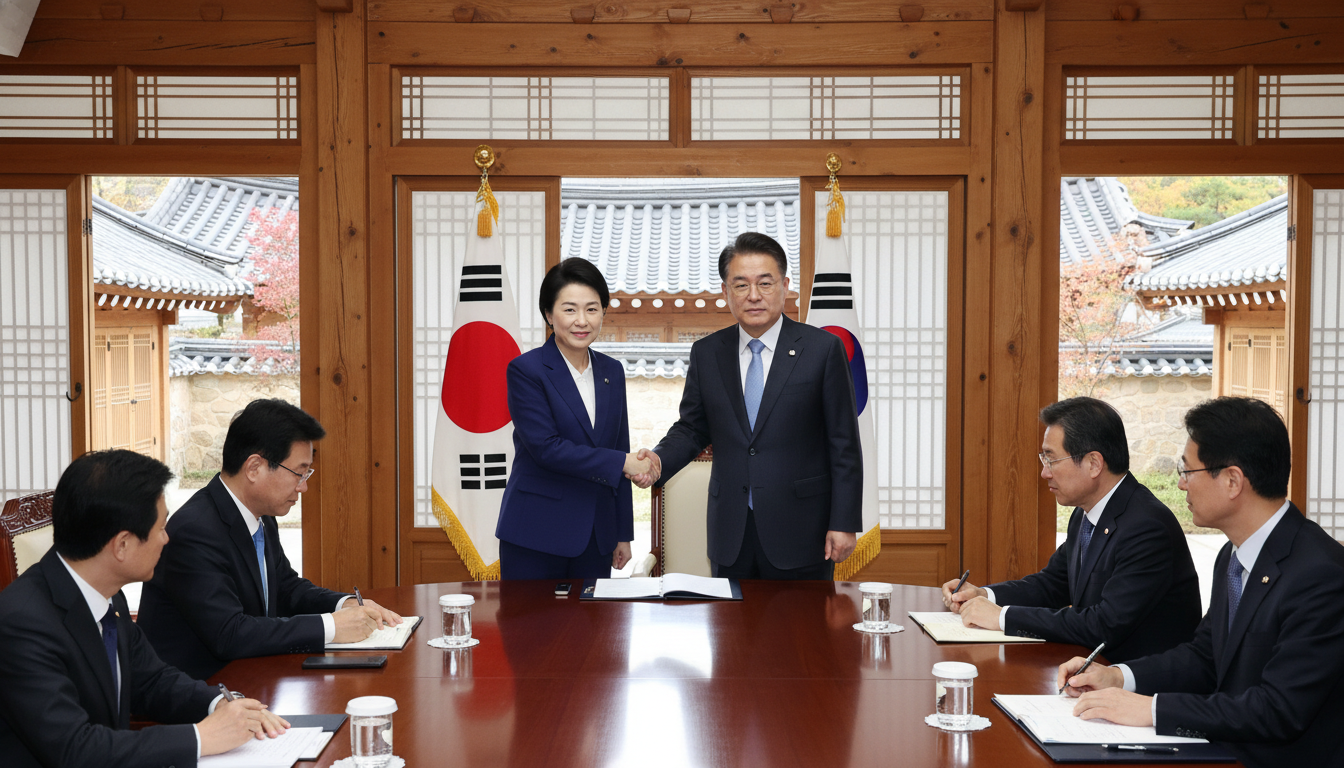
Takaichi’s Visit to South Korea: Andong Summit with President Lee Prioritizes Energy Security and Defense Ties
Sanae Takaichi met South Korean President Lee Jae Myung in Andong to discuss energy security, defense cooperation, and a new Japan-South Korea trade dialogue during her visit.
Opening summit in Andong
Prime Minister Sanae Takaichi arrived in Andong on May 19, 2026, for a two-day reciprocal visit that brought her together with South Korean President Lee Jae Myung to discuss energy security and defense cooperation. The meeting, held in Lee’s hometown, marked Takaichi’s first official reciprocal visit to South Korea since taking office and the third face-to-face encounter between the two leaders. Both sides framed the talks against a backdrop of heightened global tension, notably developments in the Middle East that have disrupted energy routes.
Takaichi opened the summit by underscoring the need for Japan and South Korea to play a stabilizing role in the Indo-Pacific, while Lee emphasized the importance of cooperation and dialogue among friendly nations. Officials from both governments said they intended to issue a joint statement outlining concrete steps on energy and industrial collaboration. The leaders also used the meeting to take stock of recent international diplomacy, including a major U.S.-China summit held earlier in Beijing.
Talks focus on energy security amid Middle East disruptions
Energy security dominated discussions, with both governments acknowledging the economic impact of disruptions to Middle Eastern supply lines and the effective closure of the Strait of Hormuz. Japan and South Korea are heavily dependent on crude oil imports from the region, and officials said contingency planning was a priority. The two leaders discussed mechanisms to ensure continuity of petroleum supplies and to reduce vulnerability to concentrated supply routes.
Delegates outlined proposals for enhanced information sharing and logistical cooperation for fuel procurement and distribution. One senior official described plans for a public-private dialogue to explore mutually beneficial arrangements for supplying refined petroleum products between the two countries. Such steps are intended to create short-term resilience while longer-term diversification strategies continue.
Agreement to establish industry and trade dialogue
The summit advanced plans to establish a new framework for regular dialogue between senior officials from Japan’s Ministry of Economy, Trade and Industry and South Korea’s Ministry of Trade, Industry and Energy. The proposed mechanism would allow both sides to consult on industrial policy, supply-chain security, and strategic trade coordination. Officials indicated preliminary agreement to convene technical working groups that would report back with actionable recommendations.
Leaders also discussed measures to support semiconductor supply chains, critical minerals, and other sectors seen as strategic for national resilience. The new framework aims to balance market-oriented cooperation with government-level coordination to address emergent risks and to foster trustworthy commercial partnerships across sensitive industries.
Security cooperation and responses to U.S.-China diplomacy
Regional security featured prominently as the two leaders reviewed recent international diplomacy, including the U.S.-China summit in Beijing held days earlier. Takaichi and Lee exchanged assessments of the summit’s implications for East Asian security and explored paths for trilateral cooperation with the United States. While concrete military arrangements were not announced, both sides signaled interest in deepening dialogue on defense interoperability, intelligence sharing, and crisis management.
Japanese and South Korean officials emphasized that strengthening bilateral ties would complement broader deterrence and stability efforts in the Indo-Pacific. Analysts within both governments noted that closer coordination among Tokyo, Seoul and Washington could present a unified regional stance without precluding engagement with other major powers.
Symbolic hospitality and cultural program in Andong
Beyond policy, the visit included visible gestures of hospitality intended to reinforce the personal rapport between the two leaders. President Lee hosted Prime Minister Takaichi for a traditional dinner featuring Andong-style chicken dishes typically reserved for distinguished guests. The leaders subsequently toured Hahoe Village, a UNESCO World Heritage site known for its preserved traditional houses, and attended a performance of Pansori, a long-form Korean musical storytelling tradition.
Those cultural elements were presented by both governments as symbols of deepening people-to-people ties that complement diplomatic work. Local officials in Andong described the visit as an opportunity to highlight regional heritage and to showcase bilateral goodwill at a time when strategic cooperation is increasingly prominent.
Takaichi is scheduled to return to Japan on May 20, concluding a two-day exchange that officials hope will translate into concrete policy initiatives on energy, trade and security. The joint statements and working groups agreed in Andong are expected to set a cadence for more frequent high-level consultations between Tokyo and Seoul as both countries navigate a complex regional environment.

