
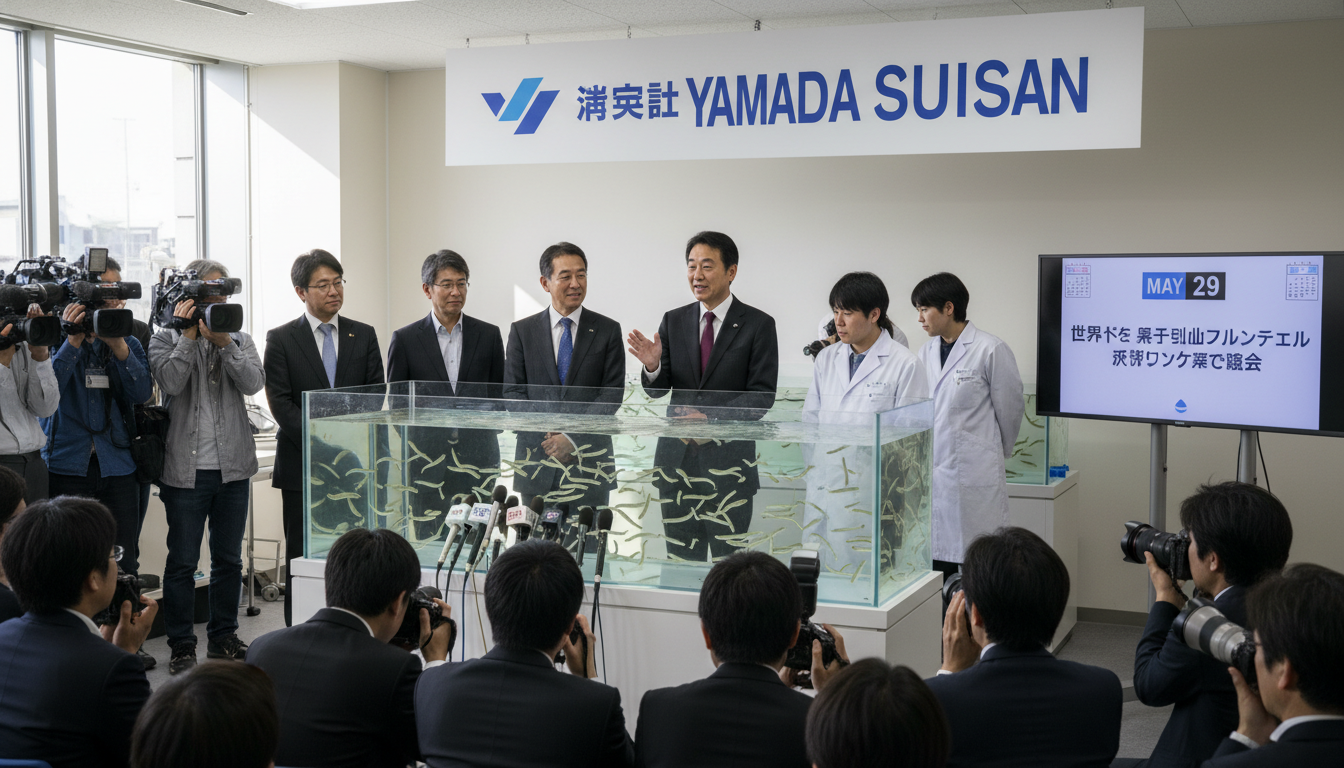
Full-cycle cultivated eel goes on trial sale in Japan from May 29
Full-cycle cultivated eel trial sales start May 29 as Yamada Suisan tests demand; officials praise taste despite remaining production and cost challenges.
Japan’s first commercial trial sale of full-cycle cultivated eel will begin on May 29, 2026, with Oita-based Yamada Suisan Co. offering the product through selected retail outlets and e-commerce platforms. The full-cycle cultivated eel, produced by hatching and rearing eels entirely from artificially obtained eggs, will be sold to gauge consumer demand and inform future commercialization steps. Company executives said each eel in the initial run will be priced at roughly ¥5,000 as they seek to balance consumer acceptance with the still-high production costs.
Trial Sales to Start May 29 and Target Retail and Online Markets
Yamada Suisan plans a limited rollout of the full-cycle cultivated eel across brick-and-mortar stores and its online channels beginning May 29, 2026, as part of a market test to measure demand and price sensitivity. The company has framed the trial as a way to collect consumer feedback and adjust supply plans before larger-scale commercialization is attempted. Initial units will be priced at about ¥5,000 apiece, a premium intended to reflect early-stage production costs while enabling broad sampling.
Government Officials Sample Product and Offer Support
Agriculture, Forestry and Fisheries Minister Norikazu Suzuki sampled the full-cycle cultivated eel ahead of the launch and offered strong endorsement of its flavor, expressing support for efforts to expand availability. While the minister welcomed the quality, he emphasized the importance of building production capacity and lowering costs before the technique can relieve market pressures. Officials signaled they will continue to cooperate with industry and research bodies to accelerate technological improvements.
How Full-Cycle Cultivation Works and Its Research History
Full-cycle cultivation involves breeding adult eels that have themselves been raised from artificially hatched eggs, inducing them to spawn in captivity and thus closing the life cycle without relying on wild broodstock. Japan’s research institutions first reported a successful full-cycle cultivation in 2010, and the Japan Fisheries Research and Education Agency has since continued to refine the methods. Advances such as larger rearing tanks and specialized feeds have incrementally improved survival rates and throughput, enabling the production of tens of thousands of juveniles annually as of 2026.
Production Gains and Remaining Technical Challenges
Despite progress, raising eels from egg to juvenile remains technically demanding, with mortality risks and variability that complicate stable mass production. The glass eels that most commercial farms currently use are still predominantly sourced from wild populations, and the transition to exclusively hatchery-origin juveniles requires further optimization. Industry and research officials say work continues on improving spawning induction, larval survival, and feed formulations to turn laboratory success into consistent commercial yields.
Supply Shortfalls, Cost Trends and Import Dependence
Domestic supply of eel has declined sharply from its peak, with production falling to 60,941 tons in 2024—roughly 40 percent of the year 2000 high—heightening reliance on imports from China and other countries. Cost reductions for hatchery juveniles have been significant: reported per-juvenile production costs have dropped from about ¥40,000 in fiscal 2016 to approximately ¥1,800 in 2026. Still, Yamada Suisan and government scientists acknowledge that cost for hatchery juveniles remains three to four times higher than that for wild-caught glass eels, and the Fisheries Agency has set an interim target of reducing the cost to around ¥800 to make full-cycle production commercially viable.
Industry Outlook and Roadmap to Commercialization
Company leaders say the May 29 trial is intended to inform a phased scaling strategy, using market feedback to refine production targets, packaging, and distribution plans. Yamada Suisan’s president indicated that as volumes increase and techniques improve, prices should move toward levels acceptable to mainstream consumers and restaurants. Observers caution that wider adoption will hinge on continued investment in hatchery technology, feed efficiency, and supply-chain adaptations to accommodate a new category of domestically produced juveniles.
The trial launch of the full-cycle cultivated eel on May 29 represents a key moment for Japan’s eel industry: it tests whether decades of research and incremental production gains can translate into consumer acceptance and a practical path to reducing import dependence. The coming months of retail and online sales will be closely watched by producers, regulators, and dining-sector buyers as stakeholders assess taste, price elasticity, and the technical hurdles that remain before larger-scale commercialization can be realized.

