
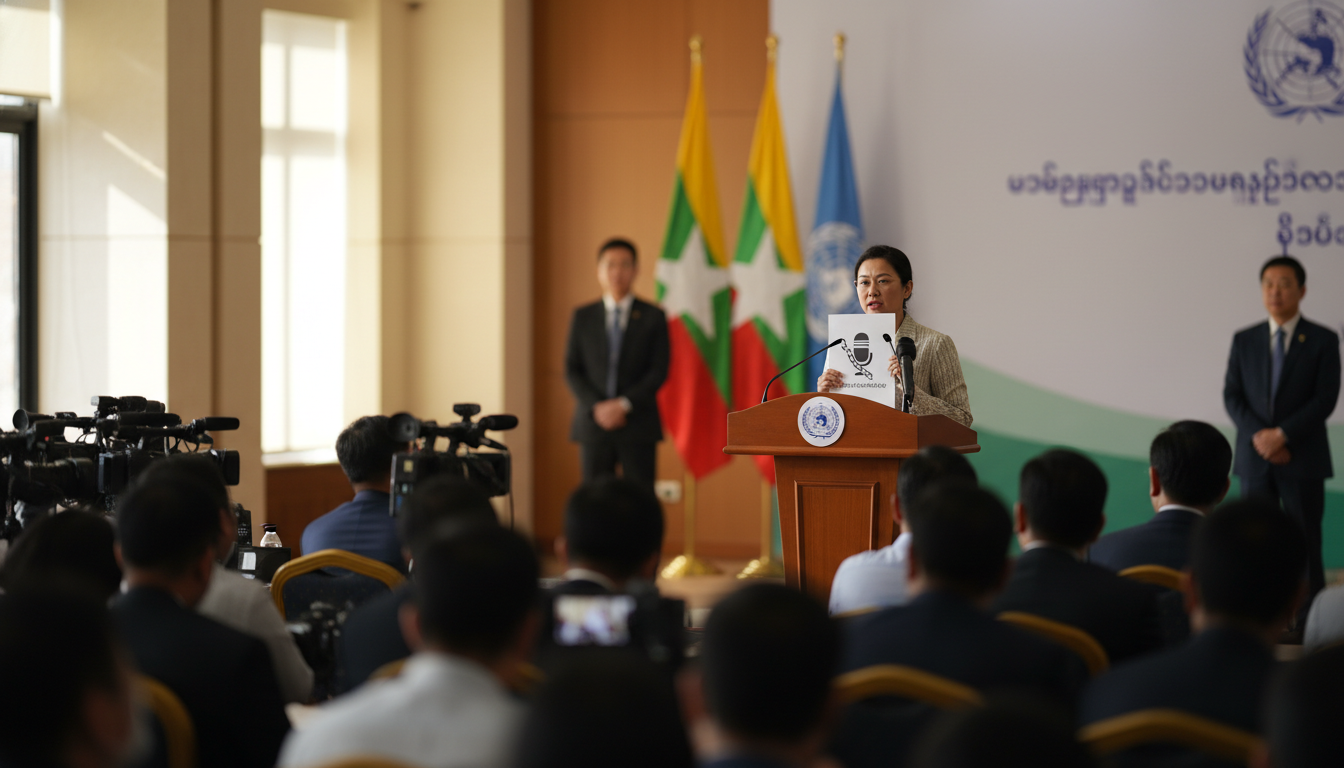
Press freedom in Myanmar must be a benchmark for transition, watchdog urges
Watchdog urges Southeast Asian governments to make press freedom in Myanmar a benchmark for political transition amid severe journalist imprisonments.
Southeast Asian governments should adopt press freedom in Myanmar as an explicit benchmark for judging any political transition, the head of a global media watchdog said Wednesday. The Committee to Protect Journalists’ chief highlighted the country’s standing as among the worst in the world for imprisoning journalists and urged regional leaders to make media liberties a visible condition for engagement. The call came during a public address given at the organization’s 2025 International Press Freedom Awards in New York, where the issue of journalist safety in Myanmar took center stage.
Watchdog frames press freedom as a measurable transition marker
The media watchdog argued that freedom of the press is a concrete, verifiable indicator that can show whether political change in Myanmar is genuine or merely cosmetic. By tying political benchmarks to the release of jailed reporters, the watchdog said governments can better assess whether power is shifting away from repressive institutions. The proposal reframes media freedom from an abstract value to an operational metric that can be tracked over time.
The recommendation is grounded in the watchdog’s reporting that Myanmar ranks among the very worst countries globally for incarcerating members of the press. That ranking, the speaker noted, reflects ongoing arrests, prosecutions and lengthy detentions targeting reporters, editors and independent outlets. Putting press freedom on the agenda would require regional governments to monitor these concrete steps and to make assistance or diplomatic engagement contingent on demonstrable progress.
CEO Jodie Ginsberg highlights imprisonment ranking
The Committee to Protect Journalists’ chief emphasized the human cost behind the ranking by pointing to individual cases and broader patterns of repression. In remarks delivered at the 2025 International Press Freedom Awards in New York, she underscored that the ranking is not abstract but a reflection of systematic attempts to silence reporting. The watchdog head called on neighboring governments to recognize that journalist imprisonment undermines any claim to a credible transition.
The address used the organization’s data to press for immediate, verifiable actions such as releasing detained journalists and dropping politically motivated charges. Ginsberg framed these measures as minimum steps that would signal a shift away from the tactics that have kept critical reporting off the air and online. She urged regional partners to adopt a unified, standards-based approach rather than fragmented responses.
Risks faced by journalists inside and outside Myanmar
Journalists working inside Myanmar continue to face arrests, legal harassment and the seizure of equipment, the watchdog said, while exiled reporters confront threats that limit their ability to operate freely. Media outlets that attempt to document human rights abuses encounter systematic obstruction from authorities, including raids and communication blackouts. These tactics not only endanger individual reporters but also curtail independent coverage that could inform international assessments of any transition.
The practical consequences are significant: when independent media are silenced, the public loses a reliable source of information and external actors lose a necessary tool for verifying political developments. The absence of credible reporting makes it easier for oppressive actors to claim progress while continuing repression. The watchdog therefore argues that protecting journalists is essential both for basic rights and for transparent governance.
Regional responsibility and the limits of non-interference
The call places new pressure on Southeast Asian governments that have traditionally prioritized non-interference in the internal affairs of neighbors. The watchdog recommended that this principle be balanced against the region’s interest in stability and a credible political settlement in Myanmar. Officials in the region face a choice between maintaining established diplomatic norms and adopting conditional benchmarks that could influence outcomes on the ground.
Advocates say a measured regional approach would not necessarily mean punitive isolation but could include calibrated incentives tied to media freedoms, such as increased humanitarian access or technical assistance for independent media. The watchdog suggested that collectively defined benchmarks would reduce the scope for individual states to normalize or reward repression. Making press freedom a regional benchmark could also give civil society and journalists a clearer framework for accountability.
International and civil society responses to the proposal
Human rights groups and media organizations welcomed the recommendation as a practical step toward protecting reporters and improving transparency. They said that regional agreement on benchmarks would strengthen advocacy efforts and provide a common standard for evaluating progress. International partners could then align diplomacy, aid and sanctions more closely with verifiable milestones related to media freedoms.
At the same time, implementing such benchmarks would require reliable monitoring mechanisms and political will from countries that have often resisted external scrutiny. Civil society groups indicated readiness to contribute documentation and verification, but they warned that measures must protect the safety of sources and reporters. The watchdog emphasized cooperation with local and diaspora media as essential to any monitoring regime.
The watchdog’s appeal reframes press freedom in Myanmar not merely as a human-rights concern but as a practical barometer of political change, asking regional governments to adopt concrete benchmarks tied to journalist safety and the release of those imprisoned for their work.

