
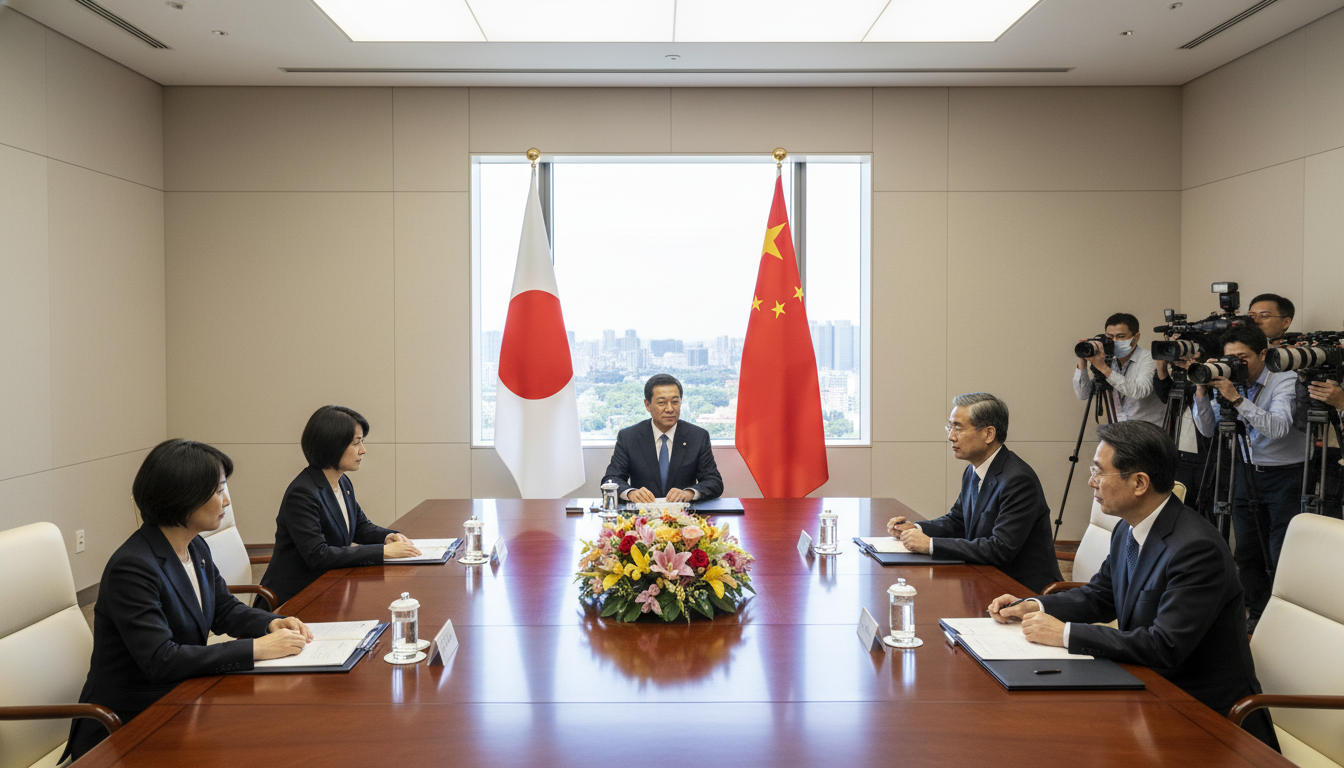
Japan-China tensions eased by highest-level talks at APEC meeting in Suzhou
Japan-China tensions take a tentative turn as senior Japanese officials meet Chinese Commerce Minister Wang Wentao at APEC in Suzhou, while a 21-member joint statement revives WTO support.
High-level contacts at APEC in Suzhou
Senior Japanese officials held face-to-face discussions with Chinese Commerce Minister Wang Wentao on the sidelines of the APEC meeting in Suzhou on May 22.
The encounter marked the highest-level contact between Tokyo and Beijing since a diplomatic rupture that began after remarks by Prime Minister Sanae Takaichi last November.
The Japanese delegation included Ryosei Akazawa, Japan’s minister of economy, trade and industry, underscoring the economic focus of the talks.
Officials from both sides described the meetings as pragmatic exchanges aimed at stabilizing communication channels and lowering tensions that have affected bilateral ties.
Background of the diplomatic standoff after November remarks
Takaichi’s public comments last November prompted immediate diplomatic friction and a cooling of official exchanges between Tokyo and Beijing.
That dispute weighed on high-level visits and prompted a period of constrained contact which raised concern in business and diplomatic circles across the region.
The Suzhou talks represent a deliberate effort to reopen lines of communication after months of limited engagement.
Analysts note that resuming ministerial-level contact is often a first step toward managing disputes and preventing further escalation.
Parallel discussions involving U.S. and Chinese officials
Alongside the Japan-China contacts, U.S. and Chinese officials also engaged in separate discussions at APEC, reflecting broader regional efforts to stabilize relations.
Those exchanges underline the meeting’s role as a venue not only for bilateral diplomacy but also for multilateral dialogue among leading economies.
Observers say simultaneous conversations involving the United States add pressure for pragmatic outcomes, especially on trade, supply chains, and regional security.
The presence of multiple delegations creates both an opportunity for coordinated messaging and a challenge in aligning competing national priorities.
21-member joint statement revives WTO support
In a related development at APEC, 21 members issued a joint statement reaffirming support for the World Trade Organization and multilateral trade rules.
The declaration signals a renewed commitment to a rules-based trade system amid growing economic nationalism and geopolitical friction.
For Japan, the joint statement bolsters an approach that links economic stability to predictable dispute-resolution mechanisms.
Supporters of the WTO note that reviving multilateral institutions could help mediate future commercial tensions between major trading partners.
Economic stakes for Japan and regional supply chains
Japan’s participation in high-level talks with China reflects concerns about trade continuity and the security of regional supply chains.
Ministry of Economy, Trade and Industry involvement highlights Tokyo’s priority on preventing disruptions to industries that rely on cross-border flows of parts and raw materials.
Japanese businesses depend on stable access to Chinese markets, and any prolonged diplomatic rift risks higher costs and uncertainty.
Restoring dialogue can reassure private-sector actors and investors, although concrete policy outcomes will be needed to fully allay business concerns.
Diplomatic signals and possible follow-up steps
The Suzhou meetings signal a willingness by both capitals to manage differences through direct contact rather than prolonged estrangement.
Officials indicated that these were preliminary conversations, leaving open the prospect of further ministerial meetings or working-level talks to translate dialogue into policy steps.
Diplomats say follow-up will likely focus on economic cooperation, rules-based trade, and mechanisms to reduce miscommunication.
Longstanding issues, including regional security dynamics and political disputes, remain unresolved and will require sustained engagement beyond a single set of meetings.
The exchange in Suzhou offers a cautious opening for lowering Japan-China tensions while reinforcing multilateral trade norms, but observers caution that steady diplomacy and tangible measures will be necessary to convert initial contacts into durable stability.

