
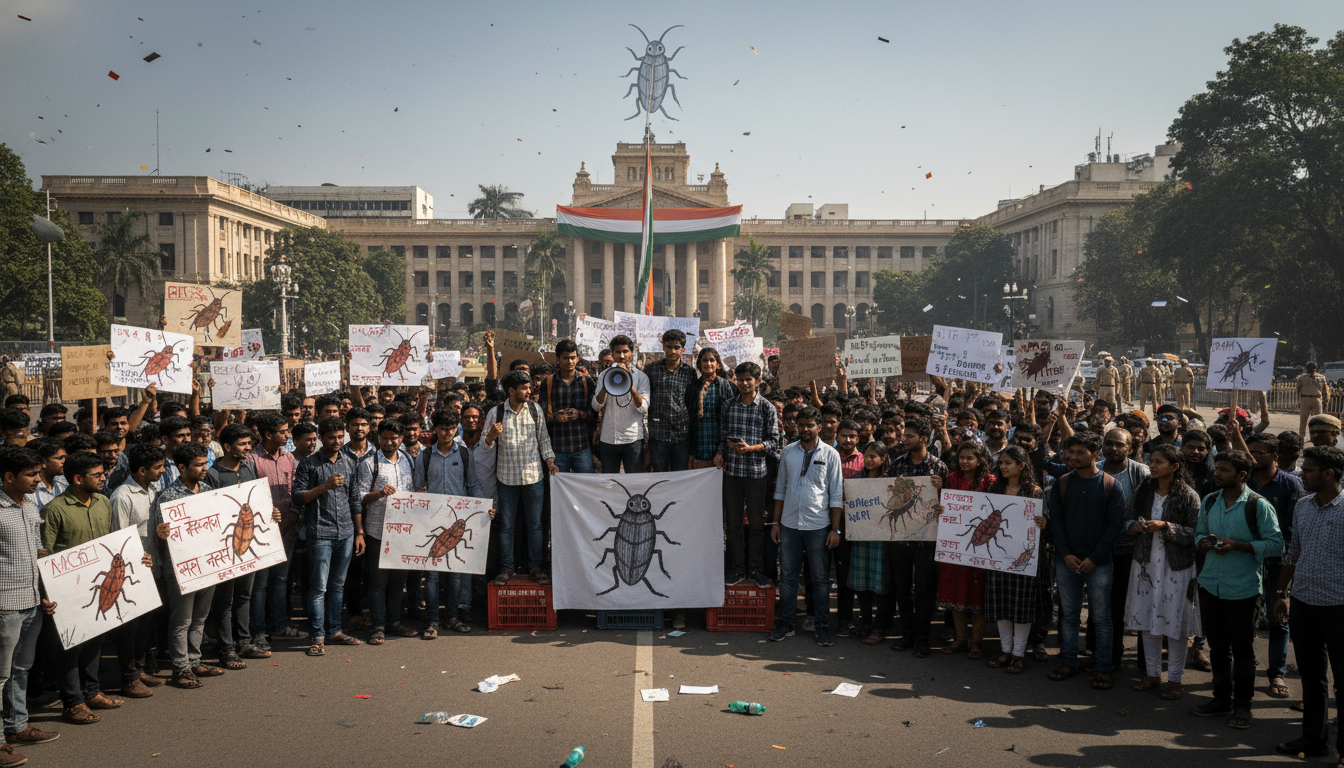
Supreme Court ‘parasite’ remark fuels millions to join Cockroach Janta Party
A Supreme Court justice’s “parasite” barb has driven a surge of young Indians into the satirical Cockroach Janta Party, turning online outrage into mass membership and a new form of political dissent.
The Cockroach Janta Party has reported a wave of sign-ups and social-media activity since the justice’s remark, with organizers and platform metrics indicating millions have affiliated with the group in the days that followed. What began as parody has rapidly become a vehicle for expressing frustration among young adults who say they are wary of traditional street protest but want to register political discontent.
Mass surge follows judge’s ‘parasite’ comment
The movement accelerated after a high-profile Supreme Court justice used the word “parasite” in a public context, drawing widespread condemnation and viral backlash. Online users seized the moment to mock the remark and to mobilize collectively under the Cockroach Janta Party banner.
Sign-up pages, meme groups and hashtag campaigns expanded quickly, turning the cockroach image into a symbol of ironic resistance. Organizers describe the enrollment as both symbolic protest and a critique of elite rhetoric that many young people regard as dismissive.
How the Cockroach Janta Party mobilized online
The Cockroach Janta Party’s appeal has rested largely on humor and satire rather than formal political organization. An intentionally absurd visual identity and tongue-in-cheek messaging lowered barriers to participation and encouraged rapid sharing.
Campaigns on messaging apps and social networks have amplified the group’s reach, with viral images and short videos framing membership as a low-risk, high-visibility response. The movement’s digital-first strategy has allowed it to scale without conventional party infrastructure.
Youth fear of street protests drives digital dissent
Many who joined the Cockroach Janta Party say they are reluctant to take to the streets because of legal and social consequences, and prefer digital avenues to signal dissent. For this cohort, online affiliation offers a safer, more creative outlet for grievances about governance, judiciary remarks, and economic insecurity.
Activists and participants describe the phenomenon as partly performative and partly substantive: satire allows people to voice anger while avoiding the immediate risks associated with physical demonstrations. That balance has made the movement particularly attractive to younger demographics.
Responses from political and civil society actors
Political figures and civil society organizations have reacted in diverse ways, reflecting the contentious nature of the debate. Some opposition leaders and rights groups criticized the justice’s choice of words and framed the Cockroach Janta Party’s growth as a symptom of institutional disconnect.
Other public officials urged restraint and called for a de-escalation of rhetoric, warning that satire can harden political divisions. Legal commentators have noted that the movement’s rapid growth will test free-speech norms and raise questions about how satire and political organization intersect under existing laws.
Potential impact on public discourse and elections
The swift popularization of the Cockroach Janta Party underscores a broader shift in how political expression is being channeled by younger voters. Analysts caution that even symbolic movements can alter public conversations, pushing certain grievances into mainstream debate.
While the group is not a formal electoral force today, its ability to aggregate sentiment and convert it into visible online metrics could shape campaign narratives and media coverage in the months ahead. Parties and candidates may find it increasingly difficult to ignore a demographic that expresses political identity through satire.
What analysts say about long-term implications
Political analysts observe that the phenomenon reflects sustained disaffection among young adults rather than a single-issue flare-up. They argue that satire-based mobilization can endure as a cultural outlet even if it lacks conventional policy proposals or party platforms.
Some experts caution that symbolic protests risk dissipating without concrete demands, while others point out their potency in shifting tone and focus during election cycles or judicial controversies. Both outcomes remain possible as the Cockroach Janta Party navigates its rapid rise.
The movement’s future will depend on whether its participants sustain engagement beyond online sign-ups and whether established institutions respond with reforms, dialogue, or suppression. For now, the Cockroach Janta Party stands as a striking example of how a single contentious remark can catalyze large-scale, digitally driven political expression.

