
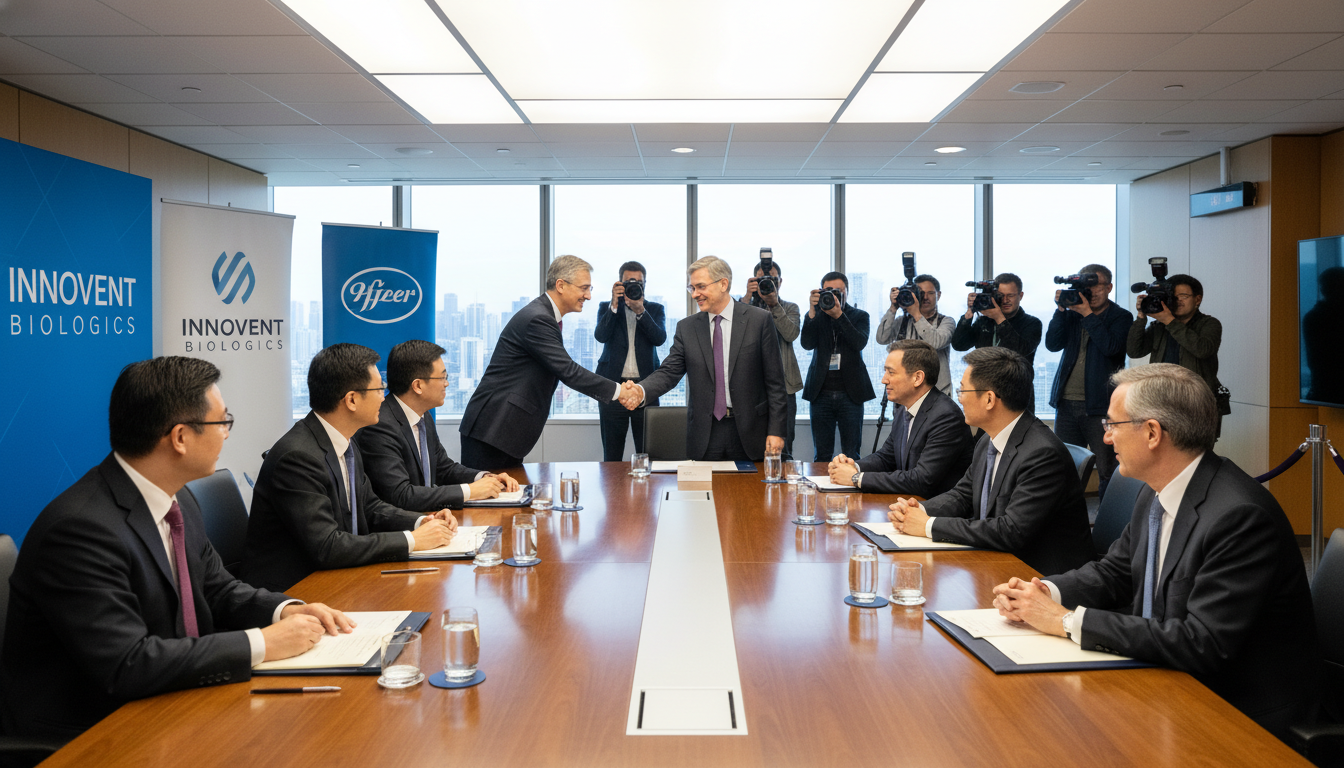
Innovent-Pfizer licensing deal valued at up to $10.5bn advances 12 oncology programs
Innovent-Pfizer licensing deal worth up to $10.5bn advances 12 oncology programs with co-development and co-commercialization, boosting China biotech ties.
Shenzhen-based Innovent Biologics and U.S. pharmaceutical company Pfizer announced a licensing agreement on May 29, 2026, that could be worth as much as $10.5 billion and focuses on 12 oncology programs. The Innovent-Pfizer licensing deal covers licensing, co-development and co-commercialization across a portfolio of cancer candidates, aiming to move multiple assets through clinical development and into global markets. The announcement signals an intensified collaboration between a leading Chinese biotech and a major global drugmaker at a time of heightened interest in oncology innovation.
Deal structure and financial terms
The agreement is structured around an upfront licensing arrangement supplemented by development, regulatory and commercial milestones plus royalties tied to sales performance. While the headline figure of up to $10.5 billion captures potential future payments, company statements indicate the sum depends on the success of the programs at each clinical and commercial stage.
Under the deal, Innovent retains significant program ownership in China, while Pfizer will support broader international development and commercialization where specified in the agreement. Both firms have highlighted shared responsibility for advancing candidates, though precise payment schedules and milestone triggers were not fully disclosed in the initial announcement.
Scope of the oncology portfolio
The 12 oncology programs included in the Innovent-Pfizer licensing deal span a range of development stages, from early-phase investigational candidates to assets approaching later-stage trials. Company communications describe the collection as focused on cancer therapies that address multiple tumor types, reflecting both targeted and immune-oncology approaches.
Industry analysts say portfolios of this size typically include monoclonal antibodies, antibody-drug conjugates or small-molecule targeted drugs, and may combine single agents with combination strategies. The range of programs gives the partners flexibility to prioritize assets based on trial results, regulatory feedback and market opportunity.
Co-development and co-commercialization responsibilities
The agreement emphasizes joint development, with both parties sharing clinical trial execution, regulatory filings and data generation for key programs. Pfizer’s global regulatory and commercial infrastructure is expected to accelerate filings and market entry outside China, while Innovent’s capabilities in local clinical networks and manufacturing underpin trials and supply within Greater China.
Co-commercialization arrangements often allocate territorial responsibilities and profit-sharing mechanisms; sources describe this deal as seeking to leverage each company’s strengths. The collaboration model aims to reduce duplication, shorten development timelines and align commercial launches to capture value across major markets.
Strategic rationale for Innovent Biologics
For Innovent, the partnership provides rapid access to Pfizer’s global commercialization channels and regulatory experience, enhancing the company’s ability to take homegrown assets to international markets. The deal also supplies potential non-dilutive funding through milestone payments, which can support ongoing R&D and manufacturing investments.
Beyond financing, Innovent gains an endorsement from a top-tier multinational that may bolster relationships with investigators, regulators and investors. The collaboration positions Innovent to scale promising oncology programs while retaining influence over development priorities in China.
Implications for Pfizer’s oncology strategy
Pfizer strengthens its oncology pipeline through external innovation, a strategy that supplements in-house research and accelerates access to novel mechanisms of action. The Innovent-Pfizer licensing deal expands Pfizer’s exposure to assets originating in China, a market that has become a growing source of biopharma innovation.
The agreement also reflects the industry’s trend toward partnering with regional biotech firms to diversify pipelines and secure late-stage candidates without assuming full early-stage costs. For Pfizer, the collaboration could deliver near- and long-term growth drivers if trials progress and regulatory approvals follow.
Market and regulatory considerations
The programs’ progress will hinge on clinical readouts and regulatory reviews in multiple jurisdictions, including China, the U.S. and Europe. Each region has distinct approval pathways and evidence requirements, meaning the timeline to commercialization could vary substantially by asset and territory.
Investor reaction and market valuation effects will likely depend on upcoming milestone outcomes and the transparency of payment terms as they are disclosed. Observers note that large headline values in biotech deals often reflect optimistic scenarios contingent on multiple successful trial endpoints and market uptake.
The Innovent-Pfizer licensing deal marks a significant instance of cross-border collaboration in oncology, combining local development strengths with multinational commercialization capacity. As the partners initiate joint trials and regulatory filings, attention will focus on early clinical results and the speed with which key milestones are reached.

