
Nvidia says largest-ever supercomputing systems for AI are now in full production
Nvidia announces its largest-ever supercomputing systems for AI are in full production, aiming to power autonomous AI agents with advanced reasoning and task execution.
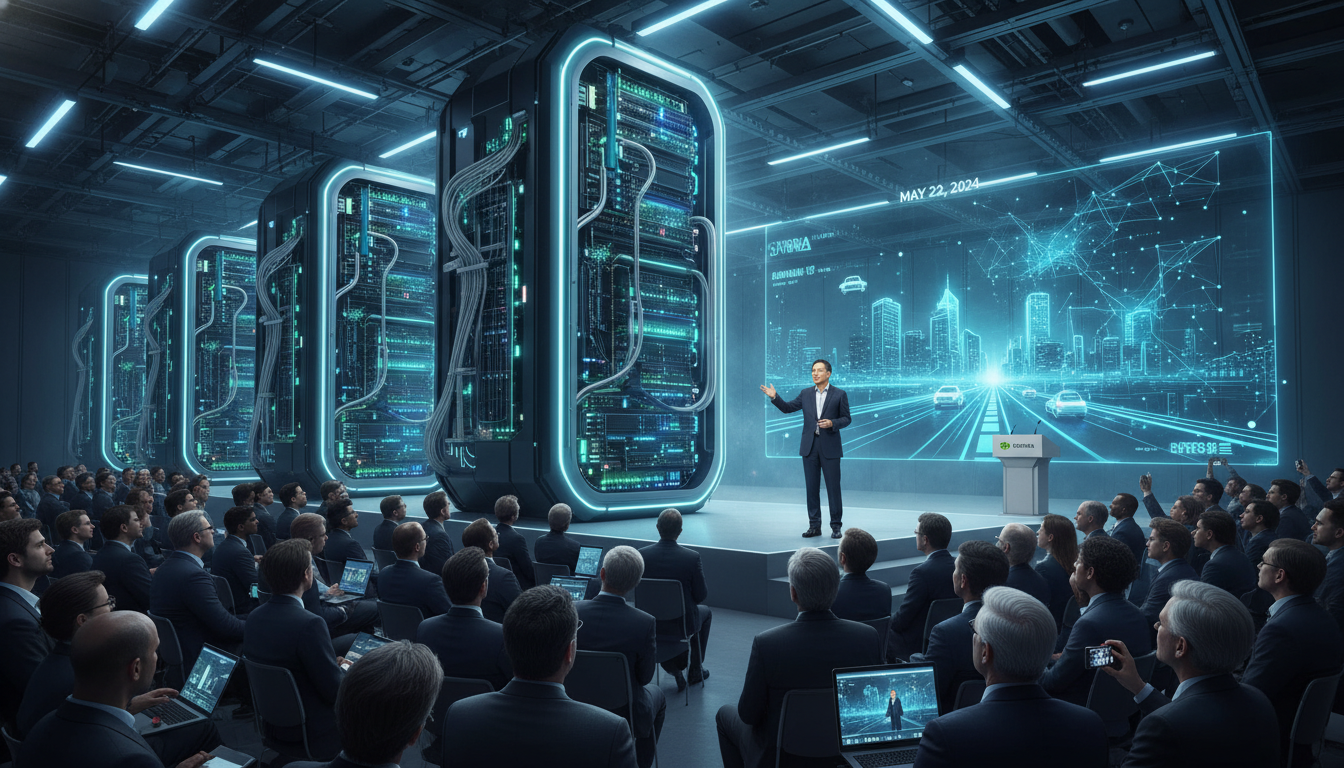
Nvidia told attendees at Computex in Taipei on June 1 that its largest-ever supercomputing systems for AI are now in full production and available for deployment. The company said the systems are designed to support a new class of AI agents that can reason, plan and carry out tasks with greater autonomy. The announcement, delivered by CEO Jensen Huang in a keynote ahead of the show, positions Nvidia at the center of a push to scale hardware for next-generation AI workloads.
Production status and company statement
Nvidia described the systems as the largest it has built specifically for artificial intelligence workloads and said production has moved beyond prototype and pilot phases. The company emphasized that manufacturing and system assembly are proceeding at scale to meet demand from cloud providers, enterprises and research institutions.
During the Taipei keynote, Nvidia framed the move as necessary to support AI agents that require extensive compute, memory and networking resources. Company executives said the full production status signals a shift from experimental clusters to commercially deployable platforms.
Architecture and technical scale
Nvidia did not publish detailed technical specifications in the keynote, but said the new systems are engineered for high-throughput AI model training and inference. The company highlighted integration of accelerated compute, high-bandwidth interconnects and software tailored to large-scale orchestration.
Engineers briefed in public remarks pointed to a focus on both raw performance and system-level efficiency, noting that software and hardware co-design will be crucial for sustained AI workloads. The systems are intended to support persistent, multi-model environments that power continuous agent behavior rather than one-off model runs.
Targeting AI agents that reason and act
At the center of Nvidia’s announcement is a strategic push toward AI agents — systems that combine language, vision and decision-making to perform multi-step tasks. Nvidia said the supercomputing platforms are being optimized to enable these agents to reason over long contexts and interact with external tools and services.
Company representatives argued that such agents require new levels of sustained compute and memory capacity to manage complex task flows, maintain internal state and integrate real-time inputs. Nvidia presented the production milestone as a foundation for customers developing autonomous workflows in industry, science and services.
Availability and customer deployment
Nvidia said the systems are entering customer deployments through a combination of direct sales, cloud partnerships and collaborations with research centers. Executives indicated that enterprises seeking to run large-scale agent workloads will be able to access the systems through established cloud providers as well as on-premises installations.
The company signaled an emphasis on delivery logistics and support services to enable rapid adoption, noting that full production reduces lead times for custom configurations. Nvidia also highlighted its software stack and management tools as part of the delivery package to help clients accelerate integration.
Market response and competitive landscape
Market observers attending Computex noted that the announcement sharpens competition among suppliers racing to supply infrastructure for advanced AI applications. Providers of cloud compute, networking gear and services are expected to accelerate investments to remain competitive for AI agent workloads.
Analysts say the move will intensify demand for global data center capacity and could prompt accelerated procurement plans among enterprises prioritizing AI transformation. The production claim places pressure on rivals to demonstrate comparable systems and on customers to evaluate trade-offs between performance, cost and operational complexity.
Regional impact and implications for Japan
The timing of the announcement at a major Taipei technology event underscores the importance of Asia’s supply chain and data center markets. For Japan, the availability of large-scale AI supercomputing systems presents opportunities for industries such as manufacturing, finance and automotive to pilot agent-driven automation and decision support.
Local cloud providers, research institutions and corporate IT organizations may face renewed pressure to upgrade infrastructure to run next-generation AI workloads. Observers in Tokyo and elsewhere in the region noted potential benefits for academic research and industrial R&D initiatives that require sustained compute for multi-modal agent development.
Nvidia’s declaration that its largest-ever supercomputing systems for AI are in full production signals a step change in the commercialization of high-end AI infrastructure, setting the stage for broader deployment of agent-style applications and renewed investment across the technology ecosystem.

