
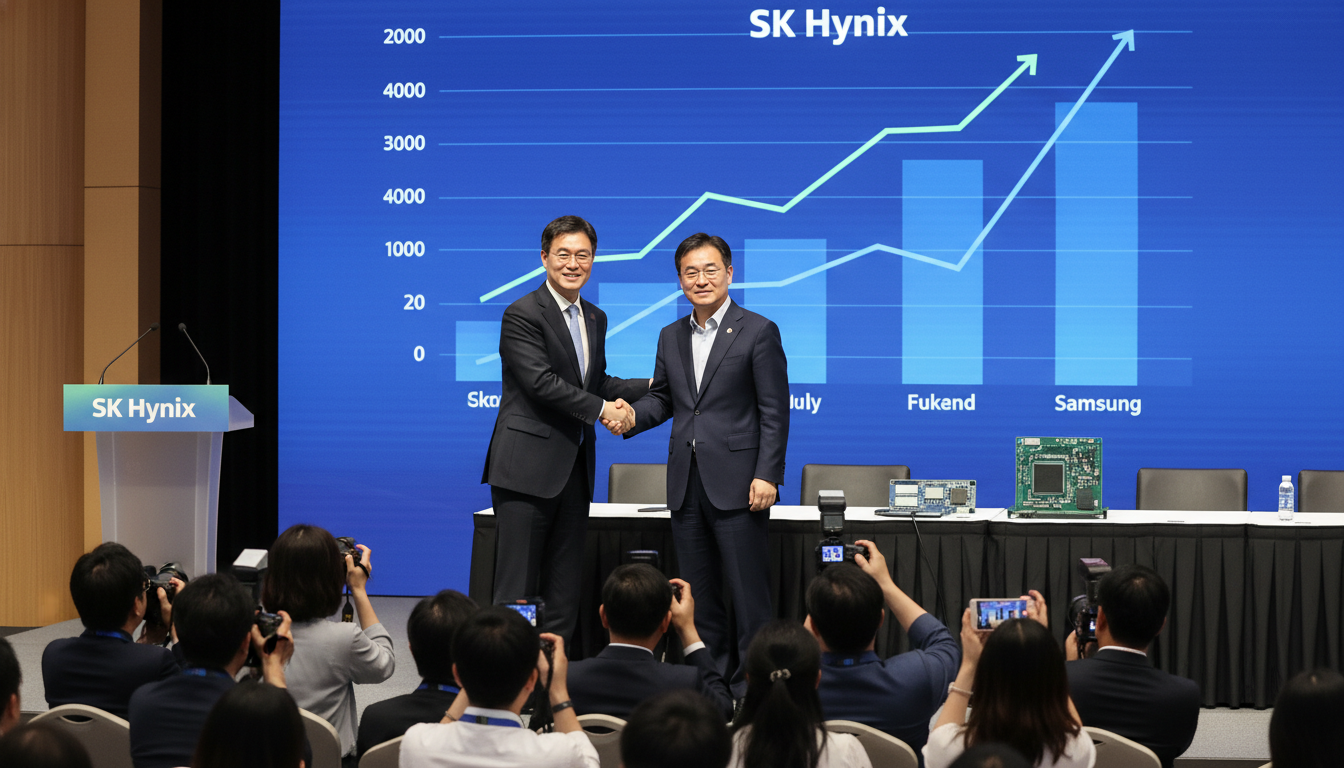
SK Hynix’s bet on high-bandwidth memory pays off as Nvidia tie-up drives market gains
SK Hynix’s pivot to high-bandwidth memory (HBM) and a deep supply relationship with Nvidia have propelled the South Korean firm into a leading position in AI-era memory, lifting profit margins and displacing rivals in key customer accounts.
South Korean chipmaker SK Hynix has sharply increased its focus on high-bandwidth memory, a specialized stacked memory used in AI accelerators and high-performance computing. The company’s close collaboration with Nvidia on supplying HBM for GPUs and AI systems has boosted demand and contributed to unusually high profit margins compared with commodity DRAM. That strategic shift has allowed SK Hynix to reduce its exposure to volatile commodity markets and capture premium pricing in the fast-growing AI infrastructure sector.
SK Hynix’s pivot to high-bandwidth memory
SK Hynix reoriented its product roadmap to emphasize HBM technology, moving away from reliance on low-margin commodity memory. HBM is produced using advanced stacking and through-silicon-via packaging that raises barriers to entry and enables higher pricing. By prioritizing this niche, SK Hynix has positioned itself to capture a disproportionate share of the value created by the global AI compute boom.
This strategy required heavy investment in process integration, wafer-level bonding and packaging capabilities that differ from standard DRAM lines. The company also reallocated capital and R&D resources to improve yields and increase per-chip capacity, reinforcing its ability to meet the specific performance needs of hyperscalers and GPU vendors.
Nvidia partnership drives HBM demand
A sustained commercial relationship with Nvidia has been a central driver of SK Hynix’s HBM sales growth, as Nvidia integrates HBM into its leading AI accelerators. Nvidia’s GPUs and AI systems demand high-bandwidth memory to feed large neural networks with data at scale, and that demand has translated into long-term purchase commitments. Close engineering cooperation has allowed SK Hynix to tailor HBM products to Nvidia’s power, density and reliability specifications.
The partnership has also shortened feedback loops for product improvements, helping SK Hynix accelerate roadmap milestones and secure priority access to design wins. For a company that once competed primarily on commodity DRAM volumes, becoming a preferred HBM supplier to a dominant GPU vendor has reshaped its commercial prospects.
Profitability surge and shifting market share
HBM’s premium pricing and the concentration of demand among AI infrastructure buyers have helped SK Hynix post markedly higher margins than typical memory suppliers. Moving up the value chain has insulated the firm from the cyclicality of commodity DRAM prices and allowed gross margins to expand where HBM volumes are meaningful. That margin improvement has been particularly visible in quarters when AI hardware refresh cycles and cloud spending spike.
As SK Hynix secured a string of HBM design wins, it began to supplant competitors in certain supply relationships, including some accounts historically served by other major memory producers. While Samsung Electronics remains a global leader across many memory categories, SK Hynix’s focused execution in HBM procurement and production has chipped away at market share in the high-end segment.
Manufacturing investments and capacity constraints
Producing HBM at scale demands specialized manufacturing steps and packaging technologies that are capital- and knowledge-intensive. SK Hynix has augmented its fabrication and assembly investments to expand HBM capacity, including additional back-end packaging lines and tighter process control measures. These investments aim both to raise throughput and to reduce yield variability, which is critical for meeting demanding AI customers’ reliability requirements.
Nonetheless, HBM production remains constrained by the complexity of stacking dies and integrating interposers, creating occasional supply bottlenecks when demand surges. Managing these constraints requires careful capacity planning and coordination with equipment suppliers and foundry partners to ensure steady throughput as AI-driven orders grow.
Implications for Samsung and the global memory landscape
SK Hynix’s ascent in HBM highlights a shifting competitive dynamic in the memory industry where specialization can trump scale in specific segments. Samsung retains broad leadership in DRAM and NAND overall, but the focused nature of HBM demand means smaller, more agile players can challenge incumbents for top-tier customers. This has led to sharper competition for design wins with GPU makers and cloud providers, and it has prompted rivals to accelerate their own HBM roadmaps.
The contest for HBM dominance also affects supply chain pricing and long-term investment strategies across the industry, as multiple manufacturers weigh the returns of committing capital to complex HBM lines versus expanding commodity memory capacity.
Outlook and risks for AI-driven memory demand
The near-term outlook for SK Hynix is tied closely to the pace of AI infrastructure deployment and the refresh cycles of data centers and GPU fleets. Continued AI model scale-up and new generations of accelerators should sustain HBM demand, supporting pricing power for suppliers who can meet quality and volume requirements. However, the concentration of demand among a few large customers poses concentration risk, and a sudden slowdown in AI hardware spending could expose suppliers to cyclical risk despite HBM’s premium position.
Other factors, including technological alternatives, advances in memory architectures, and geopolitical trade considerations, could alter the competitive landscape and affect long-term returns on current HBM investments.
SK Hynix’s strategic move into high-bandwidth memory, combined with a close operational relationship with Nvidia, has transformed the company’s revenue mix and profitability profile, demonstrating how targeted specialization can yield momentum in the AI hardware era.

