
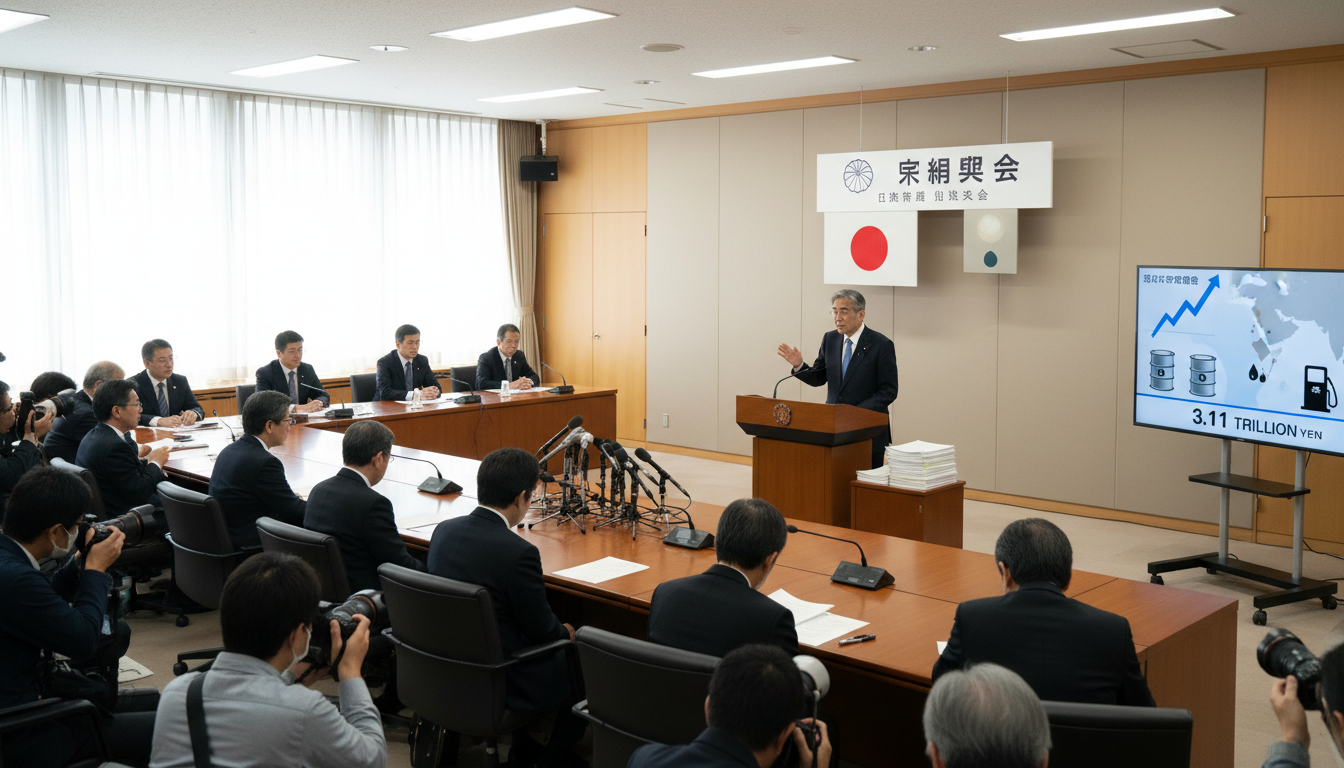
Japan approves 3.11 trillion yen supplementary budget to extend gasoline subsidies
Government finalizes 3.1135 trillion yen supplementary budget to address Middle East-driven energy price surge, prioritizing gasoline and utility fee support.
The Cabinet on June 3 approved a ¥3.1135 trillion supplementary budget aimed at cushioning households and businesses from rising energy costs linked to heightened tensions in the Middle East. The supplementary budget explicitly funds a new ¥2.5 trillion reserve to sustain gasoline subsidies, and it moves to replenish emergency spending used earlier this year for electricity and gas support. The government said the measure will be submitted to the Diet for deliberation the same afternoon and is expected to pass on June 5.
Details of the cabinet decision
The approved supplementary budget increases general account spending by ¥3.1135 trillion and earmarks ¥2.5 trillion in a newly created “Middle East response” contingency fund. That reserve is intended primarily to finance continued gasoline subsidies meant to blunt the impact of global energy price spikes on households and transport-dependent industries. The Cabinet also set aside ¥513.5 billion as a general-purpose contingency that is not pre-allocated to specific programs.
The government plans to move the bill into parliamentary debate on June 3, with an eye to securing approval by June 5. Officials framed the timing as urgent to ensure subsidy programs remain uninterrupted through the summer months when energy demand rises.
How the package supports utilities and local fuel needs
Prior to drafting the supplemental bill, the government tapped contingency funds to support electricity and gas bills for July through September and has decided to restore those reserves through this supplement. The ¥513.5 billion replenishment covers that earlier outlay and keeps the broader safety net intact for households facing higher utility costs.
In addition to national-level measures, the bill allocates ¥100 billion to expand targeted local grants that municipalities can use to subsidize liquefied petroleum gas (LP gas) — commonly used in rural and residential settings. That measure reflects concern that LP gas users, who are often outside metropolitan gas networks, might be more exposed to price swings.
Financing and fiscal implications
All of the supplementary budget’s resources will be financed by issuing deficit-covering government bonds. The administration argued that this financing step will not materially worsen fiscal conditions because last fiscal year’s bond issuance fell short of projections by roughly ¥3 trillion, owing in part to stronger tax revenues. Officials presented that shortfall as room to absorb the new issuance without triggering an acute deterioration in debt markets.
However, the supplementary budget does change Japan’s near-term fiscal arithmetic. The government’s baseline for the primary balance — the so-called PB that excludes interest payments — had been in surplus under the initial budget for fiscal 2026. With the addition of the supplemental measures, the PB is projected to move into a ¥1.7 trillion deficit for the year, marking a notable shift in single-year fiscal balance.
Prime Minister’s fiscal rationale and policy stance
Prime Minister Sanae Takaichi framed the package as an example of “responsible, proactive fiscal policy,” emphasizing the need to shield households and the economy from external shocks while preserving fiscal sustainability over multiple years. She and senior ministers have signaled that the administration will prioritize multi-year balance and economic stability rather than strict adherence to achieving a single-year PB surplus.
The government’s position is that temporary, targeted borrowing to counter a sudden, externally driven energy shock is justified if it prevents wider economic damage and supports a stable recovery. Still, opposition parties and some fiscal hawks are likely to press for clearer medium-term consolidation plans and for transparency about the conditions for winding down subsidies.
Implementation timeline and likely political debate
If the Diet approves the bill as expected on June 5, the new contingency fund and associated transfers will be available immediately to administer gasoline subsidies and to reimburse municipalities for expanded LP gas support. The timing aims to ensure continuity for subsidy programs ahead of peak summer usage and potential further volatility in energy markets.
Political debate in the Diet is expected to focus on the decision to finance the package entirely with debt and the implications for the government’s medium-term fiscal targets. Lawmakers will also examine the criteria for tapping the new Middle East response reserve and whether the subsidy design balances cost containment with effective relief for vulnerable households.
The government has indicated it will continue monitoring international energy developments and domestic economic indicators and may adjust the scale and targeting of measures as conditions evolve.
Japan’s economic managers say the supplementary budget is intended as a calibrated response to an external supply shock, balancing immediate social and economic protection with a commitment to return to sustainable fiscal positions over coming years.

