
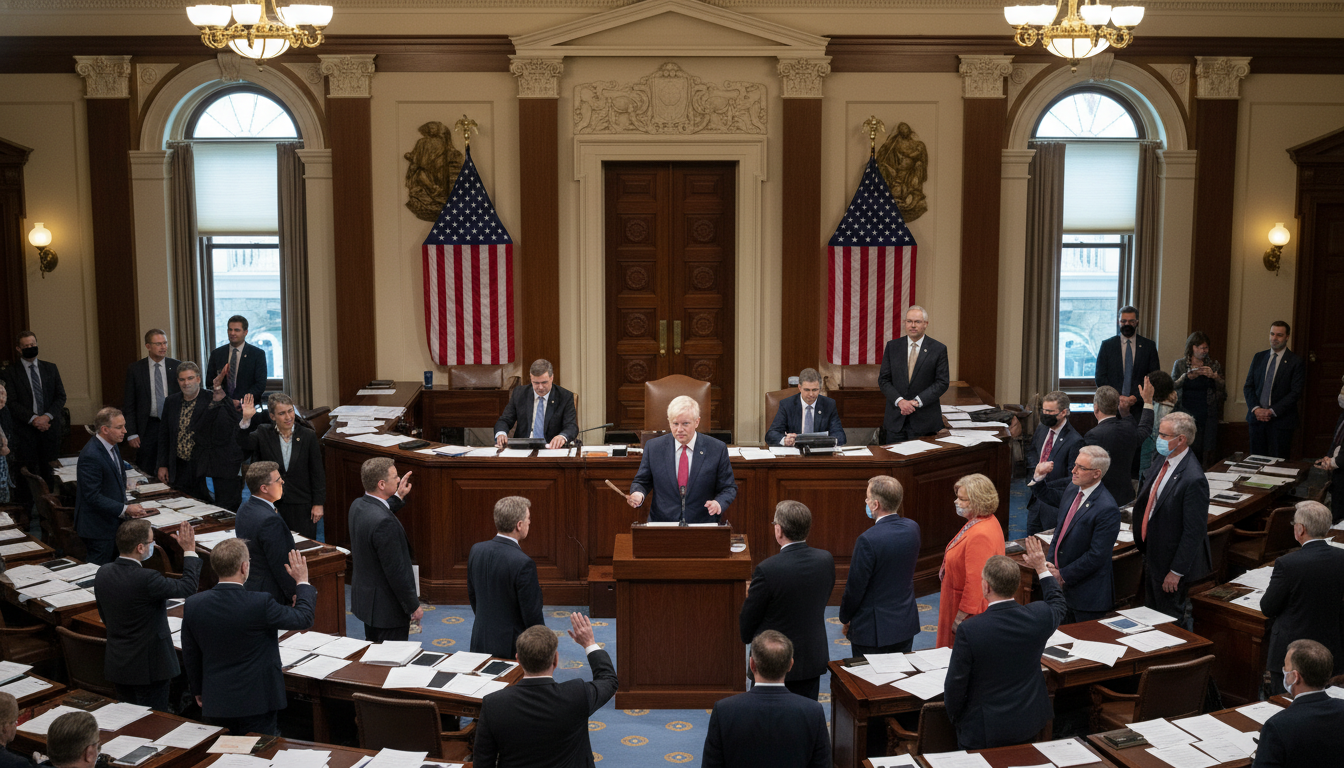
US House Passes Resolution to Curb Military Action Against Iran
US House passes resolution on June 3, 2026 to curb military action against Iran, 215–208, as Israel-Lebanon ceasefire talks advance and Trump signals restraint.
The US House passed a resolution on June 3, 2026 aimed at limiting further military action against Iran, voting 215–208 in a closely watched roll call. The US House resolution on Iran, the first congressional measure of its kind since a preemptive strike at the end of February 2026, reflected bipartisan unease about escalating hostilities and signaled lawmakers’ intent to press for restraint. While the measure carries symbolic weight in Washington, its legal effect is unclear pending Senate consideration and the administration’s response.
House Vote and Margin
The House approved the resolution by a narrow margin of 215 to 208, with four Republican members joining Democrats in supporting the measure. The outcome marks an uncommon break with party unity in a chamber where Republicans hold a majority, and it came after intense debate on whether Congress should assert greater control over the use of force. Supporters framed the vote as an effort to prevent an unchecked military escalation, while opponents argued it could undermine the commander-in-chief’s ability to respond to imminent threats.
Republican Dissent and Congressional Dynamics
Four Republicans crossed party lines to back the resolution, underscoring fractures within the GOP over foreign policy and presidential authority. Lawmakers who defected cited concerns about the risks of a widening conflict and the lack of a clear endgame following earlier strikes. The measure’s passage in the House does not guarantee action in the Senate, where leadership dynamics and filibuster rules could stall or alter any follow-up legislation.
Ceasefire Agreement Between Israel and Lebanon
Separately, US-mediated talks between Israel and Lebanese officials yielded an agreement to press for enforcement of an existing ceasefire in southern Lebanon. US State Department officials said progress was tied to a condition that Hezbollah and other armed groups cease military operations in the area, a stipulation meant to curb cross-border exchanges that have complicated diplomatic efforts. The agreement in principle aims to reduce one source of regional escalation that has complicated US-Iran tensions and hindered broader negotiations.
President Trump’s Public Statements
President Trump told reporters on June 3 that talks aimed at ending the hostilities were “moving along very well” and signaled reluctance to intensify retaliatory strikes. He cited recent Iranian attacks that targeted installations in Kuwait and Bahrain and framed ongoing diplomacy as a preferable path to avoid reciprocal escalation. The White House has not publicly disclosed whether it would treat the House resolution as legally binding, but administration officials have emphasized the need to balance deterrence with efforts to de-escalate.
Legal Effects and Washington’s Balance of Power
The resolution is structured as an expression of congressional will rather than as immediate statutory constraint, leaving its practical force dependent on subsequent legislative or executive actions. Legal scholars and congressional aides say that without companion Senate legislation or an enforceable statutory measure, the House resolution functions primarily as political pressure on the administration. Still, lawmakers noted that the vote could shape public debate, influence allied calculations in the region, and potentially set the stage for further congressional steps under the War Powers framework.
Regional Diplomacy and Allies’ Concerns
Allied capitals have watched the developments closely, with many partners urging de-escalation while seeking assurances about security guarantees in the Middle East. The Israel-Lebanon ceasefire discussions and the US House resolution on Iran occurred against a backdrop of complex regional alignments, including Tehran’s ties to proxy forces and concerns about missile transfers. Diplomats involved in the talks said stabilizing flashpoints along Israel’s northern border is seen as essential to preventing local clashes from sparking a broader confrontation.
The passage of the resolution also resonates for countries that host US forces or are directly affected by regional maritime and air security, where even limited exchanges can disrupt commerce and prompt diplomatic crises. Congressional scrutiny of military action has been heightened after the February strike, and some legislators have signaled they will pursue further oversight, including classified briefings and potential hearings.
The House measure and the diplomatic steps on the Israel-Lebanon front together reflect a brief window in which legislative pressure and shuttle diplomacy are moving in parallel. Lawmakers who voted for the resolution said they hoped it would prompt the administration to prioritize negotiations and clear rules of engagement that reduce the risk of unintended escalation. Opponents warned that rigid constraints could embolden adversaries or slow urgent defensive responses.
The resolution’s future now depends on whether the Senate will take up the measure or draft alternative language, and on whether the administration will accommodate congressional concerns without compromising operational flexibility. As ceasefire enforcement talks continue and regional actors respond to US signals, lawmakers in Washington face competing pressures between securing immediate safety for troops and civilians and preserving the president’s capacity for rapid response.

