
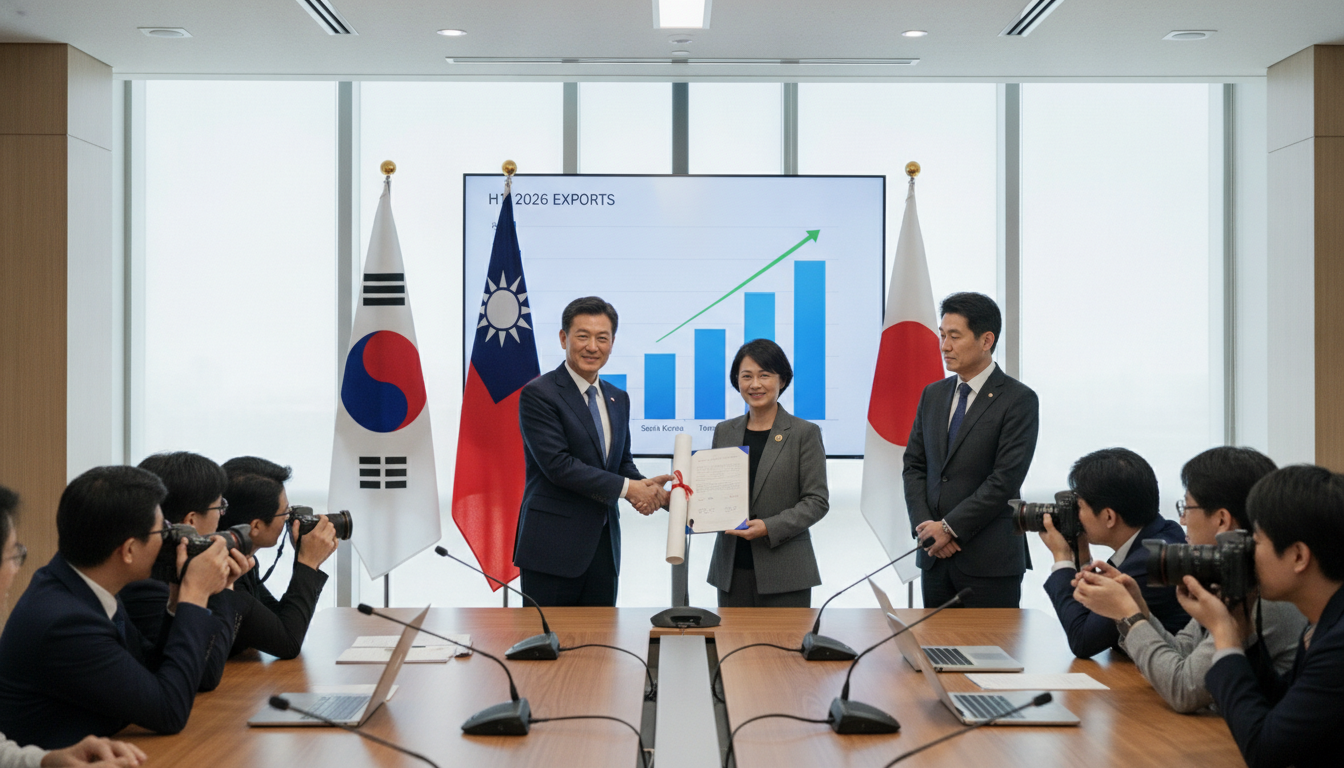
South Korea and Taiwan Overtake Japan in H1 2026 Exports as Semiconductor Demand Surges
Surging demand for semiconductors propelled South Korea and Taiwan past Japan in total exports in the first half of 2026, Nikkei analysis shows, reshaping East Asian trade dynamics.
TOKYO — South Korea and Taiwan each recorded higher total exports than Japan in the first half of 2026, a milestone driven largely by booming semiconductor shipments, according to a Nikkei analysis. The shift underscores how the global rush for advanced chips — from memory to logic foundry output — is reshaping trade standings across the region. Japan, long a regional export leader, saw competing exporters benefit more directly from the current semiconductor cycle.
South Korea and Taiwan Outpace Japan in H1 2026 Exports
Nikkei’s assessment found that export growth in both Seoul and Taipei outstripped Japan’s during the January–June period, marking the first time Japan has been overtaken on total exports by these economies in the same half-year. Industry officials and trade analysts point to semiconductor production and shipments as the primary force behind the gains, reflecting elevated global investment in data center capacity and artificial intelligence infrastructure.
The result is not only a headline statistic but a sign of shifting value capture in global supply chains, where countries hosting large-scale chip production now register outsized export gains when the semiconductor cycle turns upward.
Semiconductor Demand Fueled by AI, Cloud and Consumer Electronics
Manufacturers and buyers are reporting persistent demand for chips used in AI servers, high-performance computing, and network equipment, lifting both logic and memory segments. Data-center expansion and higher cloud computing workloads have increased orders for advanced processors and high-bandwidth memory modules, contributing to a strong first half.
At the same time, ongoing replacement cycles for smartphones and consumer devices, alongside rising adoption of specialized accelerators, have kept factory utilization rates high in key chip-producing centers.
Major Players: SK Hynix, Samsung and TSMC at the Forefront
South Korean and Taiwanese firms that dominate memory and contract foundry markets were central to the export surge. South Korea’s memory suppliers and system-chip makers, alongside Taiwan’s TSMC and other foundry operators, shipped large volumes of finished semiconductors and related goods, amplifying export totals for their home economies.
Investments completed in recent quarters to expand capacity at advanced nodes and memory fabs have allowed these companies to supply a broader set of customers, boosting both unit shipments and average selling prices at times during the period.
Japan’s Role Remains Critical But More Indirect
Although Japan lost ground in headline export totals, the country continues to supply vital materials, tools and components to the semiconductor industry worldwide. Japanese firms provide high-precision equipment, specialty chemicals, photoresists and components that remain essential to advanced chip manufacturing.
The difference is one of capture: countries with onshore wafer fabrication and memory production register finished-product exports directly, while Japan’s contributions often appear embedded within other nations’ outputs.
Policy Responses and Industrial Strategy Questions
Tokyo’s policymakers and industry stakeholders are weighing responses to the shift, including incentives for domestic chip production, support for materials and equipment makers, and measures to strengthen supply-chain resilience. Officials note the strategic value of maintaining strong upstream capabilities even as final manufacturing grows elsewhere.
Industry groups are also pressing for clearer frameworks to attract capital and boost collaboration between Japanese suppliers and overseas fabs, arguing that closer integration can translate into higher-value domestic outcomes over time.
Regional Trade Dynamics and Supply-Chain Consequences
The export reshuffling will likely influence trade negotiations and investment patterns across East Asia, as governments seek to secure supply chains for critical technologies. Export figures tied to semiconductors can fluctuate rapidly with the industry cycle, however, meaning the current lead may narrow if demand softens or inventory adjustments occur.
Companies across the region are expected to accelerate partnerships and capacity planning to manage risk, while buyers diversify sourcing to guard against single-country disruptions.
Outlook for the Second Half of 2026
Analysts caution that semiconductor-driven export performance will depend on how the second half of 2026 unfolds for cloud investment, AI chip rollouts and consumer demand. If capital expenditure by large cloud providers continues and AI applications expand, exporters concentrated in fabrication and memory could maintain momentum.
Conversely, cyclical inventory corrections or a slowdown in end-market demand could temper growth and realign export rankings before year-end.
The first-half export milestone highlights how commodity cycles in strategic sectors such as semiconductors can quickly change national trade profiles, and it underscores the need for policies that both capitalize on immediate opportunities and shore up long-term industrial competitiveness.

