
Iran shoots down US Apache helicopter; Washington and Tehran exchange strikes near Strait of Hormuz
President Trump said Iran shot down a US Apache helicopter, prompting US strikes on Iranian targets and Iranian reprisals against overseas US bases, escalating tensions in the Strait of Hormuz region.
Trump’s statement and immediate US response
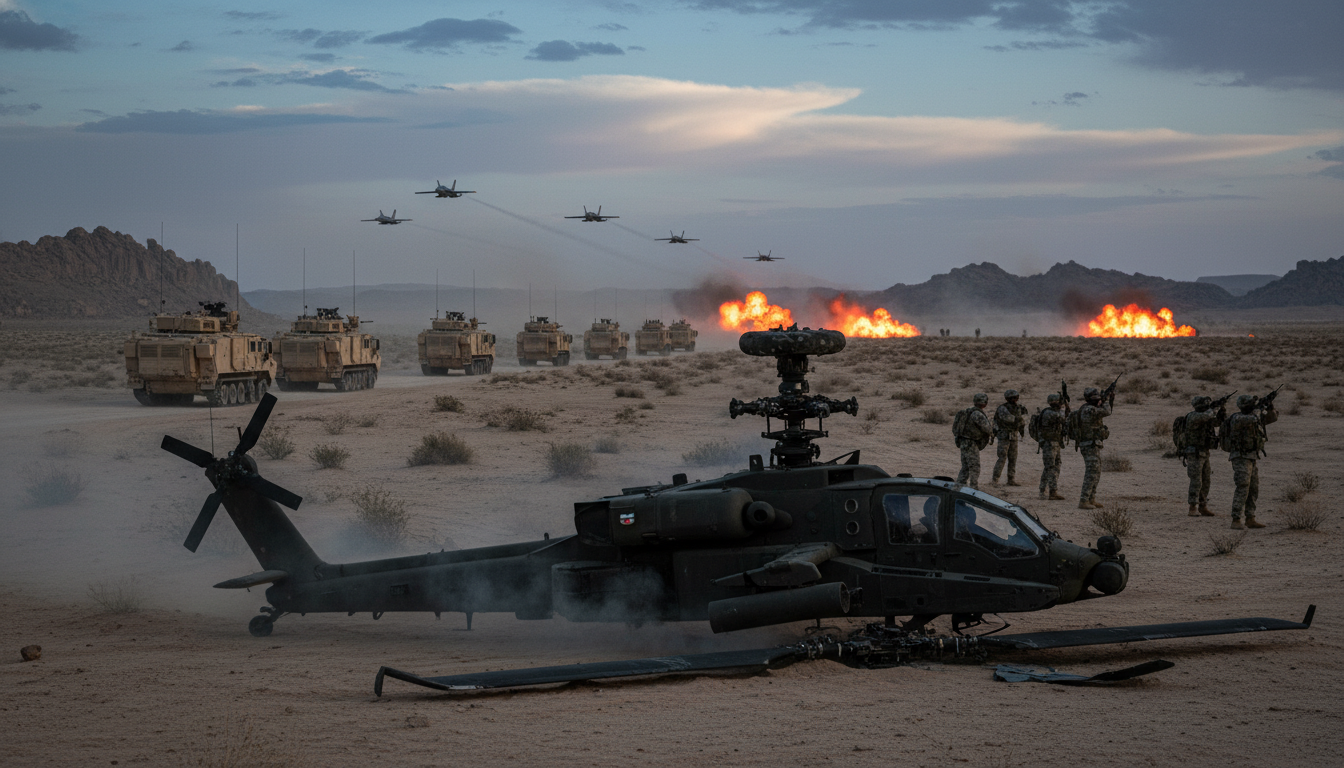
President Trump announced that an American attack helicopter, an AH-64 Apache, was downed near the Strait of Hormuz, a claim that the White House linked to Iranian drone activity. In response, US Central Command said it had launched attacks on multiple Iranian military facilities, describing the operations as retaliatory measures tied to the helicopter loss. The announcement set off a rapid cycle of strikes and counterstrikes that regional and global officials warned could increase the risk of wider confrontation.
Circumstances of the Apache’s loss
Reports and security analysts are divided over whether the helicopter was deliberately engaged or was struck in circumstances that amounted to a miscalculation. Iranian kamikaze-style drones such as the Shahed family have been used in recent years for precision attacks and are capable of hitting rotary-wing aircraft, particularly if early warning systems do not detect them in time. US attack helicopters are equipped with sensors and countermeasures able to detect and defeat many aerial threats, so investigators are focusing on why the Apache apparently failed to detect or intercept the incoming drone.
State of Iran’s air defenses along the Persian Gulf
Observers note that while Iranian air defenses around the capital, Tehran, have sustained significant degradation in recent operations, systems along the Persian Gulf coastline appear to remain more intact and operational. Those coastal batteries and radar installations are positioned to monitor vessels and aircraft traversing the narrow approaches of the Strait of Hormuz. The continued presence of functioning seaside defenses increases the likelihood that Iranian forces were able to detect and engage aircraft operating near their territorial approaches, according to defence analysts familiar with the region.
Sequence of retaliatory strikes
Following the downing, US forces struck a series of Iranian military targets they identified as linked to the attack or to Iran’s broader regional capabilities. Tehran, in turn, launched retaliatory strikes against US bases in neighboring countries, targeting facilities that host American troops and equipment. The exchanges appeared calibrated rather than indiscriminate, with each side choosing targets that signalled resolve while — at least initially — aiming to avoid an uncontrollable spiral into full-scale war.
Regional implications and maritime security risks
The fighting risks disrupting commercial shipping and energy flows through one of the world’s most important chokepoints, where a significant share of global oil and liquefied natural gas transits. Iran has previously warned that it could close or threaten shipping through the Strait of Hormuz in response to military pressure, a move that would prompt immediate economic and diplomatic consequences for regional and global markets. Neighboring states and international maritime agencies have expressed concern that further military exchanges could imperil civilian vessels and escalate insurance and rerouting costs for shipping companies.
Analyst perspective from Meikai University
Tetsuo Kotani, a security studies professor at Meikai University, assessed the incident by emphasizing uncertainty over whether the Apache was deliberately targeted or hit by accident amid heightened operations. He noted that, while US helicopters are typically equipped to detect and defeat many aerial threats, a failure to detect a drone suggests either sensor blind spots or environmental and tactical factors that prevented an effective response. Kotani also pointed to the strategic picture: Iran retains enough localized air-defence capacity along its coast to pose a credible threat, and both Tehran and Washington appear to be managing their responses to avoid uncontrollable escalation while signalling strength.
Both sides, officials and analysts say, are likely weighing the domestic and international costs of further military action as they calibrate responses. Washington must show resolve to deter future attacks on US assets, while Tehran faces internal pressures to respond forcefully to perceived aggression without provoking a coalition response that could be crippling. The careful selection of targets in the immediate exchanges suggests an attempt by each government to balance those competing imperatives.
The incident underscores the fragile nature of security in the Gulf and highlights how relatively low-cost systems such as drones can have outsized strategic effects. As inquiries continue into the precise circumstances that led to the Apache’s downing, diplomatic channels and military posture in the region will be watched closely for signs of de-escalation or further confrontation.

