
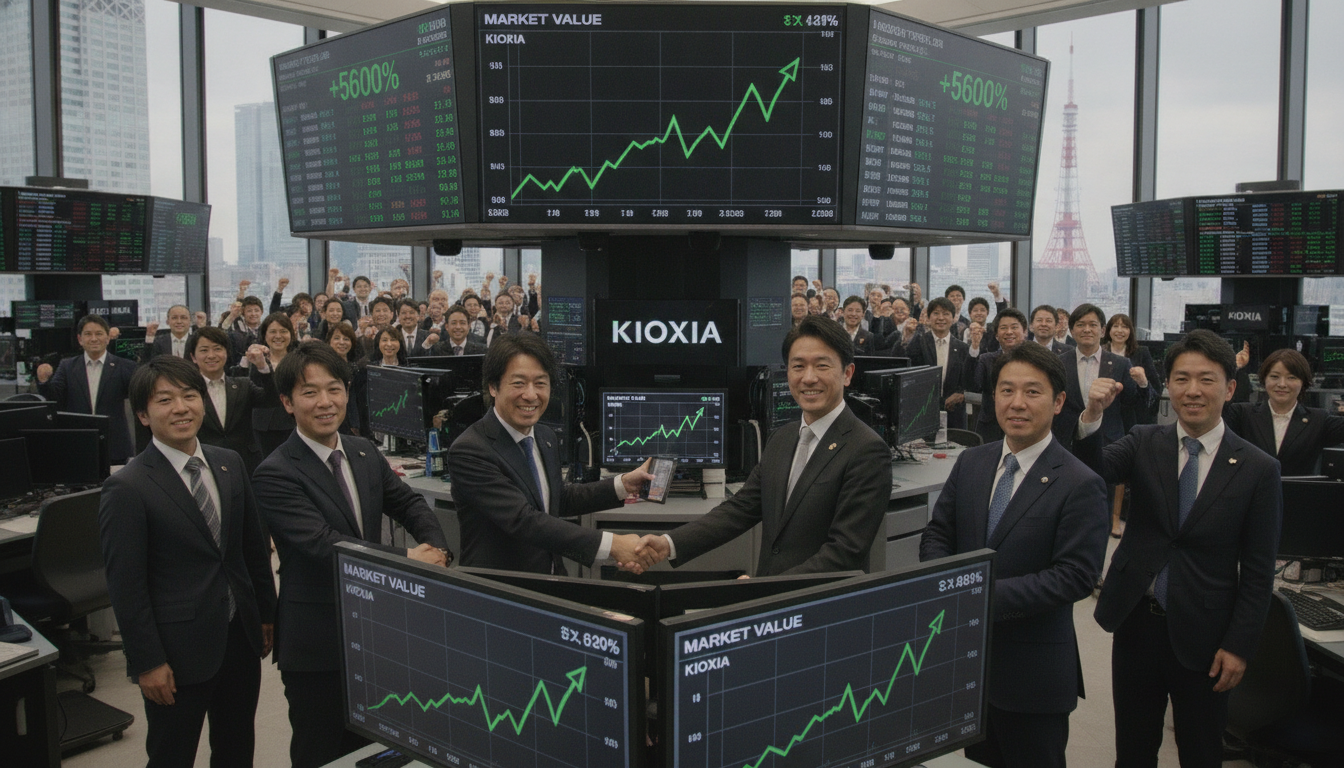
Kioxia Climbs to Japan’s Top Market Cap as AI Demand Sends Memory Prices Soaring
Kioxia becomes Japan’s most valuable listed company after its market value topped ¥44 trillion, reflecting a surge tied to AI-driven demand for memory. (japantimes.co.jp)
Kioxia Overtakes Toyota in Market Value
Kioxia’s shares rallied this week, lifting the company above Toyota to become the largest by market capitalization in Japan. (nippon.com)
The rise marks a dramatic shift in Japan’s stock rankings, with the memory-chip specialist reaching roughly ¥44 trillion in market value during an 18‑month stretch since its Tokyo listing. (japantimes.co.jp)
Market commentators said the move highlights how fast-changing technology demand can realign national market hierarchies, especially when semiconductors meet surging AI infrastructure needs. (bloomberg.com)
AI Demand and Memory Prices Drive Profitability
Industry analysts say the core driver of Kioxia’s value leap is an exceptional increase in demand for high-capacity NAND flash used in AI data centers. (bloomberg.com)
As hyperscale cloud providers expand training and inference clusters, manufacturers have seen order books extend and prices for certain memory products climb, improving margins across the sector. (bloomberg.com)
Kioxia’s reported profits and capacity utilization have reflected these market fundamentals, with company briefings and financial updates pointing to strong backlog and higher average selling prices. (japantimes.co.jp)
From Toshiba Unit to Public Powerhouse
Kioxia traces its roots to Toshiba’s memory business and completed its listing on the Tokyo Stock Exchange Prime Market in December 2024. (kioxia-holdings.com)
The public debut followed years of restructuring, private-equity backing, and industry uncertainty, and the firm has since capitalized on a swift recovery in chip pricing and demand. (kioxia-holdings.com)
Investors who bought at the IPO have seen outsized returns as the company’s strategic focus on advanced flash technologies aligned with a sudden rise in AI-driven procurement. (japantimes.co.jp)
Corporate Strategy and Shareholder Signals
Recent investor communications from Kioxia appear aimed at broadening its appeal to global equity markets and reassuring shareholders about returns. (biz.chosun.com)
Reports from market briefings indicate management has discussed the possibility of progressive dividends and share repurchases as profitability stabilizes, a move that can amplify investor interest. (biz.chosun.com)
Analysts caution, however, that capital-intensive semiconductor businesses must balance payouts with continued investment in next‑generation fabs and R&D to preserve long‑term competitiveness. (bloomberg.com)
Impact on Japan’s Market and Global Suppliers
Kioxia’s ascent has reshaped investor attention in Tokyo, drawing capital toward chipmakers and related suppliers, and altering the composition of Japan’s top publicly traded firms. (japantimes.co.jp)
The rally has also had knock-on effects for overseas peers and component suppliers as orders and pricing signals reverberate through supply chains in Korea, Taiwan and beyond. (bloomberg.com)
Market strategists note that while the current cycle favors memory makers, the semiconductor industry remains cyclical; capacity expansions and shifting end‑market demand could temper prices over time. (bloomberg.com)
Kioxia’s performance underscores how AI has quickly become a structural demand engine for memory, changing investor perceptions of which sectors will lead in the coming years. (bloomberg.com)
The company’s standing as Japan’s market‑cap leader reflects both the immediate effects of AI infrastructure spend and longer-term industry realignments that reward firms able to scale advanced memory production.

