
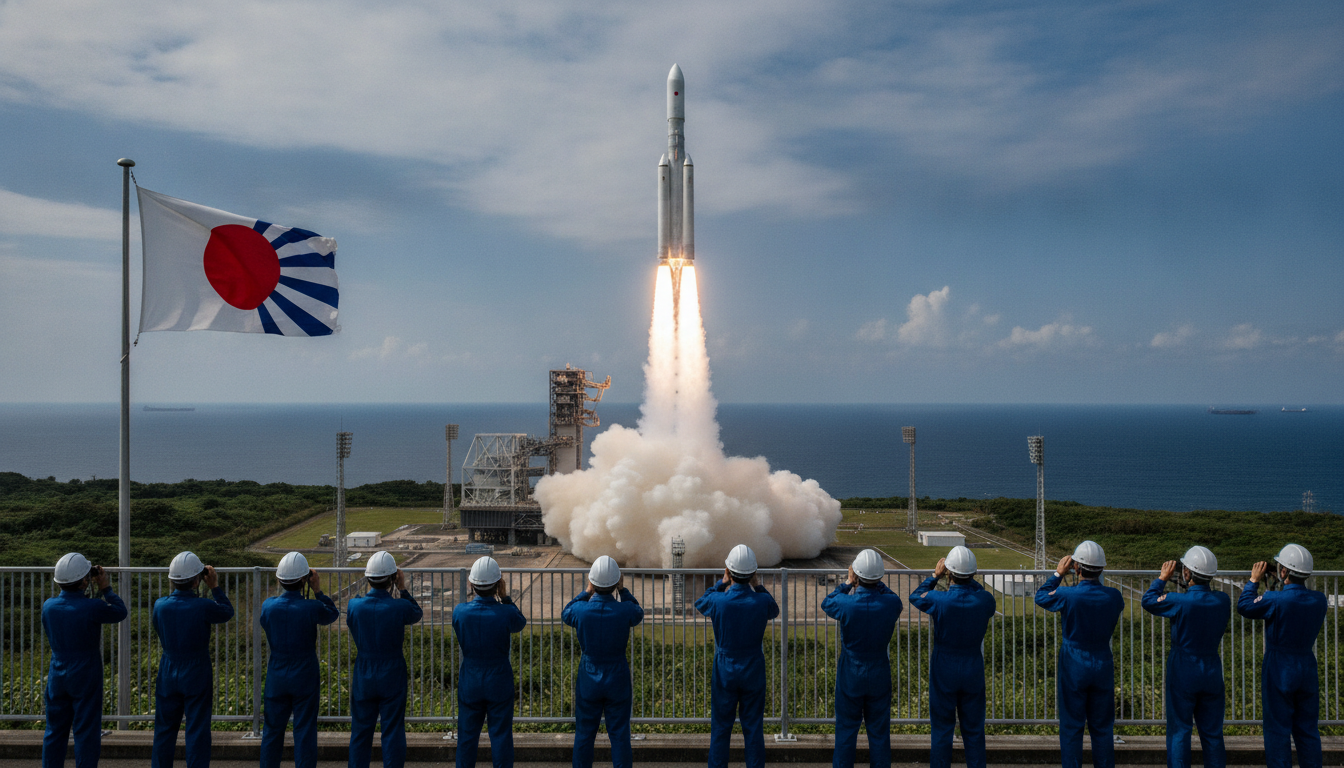
Japan’s H3 rocket completes low-cost debut, places small satellites into orbit
Japan’s H3 rocket launched on June 12, 2026, placing small satellites into orbit and aiming to undercut rivals with lower launch costs, signaling JAXA’s push.
Japan’s flagship H3 rocket successfully lifted off on Friday, June 12, 2026, delivering several small satellites to their intended orbits and marking what officials described as the agency’s lowest-cost launch to date. The mission positions Japan’s H3 rocket as a contender in the expanding low-cost launch market that is currently dominated by the United States’ SpaceX. The flight, conducted by the Japan Aerospace Exploration Agency (JAXA), underscores a broader national effort to boost commercial launch competitiveness and domestic space industry exports.
Launch success and mission outcome
The H3 vehicle reached orbit on schedule and released multiple small satellites for commercial and research customers, according to agency statements. Telemetry and tracking confirmed the payloads achieved their targeted orbital parameters, enabling operators to commence on-orbit commissioning. JAXA framed the flight as a validation of both the rocket’s performance and its cost-reduction measures implemented after earlier development phases.
The launch clears a key milestone for Japan’s heavy-lift program and provides operational data for future flights. Engineers will analyze flight data to refine performance margins and improve turnaround times for subsequent missions. The mission also demonstrated the H3’s ability to serve a mixture of government and private-sector payloads in a single launch.
Payload and customers on board
The manifest for this H3 flight included a string of small satellites spanning communications, Earth observation and technology-demonstration missions. Japanese universities and commercial satellite operators were among the primary beneficiaries, reflecting growing domestic demand for reliable, lower-cost access to space. Several payloads were identified as rideshare customers, taking advantage of the H3’s capacity to place multiple smaller spacecraft into staged orbits.
Operators of the deployed satellites reported initial contact and telemetry after separation, a standard confirmation step that allows payload teams to begin commissioning. The variety of customers points to an emerging market in Japan for responsive launches that can serve both scientific research and commercial applications. Analysts view diverse payload manifests as critical to the economic viability of national launch systems.
Cost competitiveness and market implications
Officials emphasized that the launch was carried out at a markedly reduced cost compared with earlier domestic rockets, a central objective of the H3 program. By lowering per-launch expenses, JAXA aims to offer a more competitive alternative to established low-cost providers in the global market. If sustained, these cost gains could open new opportunities for Japan to capture a slice of international launch demand and support satellite manufacturing at home.
Industry observers caution that sustained competitiveness will depend on repeatable flight cadence, proven reliability and flexible customer services. Space markets are sensitive to price and launch frequency; therefore, the H3’s commercial appeal will hinge on JAXA and industry partners maintaining steady operations and competitive pricing. The H3’s debut adds pressure on incumbent providers and could spur further innovation and pricing strategies across the sector.
Technical refinements and development background
The H3 design incorporated modular engines and simplified production processes aimed at reducing development and operational costs. Technical improvements implemented after prior testing campaigns focused on propulsion reliability and stage separation mechanisms. JAXA reported that those upgrades were validated during this flight, forming part of a broader engineering program to shorten lead times and improve manufacturability.
The H3 program followed a multi-year development effort that included prototype testing, iterative redesigns and partnerships with Japanese industry. Lessons from earlier vehicles guided choices in materials, avionics and ground-support procedures to achieve the lower-cost objective. Engineers will apply flight-proven components from this mission to standardize future builds and to lower per-unit production variance.
Domestic industry and government response
The successful launch drew responses from government ministries and industry groups highlighting the strategic value of a competitive national launcher. Officials framed the H3’s success as supporting Japan’s economic and scientific agendas, including satellite-based services, disaster monitoring and commercial exports. Industry leaders noted the potential for new contracts and supply-chain activity as launch demand grows.
Market analysts expect a mix of public and private investment to accelerate around the launch ecosystem, from satellite manufacturers to launch-service brokers. The government indicated continued interest in policies that support commercialization of space technology and international partnerships. Observers also pointed to the need for regulatory and export controls to adapt as Japan seeks a larger role in the global launch market.
Japan’s H3 rocket debut now sets the stage for a series of follow-on flights aimed at demonstrating repeatability, lowering unit costs further and expanding the vehicle’s commercial manifest. JAXA and industry partners will publish detailed post-launch findings as they complete their flight analysis and customer reviews. The mission’s operational outcomes will be a key reference point for prospective international customers weighing the H3 against established providers.
The H3’s successful flight on June 12, 2026, therefore represents both a technical achievement and a strategic signal that Japan intends to compete more aggressively in the global low-cost launch arena.

