
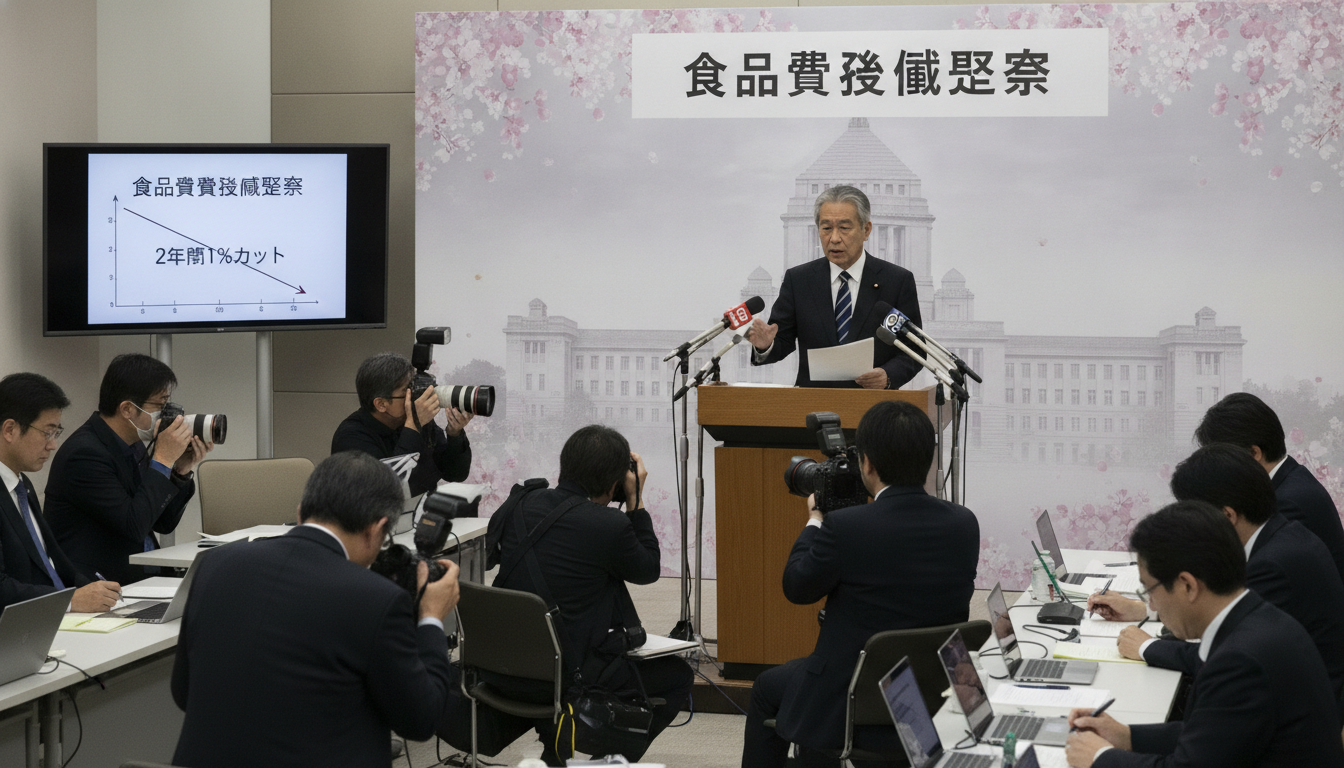
Japan’s LDP Proposes Two‑Year Cut to Food Consumption Tax to 1%
LDP chair Itsunori Onodera proposed lowering Japan’s food consumption tax to 1% for two years from April 2027, with about ¥600 billion in offset payments for low- and middle-income households.
The Liberal Democratic Party’s tax policy chief, Itsunori Onodera, on June 17 presented a plan to cut the food consumption tax to 1% for a two‑year period starting April 2027, aiming to create a temporary “practical zero” for grocery purchases. The proposal, delivered at a working meeting of the Social Security National Council held in the Diet building, also calls for advance benefit payments for low‑ and middle‑income households equivalent to the 1% tax reduction. Party officials described the measure as a bridge to a comprehensive, income‑linked benefit system scheduled for full rollout in autumn 2029.
Proposal Details and Cost Estimate
Onodera’s plan limits the reduced rate to April 2027 through March 31, 2029, while seeking to offset the fiscal impact by directing approximately ¥600 billion toward targeted benefits. The proposal anticipates providing payments to middle and low‑income households ahead of the tax cut to ensure immediate relief. Officials framed the measure as combining a temporary tax rate change with targeted transfers to achieve an effect close to zero taxation on food for vulnerable households.
Political Context and Party Pledges
The measure reflects a campaign pledge by the LDP during the February lower house election to accelerate consideration of cutting the food tax to zero. Prime Minister Sanae Takaichi had previously signaled interest in realizing such relief within fiscal 2026, but Onodera’s timetable shifts the effective start date to April 2027. Party strategists said the 1% rate for two years was chosen to manage practical implementation issues while maintaining momentum toward broader reform.
Implementation Rationale and Technical Constraints
Government advisers have warned that moving the current reduced rate on food from 8% to zero immediately would require substantial technical adjustments, including till and point‑of‑sale system upgrades that can take about a year. The 1% temporary rate is presented as a pragmatic alternative that avoids immediate system overhaul while still delivering meaningful price relief. Supporters say this approach buys time to finalize design and IT work for the income‑linked benefit scheme that is to succeed the temporary measure.
Reaction from Opposition and Stakeholders
Opposition parties at the June 17 working meeting reacted critically to the chairman’s unilateral presentation, with lawmakers calling the proposal abrupt and questioning why extended deliberations were necessary if the outcome was already set. Consumer and retail groups expressed mixed views, welcoming relief for shoppers but urging clarity on how retailers and payment platforms would adapt to the rate change. Economists noted that targeted benefits can be administratively complex and stressed the importance of clear eligibility rules to avoid delays in disbursement.
Timing for Full Benefit System and Council Deliberations
The Social Security National Council, the parent body of the working group, is aiming for an interim summary by the end of June as it considers broader social security and fiscal measures. Under Onodera’s outline, the temporary 1% food rate would end in March 2029, with a comprehensive, income‑linked benefit system coming into full effect in autumn 2029. Officials said the interim period will be used to design eligibility criteria, delivery mechanisms and the necessary legal and budgetary steps.
Budgetary and Administrative Challenges Ahead
Translating the chairman’s outline into law will require concrete budget allocations, revisions to the tax code and coordination among ministries responsible for finance, social security and digital administration. The estimated ¥600 billion figure for offset payments will need to be refined in formal budget planning and presented to parliament for approval. Administrative hurdles include identifying recipients for advance payments, updating benefit registries and ensuring private sector payment systems can process a different reduced rate without disrupting business.
The proposal represents a tactical compromise between electoral promises and operational realities, combining a short‑term tax adjustment with targeted transfers while preserving the goal of broader reform. Lawmakers and officials now face a tight timetable to reconcile policy design, fiscal constraints and technical implementation before the planned April 2027 start date.

