
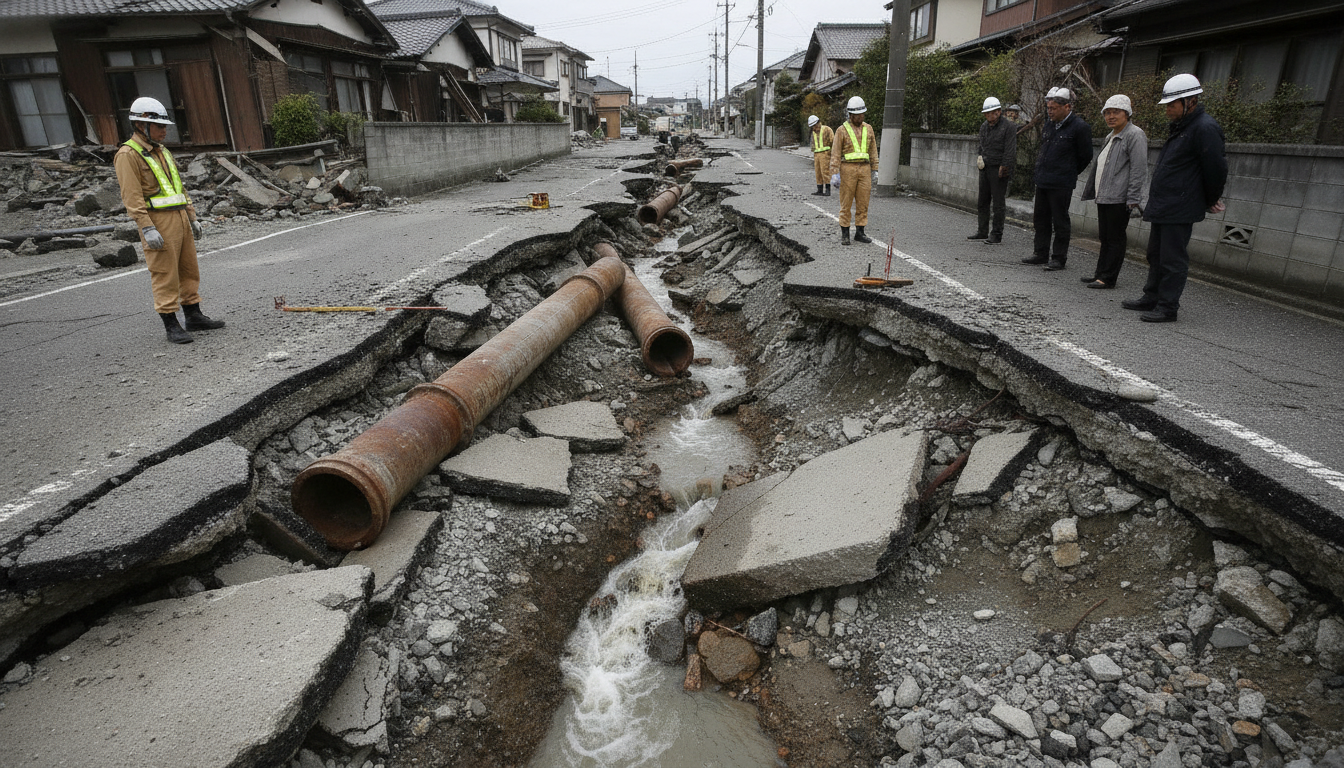
Kumamoto earthquake fault rips out water main and displaces highway bridge
Research teams found a 30cm water main pulled from underground and a highway girder shifted by fault movement, revealing severe infrastructure damage from the Kumamoto earthquake.
The Kumamoto earthquake fault left conspicuous damage across southern Kumamoto Prefecture, with investigators finding a 30-centimeter water main pulled cleanly from its underground fittings and a highway bridge girder displaced where the fault crossed beneath the road. Researchers who joined the site inspections described the force of lateral fault movement as unexpectedly strong, capable of uprooting buried pipelines and undermining bridge supports. Local restoration crews reported multiple similar incidents in hillside settlements and along regional roads, complicating immediate repair work.
Water main extracted from underground
In a roadside excavation near a mountainside settlement in Uto City, crews found a deep hole roughly one meter across where a water main had separated from its fittings. The pipe, about 30 centimeters in diameter, had been drawn free of its bolted connection and left a gap of several tens of centimeters to the surrounding soil. A restoration worker at the scene described how sections of buried pipeline had “come out with a snap,” saying the crew had encountered many comparable failures while making temporary repairs.
Engineers noted that the mode of damage—an anchored pipe pulled vertically or laterally from beneath the ground—indicates substantial horizontal shear or vertical offset at shallow depth. Such movements can place concentrated forces on stiff fittings and couplings, causing clean pulls rather than simple fractures. The pattern raises immediate concerns for water supply reliability in affected neighborhoods while recovery crews secure and reroute services.
Bridge girder displacement where fault crosses
Investigators also documented the active fault trace crossing a cemetery before extending beneath an elevated section of expressway, where a bridge girder had shifted and partially fallen. Photographs and on-site measurements show the fault cutting across surface features and continuing beneath engineered infrastructure, producing localized offsets sufficient to dislodge structural elements. The proximity of the trace to the highway required authorities to close lanes and prioritize structural inspections of the bridge and adjacent spans.
Structural engineers at the scene emphasized that even limited offsets under a bridge can transfer loads unexpectedly, compromising bearings and connections. Immediate shoring and detailed assessment are necessary to determine whether sections can be reopened safely or require replacement. Highway agencies face the twin tasks of ensuring public safety and restoring a key transport artery for relief logistics.
Researchers express surprise at fault force
“Bolts tightened around the water main, and yet the pipe was pulled out underground—this is a remarkable demonstration of fault force,” said Susumu Yasuda, emeritus professor at Tokyo Denki University, during an inspection on August 1. Yasuda and other ground-failure specialists who accompanied reporters said the scale and character of the damage exceeded some expectations for shallow surface ruptures. They stressed that observed effects reflected both the magnitude of the earthquake and local ground conditions that amplified displacement.
Experts pointed out that active faults behaving in this way create complex hazards beyond shaking alone, including ground rupture, surface offset, and differential settlement that interact with buried utilities and foundations. The unusual combination of pulled pipelines and displaced bridge elements provides new field data for seismic-hazard modeling and infrastructure resilience planning.
Restoration crews face multiple ruptures
Repair teams working in the affected settlements reported encountering numerous points where buried pipes had been drawn from fittings or otherwise separated by ground movement. Temporary excavations to access and reconnect mains revealed inconsistent damage patterns, requiring bespoke fixes at each site rather than a single standardized repair. Teams said logistical complications, including traffic restrictions and the need to stabilize trenches in unstable ground, have slowed progress.
Local authorities have prioritized emergency reconnections to restore potable water and to secure damaged roadways, but officials warned that full restoration may take weeks in areas where fault-induced ground deformation has disrupted subsurface networks. The multiplicity of failure locations also increases demand for specialized fittings, heavy equipment, and experienced crews.
Implications for infrastructure planning and mapping
The field observations underscore the importance of up-to-date fault mapping and integrating active-fault data into infrastructure siting and design standards. Where fault traces intersect transportation corridors or utility corridors, design strategies such as flexible joints, deliberate routing, and defensible clearances could reduce the likelihood of catastrophic disconnection. Policymakers and engineers said the recent damage will prompt reviews of pipeline anchoring practices and bridge bearing designs in vulnerable regions.
Seismologists and civil engineers called for coordinated post-event investigations to document fault surface expression and subsurface displacement in detail. Collected data will feed into hazard assessments, update seismic design guidance, and inform where retrofits may be required to decrease future risk to critical services.
This on-site reporting from southern Kumamoto highlights that the earthquake’s destructive power extended beyond building collapses to include ground rupture effects that can sever lifelines and undermine essential transport links, complicating recovery and underscoring the need for resilient infrastructure planning.

