
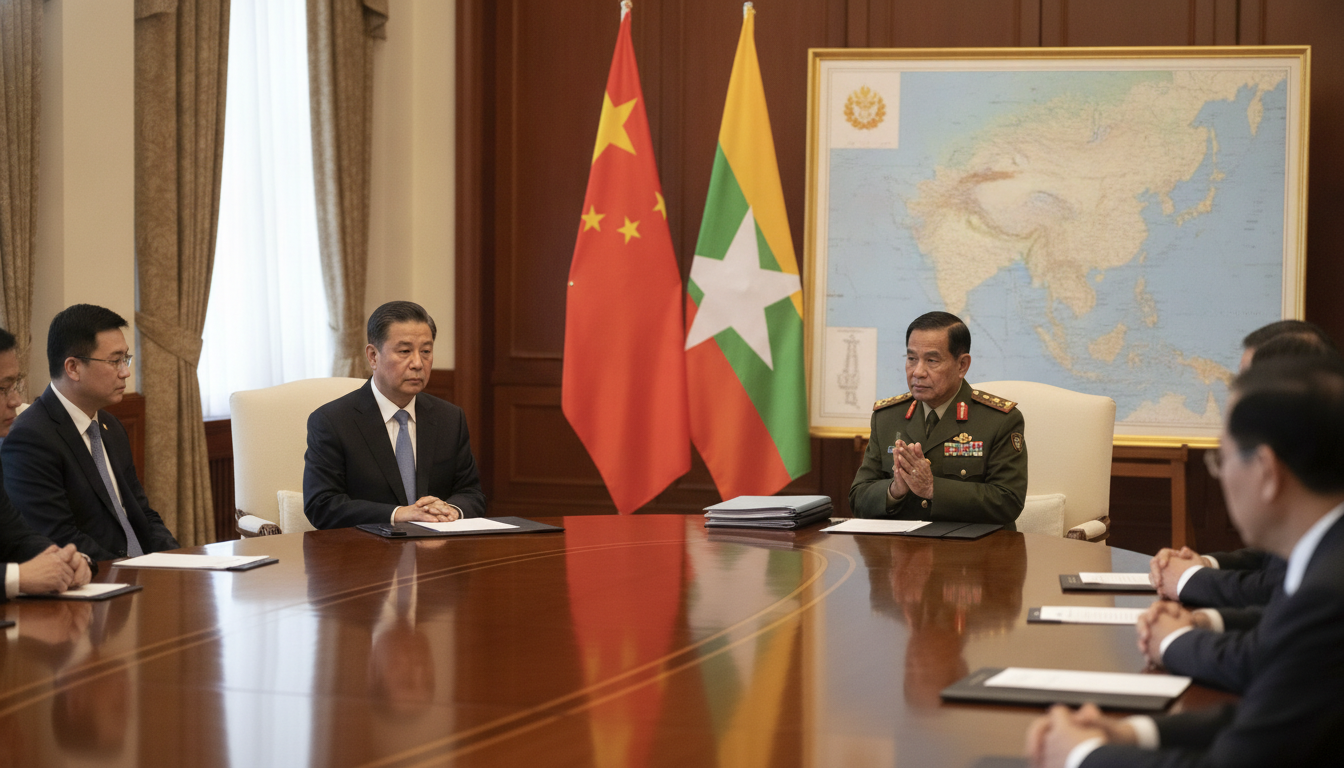
China Presses Min Aung Hlaing During Beijing Visit to Secure Peace with Ethnic Armed Groups
Chinese leaders urged Myanmar’s President Min Aung Hlaing to deliver peace with ethnic armed groups during his Beijing visit, linking political settlement to the revival of stalled Chinese investments.
Shortly after taking office in April 2026, President Min Aung Hlaing travelled to Beijing for high-level talks that focused on restoring stability along Myanmar’s borders and safeguarding cross-border projects. The meeting in mid-June highlighted China’s expectation that the new Myanmar administration secure peace deals with ethnic armed organizations in return for renewed economic engagement. Chinese President Xi Jinping gave Min a ceremonial welcome on June 16, 2026, and reportedly warned him to find the “right path” during their discussions.
Xi Hosts Min Aung Hlaing in Beijing
Xi Jinping received Min Aung Hlaing at the Great Hall of the People on June 16, 2026, in a ceremony that underscored Beijing’s strategic interest in Myanmar. The summit combined state protocol with pointed diplomatic messaging about security and investment priorities. Chinese officials made clear that normalizing ties depends not only on formal diplomatic steps but on tangible progress toward peace with armed groups.
Beijing Links Investment to Political Settlement
Chinese interlocutors pressed for assurances that ethnic conflict will be reduced so stalled projects and new investments can proceed. Beijing framed economic cooperation as contingent on stability along key transport corridors and in resource-producing regions. For China, reopening large-scale projects and protecting Chinese nationals and assets remain central priorities in restoring closer bilateral ties.
Escalation by Ethnic Armed Organizations Since 2021
Since the military takeover on February 1, 2021, Myanmar’s conflict landscape has shifted, with many ethnic armed organizations increasing resistance and opening new fronts. Analysts say fighting has complicated efforts to secure roads, pipelines and other infrastructure that cross contested areas. The rise in hostilities has also contributed to humanitarian displacement and disrupted local economies near the Chinese border.
Domestic Legitimacy and the Clock on Peace Deals
Min Aung Hlaing, who formally assumed the presidency in April 2026, faces pressure at home to deliver both security and economic relief. The administration has publicly tied reconciliation talks with ethnic groups to a broader agenda of national stability. Observers note, however, that military-dominated delegations and deep-seated mistrust among communities will make rapid, comprehensive ceasefires difficult to secure.
Economic Stakes for China and Myanmar
Chinese investment in Myanmar spans trade, energy and infrastructure, and many projects have been delayed or scaled back amid conflict and sanctions. Beijing’s economic calculus includes not only direct returns but also regional connectivity ambitions that rely on overland links through Myanmar. For Myanmar, reopening investment channels could provide crucial revenue and employment, but it may also intensify debates over sovereignty and local control of resources.
Diplomatic Signals to Regional and International Partners
Beijing’s display of support for Min Aung Hlaing during the June visit sends a diplomatic signal across Southeast Asia and to international actors monitoring Myanmar. China has balanced public calls for stability with quiet diplomacy aimed at protecting its strategic interests. The visit is likely to shape regional discussions on engagement, humanitarian access and the role external powers play in nudging conflict parties toward negotiation.
China’s emphasis on a political solution reflects a priority to limit spillover of violence and to resume economic projects that were put on hold after the 2021 coup. Min Aung Hlaing returns from Beijing with renewed expectations to reach deals with ethnic armed organizations, but the path to durable ceasefires remains complex and uncertain.
Observers caution that progress will depend on credible guarantees for minority rights, local governance arrangements, and security mechanisms acceptable to all parties. Until such elements are negotiated and implemented, both investors and communities along Myanmar’s border regions may continue to face instability and economic disruption.
The June 16, 2026 meeting in Beijing demonstrated China’s willingness to engage Myanmar at the highest levels, while also making clear that political settlement with ethnic forces is central to any substantive revival of bilateral economic cooperation.

