
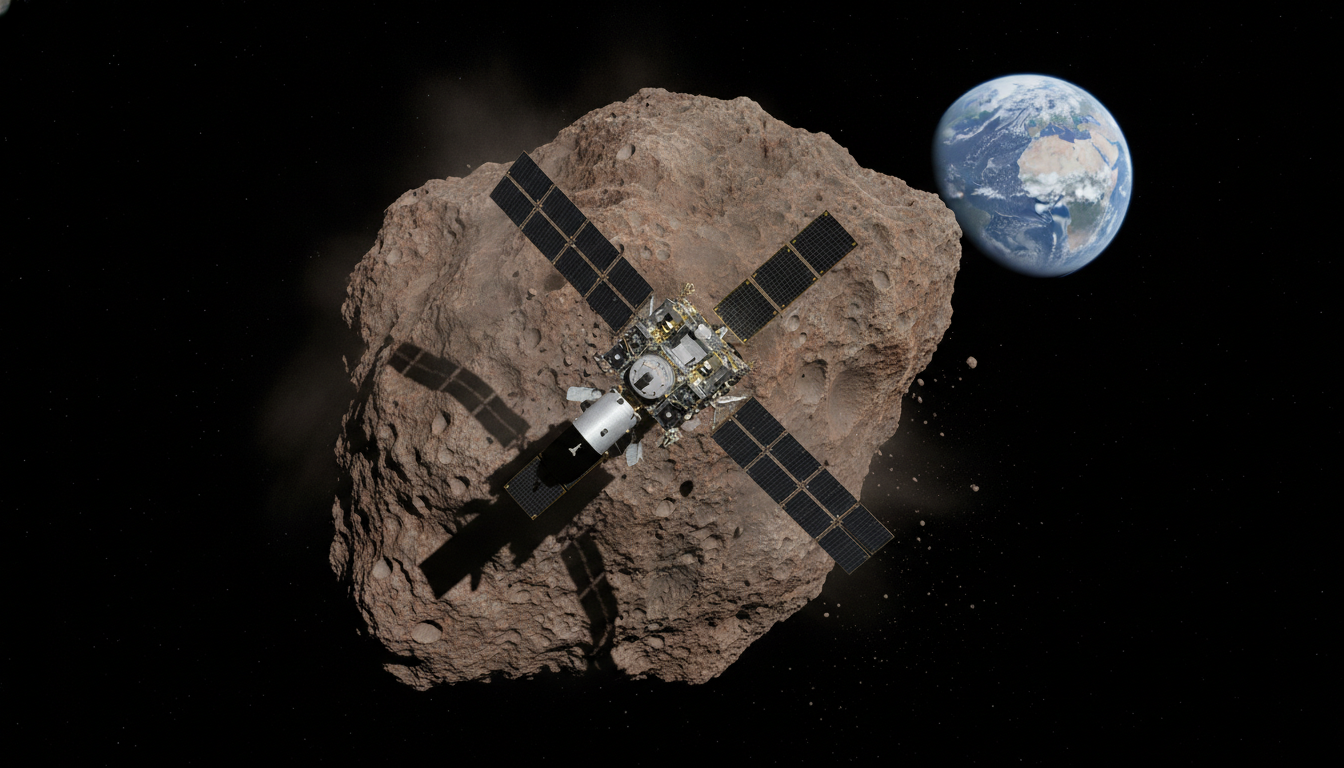
Japan’s Hayabusa2 Makes 800-Meter Flyby of Asteroid Torifune to Test Planetary Defense Technologies
Hayabusa2 conducted a close flyby of asteroid Torifune on July 5, 2026, approaching to roughly 800 meters as part of a mission phase to test technologies relevant to planetary defense. The Japan Aerospace Exploration Agency (JAXA) confirmed the maneuver and said the encounter will provide high-resolution data on the asteroid’s surface and testable operational techniques.
Close Approach Confirmed: 800-Metre Pass on July 5, 2026
Hayabusa2 passed within an estimated 800 meters of Torifune during a precisely timed flyby on Sunday, JAXA reported. The probe’s proximity allowed instruments to collect detailed imagery and measurement data at a range rarely achieved during routine asteroid surveys.
Mission controllers described the encounter as nominal, with navigation and tracking systems maintaining expected performance throughout the close approach. The flight profile demonstrated Hayabusa2’s ability to carry out high-precision trajectories around small, irregular bodies.
Planetary Defense Systems Tested During Flyby
A primary objective of the Torifune encounter was to test technologies and operational concepts relevant to detecting, characterizing, and potentially mitigating hazardous near-Earth objects. Engineers used the flyby to validate guidance, navigation and control techniques that could be applied in future deflection or disruption scenarios.
The probe’s observations will refine models for how small asteroids respond to close-proximity spacecraft operations, and will inform the design of instruments and procedures for rapid-response missions. This practical testing contributes directly to international planetary defense preparedness by demonstrating capabilities in a realistic environment.
Hayabusa2’s Extended Mission and Prior Achievements
Launched originally for a sample-return mission, Hayabusa2 previously returned material from asteroid Ryugu, a milestone for sample science and small-body exploration. Following that success, JAXA extended the spacecraft’s mission to target additional small bodies and to pursue technology demonstrations beyond its original objectives.
The Torifune flyby forms part of that extended campaign, leveraging Hayabusa2’s remaining propellant, instruments and robust navigation experience. The continuation underscores the value of repurposing interplanetary hardware to maximize scientific and practical returns.
Scientific Objectives: Surface Imaging and Composition Constraints
During the close pass, Hayabusa2 acquired high-resolution images of Torifune’s surface morphology, including boulder distributions, regolith patterns and potential impact features. These visual data will be combined with remote sensing measurements to constrain the asteroid’s composition and structure.
Understanding small asteroid surfaces at close range helps researchers interpret formation processes and collisional histories, and provides calibration points for remote observations from Earth. The new dataset will enable comparative studies with Ryugu and other small bodies visited by spacecraft.
Operational Lessons and International Collaboration Prospects
Data from the flyby will be analyzed to assess real-time navigation precision, instrument pointing stability and the effectiveness of autonomous onboard systems. JAXA plans to share relevant findings with international partners involved in planetary defense, fostering collaborative approaches to hazard mitigation.
Operational lessons are expected to influence both future JAXA missions and multinational contingency planning for potentially threatening near-Earth objects. Demonstrating interoperable procedures and data-sharing frameworks is a growing priority in the planetary defense community.
Next Steps: Data Analysis and Possible Follow-Up Observations
Mission scientists will now begin detailed processing and calibration of the flyby measurements, a phase that typically takes weeks to months as teams extract scientific and engineering insights. Follow-up observations from ground-based telescopes and possibly other spacecraft may be coordinated to place the flyby data in a broader observational context.
JAXA has indicated that subsequent mission phases will be determined after initial analyses, with options including additional close approaches, distant surveys or targeting of different small bodies. The agency emphasized that the Torifune encounter strengthens the spacecraft’s legacy as both a scientific explorer and a testbed for planetary defense.
The close flyby of Torifune reinforces Hayabusa2’s dual role in advancing solar system science and improving techniques for protecting Earth from asteroid hazards. As teams sift through the new data, the mission’s outcomes are expected to inform both future research and international preparedness efforts.

