
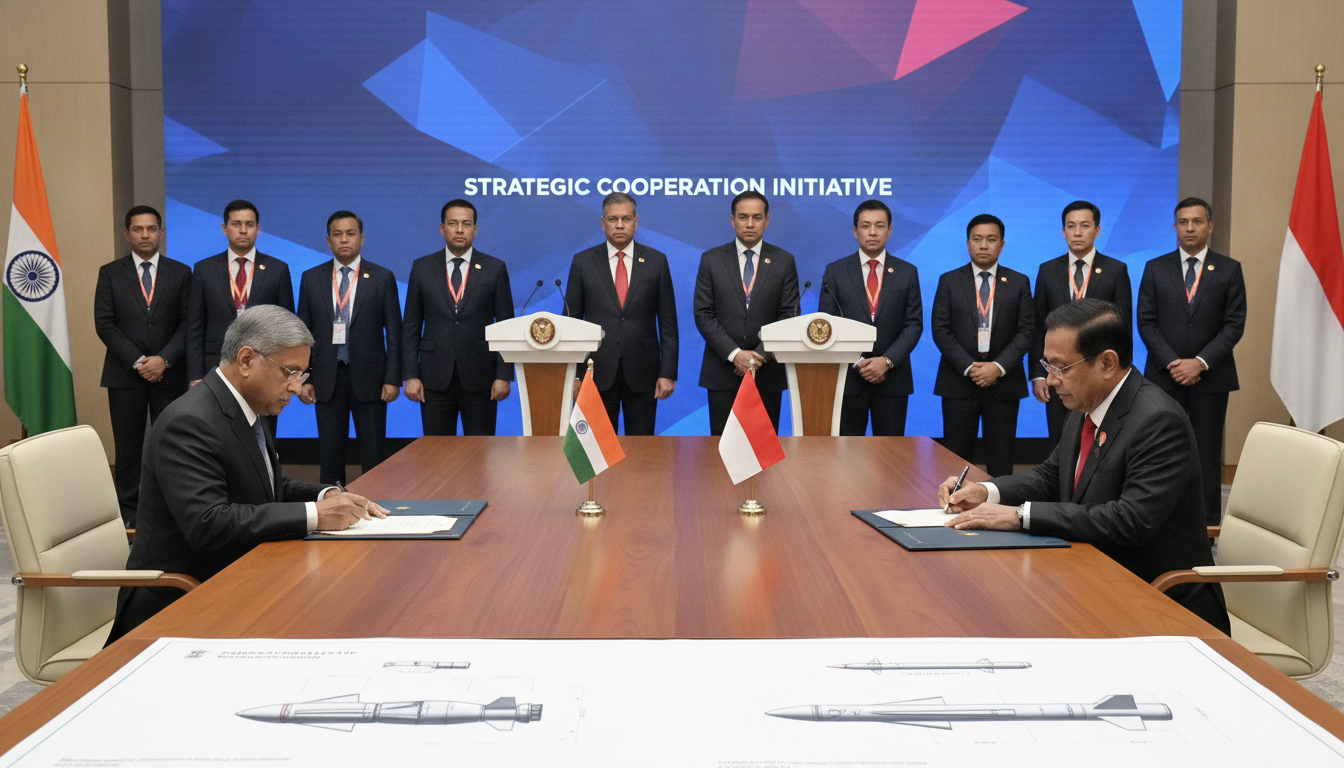
India-Indonesia missile deal signed as Modi visits Jakarta, boosting defence cooperation
India and Indonesia signed deals for supersonic cruise and air-to-air missiles during Prime Minister Modi’s Jakarta state visit, marking a step up in bilateral defense ties.
Indonesia and India on Tuesday formalized a defense agreement in which New Delhi will supply Jakarta with supersonic cruise missiles and air-to-air missiles, officials said, in a move described as a deepening of the India-Indonesia missile deal and broader bilateral security cooperation. The pact was concluded during Prime Minister Narendra Modi’s state visit to Jakarta and reflects an expanding strategic partnership between the two democracies. Indonesian President Prabowo Subianto and Prime Minister Modi presided over ceremonies and talks at the Merdeka Palace as both governments emphasized closer defence ties.
Deals Signed During Modi’s Jakarta Visit
The agreements concluded in Jakarta cover the sale and transfer of advanced missile systems, including supersonic cruise missiles intended for long-range strike roles and air-to-air missiles for Indonesia’s fighter fleet. Officials characterized the arrangements as part of wider defense cooperation that also includes training, logistics and possible maintenance support. Jakarta framed the purchases as measures to bolster its deterrent and maritime security capabilities in an increasingly contested region.
The signing was accompanied by ceremonial events and high-level meetings between the two delegations, underscoring the political weight behind the India-Indonesia missile deal. Both capitals described the package as a symbol of growing trust and interoperability, with Indonesia seeking to diversify its suppliers and India aiming to strengthen ties with Southeast Asian partners. Sources noted that the deals were finalized as part of an expansive agenda spanning defense, trade and cultural exchanges during the state visit.
Weapons Described: Supersonic Cruise and Air-to-Air Missiles
Supersonic cruise missiles are designed to travel at speeds greater than Mach 1 and to strike distant surface targets with high survivability, while air-to-air missiles are integrated onto frontline combat aircraft to counter aerial threats. The deal does not publicly specify exact models, but defense analysts say the combination indicates Jakarta’s intent to enhance both offensive reach and aerial defence. Such capabilities adjust Indonesia’s force posture by extending strike options and modernizing intercept capability for its air force.
Beyond the hardware, the agreements are expected to include associated systems such as fire-control, sensors and possibly integration work for Indonesian platforms. Training for pilots, technicians and ground crews will be necessary to operate and sustain the weapons, raising the prospects for extended military-to-military exchanges. Industry cooperation and transfer-of-technology clauses may also form part of the broader India-Indonesia missile deal framework.
Strategic Motives Behind the India-Indonesia Missile Deal
Jakarta has openly cited concerns about securing its extensive archipelagic waters and protecting sea lines of communication, making enhanced missile capability a priority. For New Delhi, the agreement advances a policy of deepening strategic links across the Indian Ocean and Southeast Asia while promoting indigenous defence exports. Observers view the pact as consistent with India’s outreach to maritime neighbours and with Indonesia’s pursuit of diversified partnerships for its defence modernization.
The timing of the deals during a high-profile state visit reinforces their diplomatic dimension, sending a message about the two countries’ alignment on regional security. Both capitals emphasized that their cooperation is aimed at stability rather than confrontation, though analysts note the move will inevitably be read in the context of great-power competition in the Indo-Pacific. The India-Indonesia missile deal thus carries both practical military implications and broader geopolitical signaling.
Statements from Jakarta and New Delhi
Indonesian and Indian officials framed the agreement as the result of sustained dialogue and growing defence collaboration, highlighting mutual respect for sovereignty and regional order. Jakarta’s leadership emphasized the need to modernize capabilities to address maritime challenges, while New Delhi underlined the partnership’s role in enhancing interoperability and industrial ties. Both governments said they would continue consultations on implementation specifics and on complementary areas of cooperation.
Public language from the two capitals also sought to reassure neighbouring states and allies that the transfers are intended to strengthen deterrence and contribute to regional security architecture. Officials promised transparency in the execution of the deals and reiterated commitments to abide by international law and existing non-proliferation norms. Analysts expect further official detail to emerge as procurement schedules and support packages are finalized.
Regional Security Reactions and Concerns
Reactions among regional and global stakeholders are likely to be mixed, with some states welcoming deeper bilateral defence cooperation while others may voice concerns about shifts in military balances. ASEAN members generally favor stability and predictability, and Jakarta has stressed that its procurement decisions respond to legitimate defence needs. Major powers observing the region will be attentive to how the India-Indonesia missile deal affects maritime dynamics and alliance calculations.
Analysts caution that arms transfers can increase the risk of misperception unless accompanied by confidence-building measures such as data sharing and exercises open to regional partners. The prospect of expanded India-Indonesia defence ties may spur further diplomatic engagement aimed at reducing the likelihood of inadvertent escalation. Transparency in deployment plans and clear communication of defensive intent will be essential to manage regional sensitivities.
Delivery Timeline, Training and Industrial Cooperation
Officials have not disclosed firm delivery dates or the full scope of logistical support, leaving timelines for deployment uncertain at this stage. The implementation phase is expected to cover training, maintenance arrangements and possibly local assembly or co-production elements, depending on negotiated offset provisions. Such industrial cooperation could benefit Indonesia’s defence sector while supporting India’s ambitions to expand arms exports and technology partnerships.
Observers say the pace of deliveries will hinge on production capacity, certification processes and the completion of interoperability testing with Indonesian platforms. Both sides indicated that follow-up agreements would set out technical annexes, support contracts and personnel training schedules. The India-Indonesia missile deal thus initiates a multi-year process that will require detailed planning and sustained government-to-government coordination.
The agreement marks a notable step in the deepening strategic partnership between India and Indonesia, and it will shape defence ties and regional calculations for years to come.

