
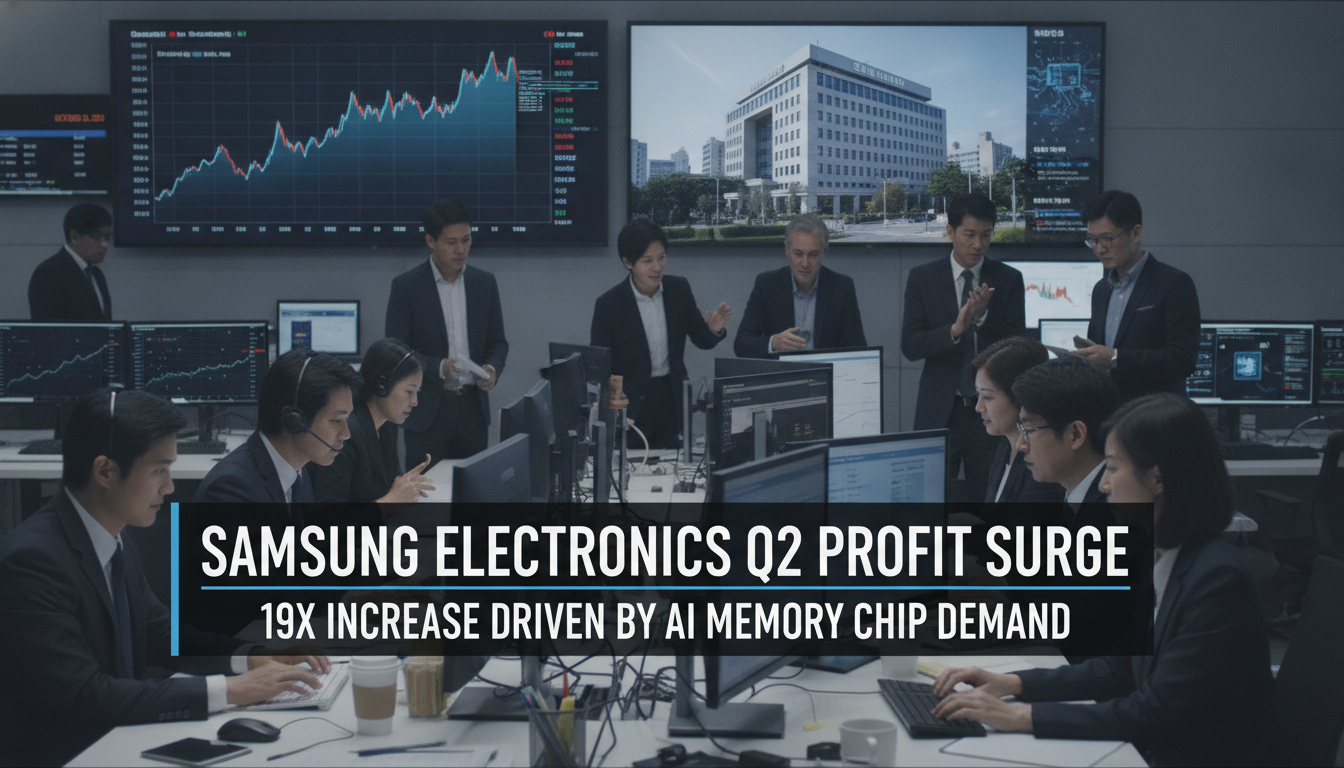
Samsung Electronics profit surge as Q2 operating profit jumps amid AI-driven memory demand
Samsung Electronics profit surge: Q2 operating profit at 89.4 trillion won as AI-driven memory demand spurs fab expansion amid investor caution over capacity.
Samsung Electronics profit surge in the second quarter put the South Korean tech giant in the spotlight on July 7, 2026, after the company reported operating profit of 89.4 trillion won ($58.4 billion), more than 19 times the level a year earlier. The company attributed the leap to soaring demand for memory chips used in artificial intelligence computing, even as analysts and investors warned that the boom could prove cyclical. Samsung also signalled plans to expand fabrication capacity to meet demand, a move that has heightened debate over the risk of future oversupply.
Q2 Operating Profit Soars to 89.4 Trillion Won
Samsung’s headline figure for the quarter — operating profit of 89.4 trillion won — far exceeded market expectations and reflected a sharp rebound from a weak year-ago base. The company reported the gain on July 7, 2026, citing strong pricing and volumes in its memory business as the primary drivers. The result underscores how the AI hardware cycle has shifted near-term cash flows for major chipmakers.
AI Demand Creates Memory Chip Shortage
Samsung and other suppliers say growing demand for AI servers and data-center accelerators has tightened memory markets, particularly for high-bandwidth and high-capacity modules. Customers from cloud providers to hyperscalers are scrambling for inventory to feed model training and inference workloads, lifting prices and revenues across the sector. That dynamic has been the central explanation for the company’s sudden profit expansion.
Plans for New Fabrication Plants Announced
In response to the demand surge, Samsung signalled plans to expand wafer fabrication capacity and invest in new fabs for advanced memory production. Company statements indicate a priority on scaling production of high-density DRAM and next-generation memory types used in AI systems. Samsung’s investment push aims to shorten delivery times for large enterprise customers while preserving its competitive lead in memory technology.
Investor Concerns Persist Despite Strong Results
Despite the blockbuster quarter, investors remained cautious about the sustainability of elevated margins and pricing in memory chips. Market commentary following the earnings release pointed to the history of cyclical swings in semiconductor demand and the long lead times for new fabs to come online. Some shareholders noted that the market reaction was tempered by uncertainty over how long AI-driven demand will remain at current intensity.
Risk of Memory Oversupply Looms
Building new fabrication capacity is costly and takes years, but once operational it can quickly add supply that outpaces demand growth. Analysts warn that aggressive capacity expansion across multiple suppliers could reverse recent price gains if AI demand growth softens. The balance between meeting immediate shortages and avoiding future oversupply will be a key test of Samsung’s capital allocation and timing.
Implications for Global Semiconductor Supply Chains
Samsung’s results and expansion plans reverberate beyond the company, influencing equipment makers, materials suppliers, and global supply chains for servers and AI infrastructure. Higher capital spending by major memory producers typically boosts demand for lithography, chemicals, and testing services, while also raising geopolitical interest in chip manufacturing locations. The company’s moves will be watched closely by competitors and customers planning their own AI capacity roadmaps.
Samsung’s strong quarter highlights how AI workloads have reshaped semiconductor economics in the near term, but it also raises strategic questions about timing and scale of investment. The company faces the twin challenge of converting short-term profitability into sustainable growth while avoiding the cyclical pitfalls that have historically affected the memory market. The coming quarters will reveal whether elevated profits herald a longer structural shift or a temporary spike driven by AI buying patterns.

