
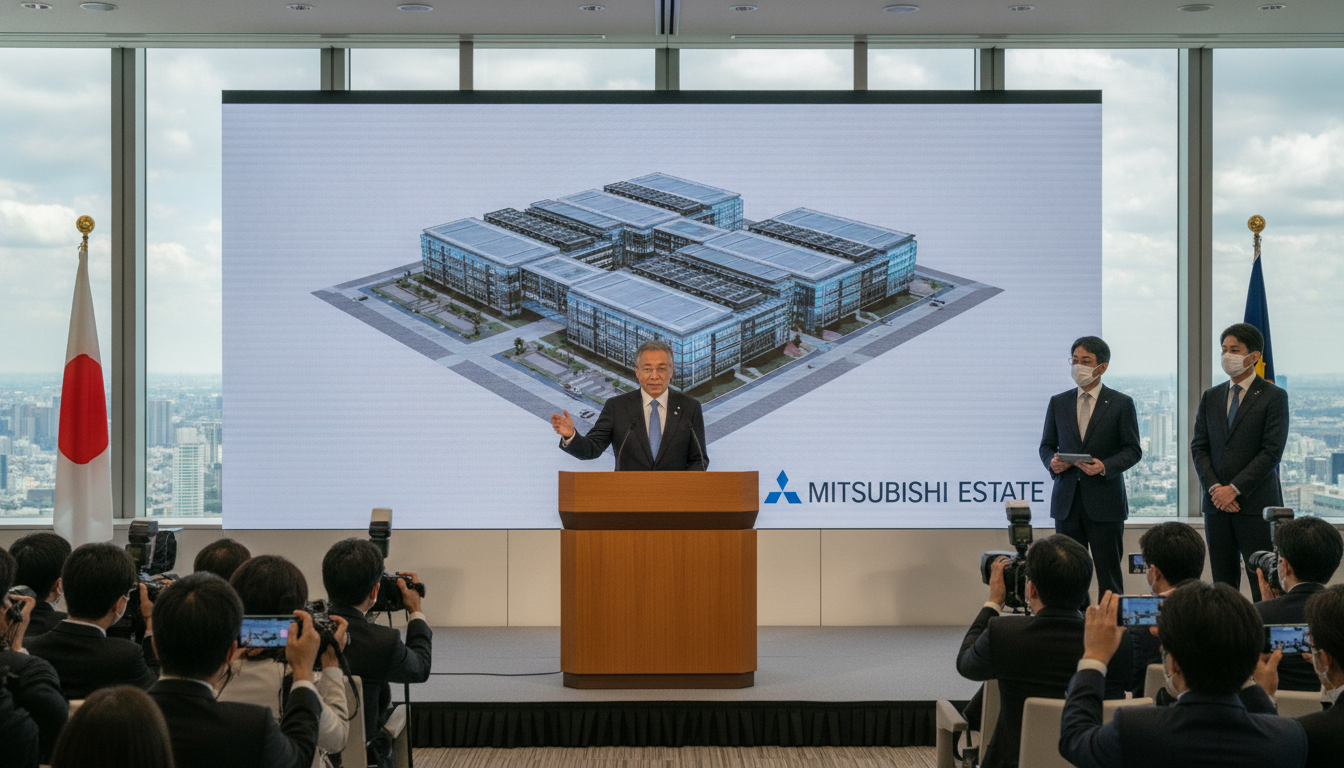
Mitsubishi Estate to Invest ¥1.5 Trillion in Japan Data Centers as AI Drives Demand
Mitsubishi Estate will invest about ¥1.5 trillion to build large-scale data centers in Japan, using expertise gained in the United States to capture rising AI-driven demand.
Mitsubishi Estate announced plans to invest roughly ¥1.5 trillion ($9.3 billion) to construct a network of large-scale data centers across Japan, aiming to secure a greater share of infrastructure needed for artificial intelligence and cloud services. The developer said it will draw on operational know‑how acquired in the United States to speed deployment and enhance resiliency of the new facilities. Company executives described the move as a strategic pivot to meet rapid growth in demand for compute capacity driven by generative AI and enterprise cloud adoption.
Investment Plan and Scale
Mitsubishi Estate outlined a multi-year investment program focused on constructing purpose-built data centers capable of hosting hyperscale and enterprise customers. The total commitment of about ¥1.5 trillion will cover land, construction, power infrastructure, and redundant cooling systems required for modern high-density facilities.
Executives indicated the program will prioritize capacity that supports high-power compute racks and secure network connectivity. The developer expects to phase projects to align with customer commitments and grid upgrades, reducing the risk of overbuilding while ensuring scale where demand materializes.
Motivation from AI and Cloud Growth
The primary driver for the investment is the surge in demand for processing power from AI model training and inference workloads. Companies running large language models and other AI services require concentrated compute and reliable, low-latency network access that purpose-built data centers provide.
Cloud providers, financial firms, and industrial customers are seeking domestic capacity in Japan to address data sovereignty, latency and supply-chain concerns. Mitsubishi Estate believes that by offering large, scalable sites it can attract both global hyperscalers and regional enterprises.
Leveraging U.S. Experience
Mitsubishi Estate said it will transfer lessons learned from its U.S. operations to accelerate delivery and improve operational efficiency in Japan. Those lessons include advanced site selection, modular construction techniques and management of power and cooling at hyperscale densities.
The company plans to adopt standardized designs and operational playbooks used overseas, while adapting them to Japan’s regulatory environment and seismic requirements. Executives expect this approach to shorten construction timelines and reduce cost variability across projects.
Planned Locations and Timetable
While Mitsubishi Estate has not released a definitive site list, the company signaled interest in regions with strong grid capacity and proximity to major fiber routes. Potential areas include coastal metropolitan outskirts where space and access to electrical substations are available.
The rollout will be phased over several years, with initial projects prioritized to meet contracts and confirmed demand. Mitsubishi Estate aims to align openings with incremental grid upgrades and local permitting schedules to avoid bottlenecks that have slowed some data center projects internationally.
Market and Competitive Landscape
Japan’s data center market is already competitive, with domestic developers, local utilities and international operators expanding capacity to capture cloud and AI workloads. Mitsubishi Estate’s scale and deep ties to corporate customers give it an advantage in assembling sites and negotiating power arrangements.
However, competition for grid capacity and skilled operational staff remains a constraining factor. The developer will likely need to negotiate long-term power purchase agreements and work closely with utilities to secure the reliable, high-voltage supply necessary for high-density operations.
Economic and Regulatory Considerations
Large-scale data center construction will interact with local economic policies, land-use rules and energy regulation. Municipalities may welcome the investment for job creation and infrastructure upgrades, but planners will scrutinize environmental and noise impacts, as well as water use for cooling systems.
Mitsubishi Estate will also have to navigate Japan’s energy transition goals, balancing demand for power with decarbonization commitments. The company signaled interest in incorporating renewable energy sourcing and efficiency measures to address both regulatory expectations and corporate sustainability goals.
Mitsubishi Estate’s ¥1.5 trillion data center program reflects a broader push by real estate firms to move beyond traditional office and retail assets into critical digital infrastructure. By leveraging overseas experience and targeting AI-driven demand, the developer aims to become a major domestic provider of high-capacity data centers as enterprises and cloud providers expand computing footprints in Japan.

