
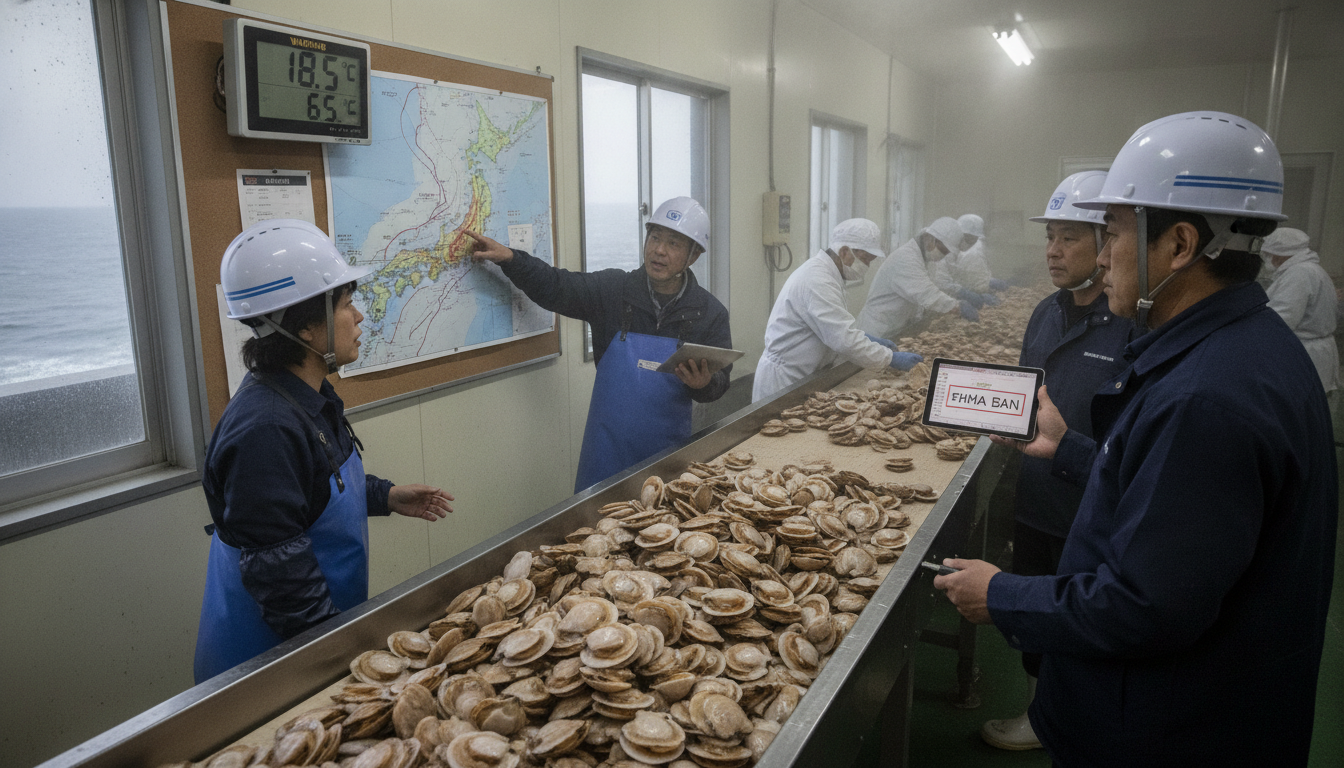
Hokkaido scallops face growing threat from warming seas despite market shifts after China ban
Hokkaido scallops are under pressure as warming waters cut catches, even after the industry reduced its reliance on China following Beijing’s import ban nearly three years ago.
Industry pivots after Beijing import ban
Since Beijing imposed an import ban on Japanese marine products nearly three years ago, Hokkaido scallop exporters have markedly diversified their sales channels. Domestic processors, wholesalers, and alternative export markets in Southeast Asia and Europe absorbed volumes that had previously flowed to China, easing immediate economic pain for many producers.
Those market adjustments, however, came with costs. Companies invested in new certification, logistics and marketing to win over different buyers, while smaller producers reported narrower margins and higher transaction burdens as they chased unfamiliar supply chains.
Warming seas cut scallop yields
Fishermen and seafood processors in northern Hokkaido now point to climate factors as the more consequential threat. Rising sea temperatures and altered currents have been linked by local experts to reduced recruitment and smaller growth rates in scallop beds around the region.
The result is less predictable seasonal output and shorter windows for profitable harvesting. For vessels that rely on dense, short seasons to cover fixed costs, the variability is translating into economic strain even where market access has improved.
Operational changes on the water
To counter falling yields, many crews have altered fishing practices, shifting grounds, changing tow depths, and adjusting harvest timing to match new biological patterns. Some operators are experimenting with longer-term fallowing of beds and altered seed collection to boost survival rates.
These adaptations demand investment and technical knowledge that is unevenly distributed across the fleet. While larger cooperatives can finance research-backed shifts, independent fishers frequently face difficult trade-offs between short-term survival and long-term sustainability.
Processing and product strategies evolve
Processors in Hokkaido have increased efforts to add value and diversify product lines as a buffer against fluctuating catches. Companies are promoting frozen and pre-processed scallop products, exploring certified sustainable labels, and leveraging Japan’s reputation for quality to enter niche markets.
Value-added strategies help stabilize revenues but cannot entirely offset lower primary volumes. Processors warn that if biological declines continue, the industry may face capacity underutilization and pressure on employment across coastal towns.
Government and research responses
Local and prefectural authorities have launched programs to monitor sea temperatures and scallop recruitment, and to support cooperative initiatives aimed at stock restoration. Grants for hatchery development and pilot projects for adaptive aquaculture have been expanded in recent seasons to help producers build resilience.
Researchers are also studying the interactions between warming waters, phytoplankton shifts and scallop larval survival to guide management decisions. Officials emphasize that policy and science must move in tandem if the sector is to remain viable over the coming decade.
Economic implications for Hokkaido communities
Scallop fisheries support many coastal communities in northern Hokkaido, where seasonal landings underwrite local employment and ancillary services. Continued declines in catch volumes could erode that economic base and prompt consolidation in processing and fishing operations.
Community leaders are urging a mix of short-term financial relief and longer-term diversification of local economies, including tourism and alternative marine products, to spread risk and preserve livelihoods.
Japan’s scallop industry responded to a major market shock by reducing dependence on China, but the emerging and persistent impacts of climate change are testing the sector’s ability to adapt. Continued monitoring, targeted support and investments in science-guided management will be crucial if Hokkaido scallops are to remain a sustainable economic resource for the region.

