
India’s services exports poised to overtake goods as IT drives trade shift
India’s services exports near historic high as IT-led growth outpaces merchandise exports, testing manufacturing ambitions and reshaping trade, jobs and policy.
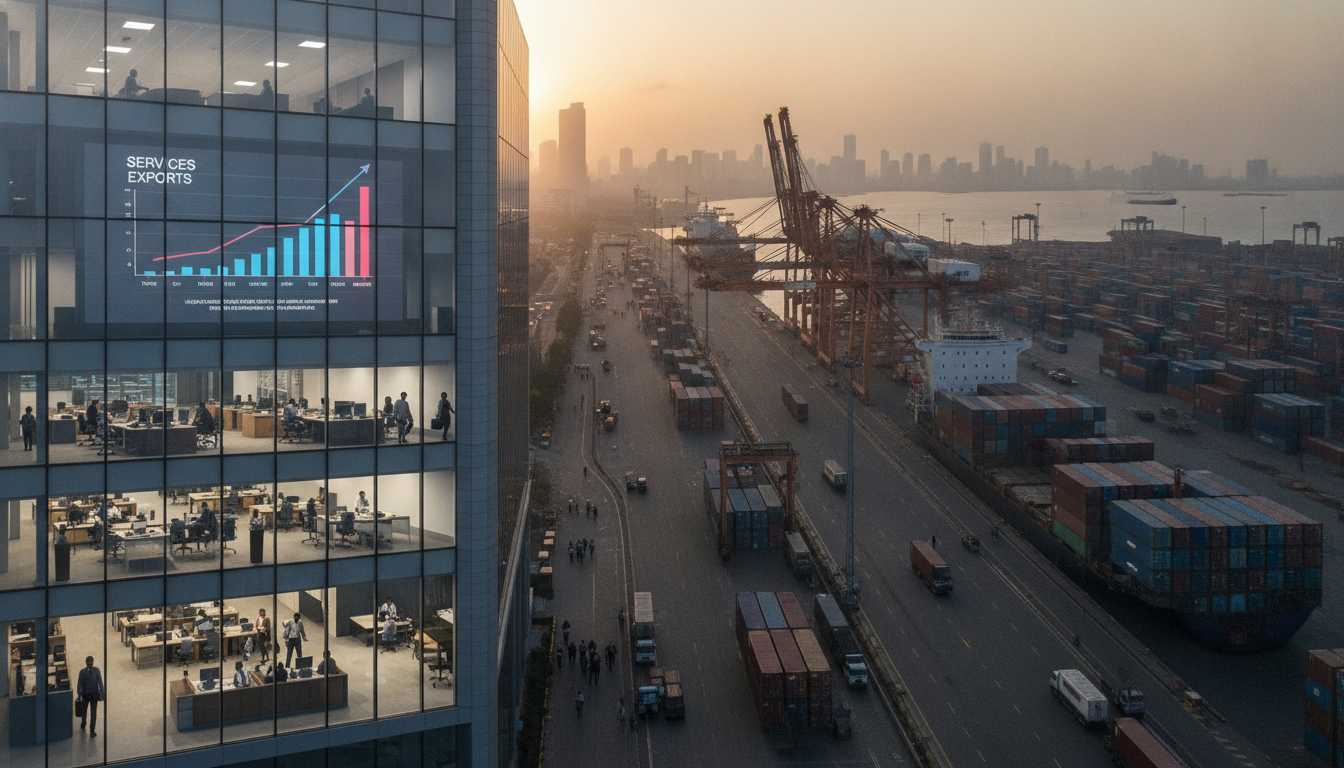
India’s services exports are on the verge of eclipsing merchandise exports for the first time, driven largely by rapid growth in information technology and related services. The shift reflects a compound annual growth rate of about 9.3% in services over the past 12 years, while goods exports have expanded at barely a third of that pace. Policymakers who have long prioritized manufacturing now face a changing export profile that could alter industrial strategy and labor markets.
Services Set to Surpass Goods in Export Value
India’s services exports have accelerated steadily, narrowing the gap with merchandise exports and moving the services sector toward the top position in external trade. The gap-closing trend is measurable: over the past dozen years services expanded at roughly three times the pace of merchandise. This sustained outperformance has moved services from a complementary role to a potential primary pillar of external receipts.
Analysts say the composition of services — dominated by software, IT-enabled services and business process outsourcing — makes the sector naturally export-oriented and adaptable to remote delivery. That contrasts with merchandise, where logistics, supply-chain integration and capital-intensive production have been slower to expand.
IT and Software Lead Service Growth
Information technology and software services remain the engine of services export expansion, supported by rising global demand for cloud, cybersecurity, and digital transformation work. Indian firms have increased their share of large, long-term enterprise contracts and continue to win projects that were once the preserve of Western consultancies.
Beyond pure software, business process management, engineering services and digital content have contributed to higher export volumes and greater value-added per worker. The scalability of digital services has also helped firms raise prices and margins in some segments, which boosts export revenue even without equivalent increases in employment.
Merchandise Exports Lag Behind
By contrast, India’s merchandise exports have shown comparatively modest gains, held back by limited scaling in manufacturing value chains and persistent logistical constraints. Commodity-linked shipments and lower-value manufactured goods have not kept pace with the higher-growth services sector, leaving merchandise expansion at roughly a third of services’ rate in recent years.
Structural challenges in goods exports include limited domestic intermediate inputs for some industries, higher freight costs, and the need for deeper integration into regional production networks. These obstacles have made it harder for policymakers to deliver the rapid export growth that ambitious manufacturing targets require.
Manufacturing Push Faces Policy and Practical Hurdles
The government’s longstanding efforts to transform India into a global manufacturing hub now contend with the reality of a services-dominated export boom. Initiatives aimed at incentivizing factory investment, such as production-linked schemes and infrastructure spending, have produced pockets of progress but have not yet shifted the export mix decisively.
Economists caution that shifting the trajectory of exports will require sustained improvements in logistics, customs procedures, land acquisition, and power infrastructure, alongside targeted support for higher-value manufacturing. Meanwhile, services growth provides revenue and foreign exchange even as manufacturing builds capacity, suggesting a need for a balanced, multi-sector strategy.
Global Demand and Regional Patterns Influence the Shift
International demand for digital services has been a major tailwind, particularly from advanced economies investing in cloud migration and software outsourcing. Geopolitical fragmentation and trade tensions have also encouraged some firms to seek cost-effective, flexible partners, benefiting Indian service providers.
At the same time, regional trade arrangements and local supply-chain reconfigurations have not yet produced a large-scale manufacturing shift into India comparable to service-sector gains. Export performance therefore reflects both changing global consumption of services and the slower transmission of foreign direct investment into labour-intensive manufacturing.
Implications for Jobs, Trade Balance and Policy Priorities
The rise of services exports has significant implications for employment, government revenue and the trade balance. Services tend to generate higher value per worker but historically employ fewer people in manufacturing-style mass employment; this raises questions about how to create widespread, good-quality jobs for a large workforce entering the labour market each year.
For the trade balance, stronger services receipts can help offset merchandise deficits and improve external resilience, but they also expose India to cyclical shifts in global tech spending. Policymakers may respond by bolstering skills training, expanding digital infrastructure, and refining incentives to attract manufacturing investment that complements the services sector.
India’s services exports are now central to the country’s external economic performance, and the coming months will be closely watched to see whether services formally overtake goods in export value. The outcome will shape future industrial policy choices and influence how India balances ambitions to become both a manufacturing powerhouse and a global leader in digital services.
As the economy evolves, officials and industry leaders will need to reconcile rapid IT-led export growth with long-standing manufacturing goals, ensuring that trade strategy, workforce development and infrastructure planning move in concert to support inclusive and sustainable growth.

