
Moonshot AI’s Kimi K3 Spurs Market Jolt as Low-Cost Chinese Model Challenges U.S. Lead
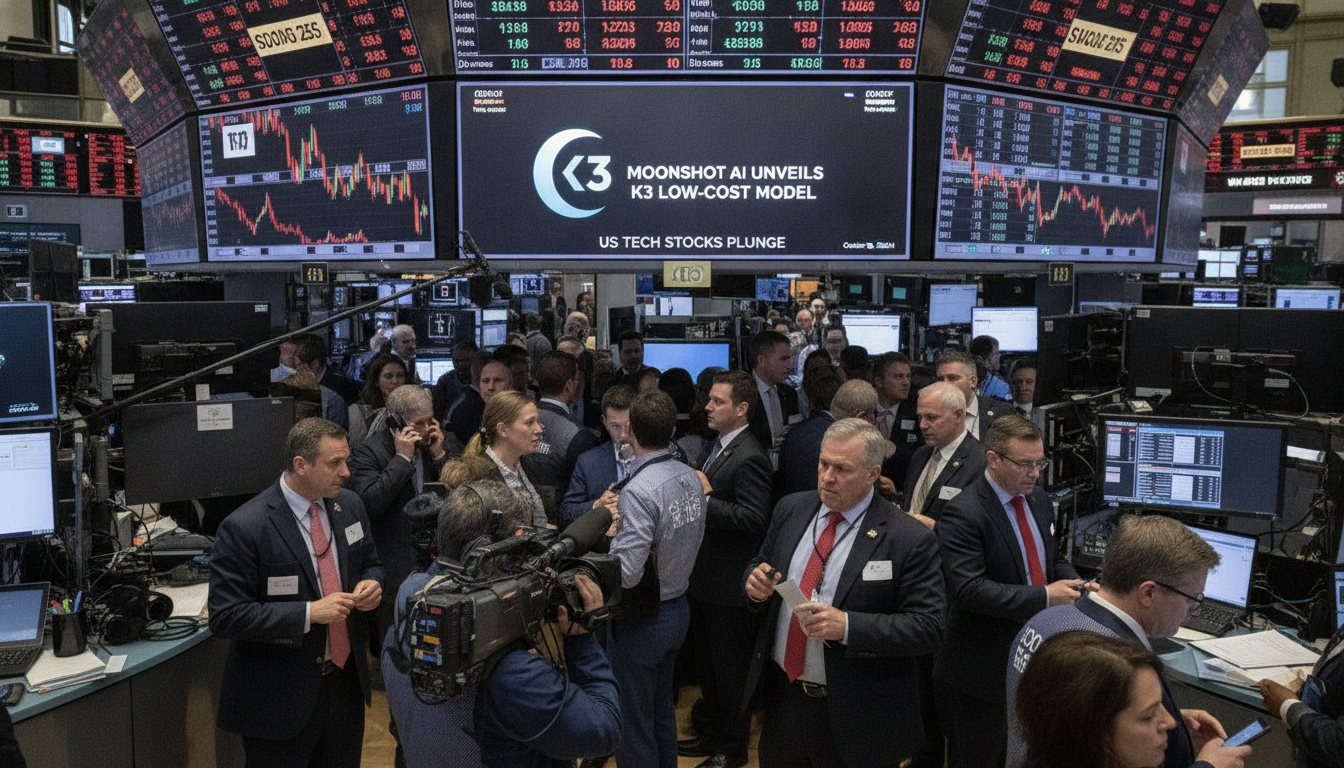
Moonshot AI’s Kimi K3, a low-cost Chinese large language model, triggered a sharp sell-off in U.S. technology stocks as investors weighed the threat to American AI dominance and cloud pricing power.
NEW YORK — Investors sent U.S. technology shares lower after Moonshot AI unveiled Kimi K3, a low-cost artificial intelligence model from a Chinese developer that market participants said could match leading systems while undercutting prices. The Kimi K3 announcement prompted renewed discussion about the narrowing technology gap between Chinese and U.S. AI developers and about potential pressure on margins across cloud and enterprise AI services. Traders and analysts signaled that the combination of competitive performance and aggressive pricing from Chinese firms could force a re‑pricing of expected returns for U.S. AI incumbents.
U.S. technology stocks tumble after Kimi K3 announcement
Markets responded quickly, with broad selling across technology names as investors reassessed earnings outlooks tied to AI services and infrastructure. The move reflected concerns that faster, cheaper offerings from China could reduce future revenue growth for companies whose valuations depend on premium AI pricing. Market participants said the shock was not just about one model, but about the prospect of sustained price competition that could compress margins industrywide.
Moonshot AI positions Kimi K3 as a low-cost alternative
Moonshot AI presented Kimi K3 as a model designed to deliver strong generative capabilities at a fraction of prevailing prices, according to company‑issued materials and industry summaries circulated after the launch. That positioning — high capability with low cost — is central to the market reaction because it directly targets enterprises and cloud customers that are cost‑sensitive. Analysts note that if the model’s real‑world performance matches promotional benchmarks, it could spur rapid adoption in price‑conscious segments.
Investors cite price and performance as immediate concerns
Several institutional investors said the immediate question is not only how Kimi K3 performs, but how quickly Chinese developers can scale deployment and underwrite steep discounts. Lower prices can accelerate customer trials and migration, particularly for companies seeking to prototype AI features without substantial cloud bills. The potential for a two‑tier market — premium, high‑cost services and broadly adopted, low‑cost alternatives — is now being priced into equities and merger and acquisition strategies.
Chinese developer ecosystem shows accelerating capabilities
Financial market observers point to a maturing ecosystem in China that combines deep technical talent, large‑scale data infrastructure, and rapidly growing commercial partners. That ecosystem has produced several models and services in recent months that close functionality gaps with Western counterparts, and Kimi K3 is perceived as the latest demonstration of that trend. The pace at which features, tooling, and enterprise integrations are being rolled out in China has raised questions about how U.S. firms will respond on product development and pricing.
Potential impacts on U.S. AI companies and cloud providers
U.S. AI companies and cloud service providers face a range of strategic responses, from accelerated investment in next‑generation models to revised pricing and bundling for enterprise customers. Some firms may increase spending on proprietary hardware and optimized software to maintain a performance edge, while others could seek strategic alliances to expand market reach. Investors are watching which companies pivot toward differentiated offerings and which see margins squeezed by intensifying price competition.
Policymakers and corporate risk teams reassess supply chains and security
The Kimi K3 launch has also encouraged renewed scrutiny of supply‑chain resilience, export controls, and data security standards as companies weigh the benefits of lower‑cost services against potential regulatory and geopolitical risks. Corporate security teams are evaluating vendor risk frameworks and contractual safeguards that would allow use of foreign models while attempting to mitigate data‑handling concerns. Policymakers may increase calls for clearer guidelines on model provenance, cross‑border data flows, and acceptable use when national security and commercial competition intersect.
Looking ahead, Kimi K3’s market debut underscores a faster, more contested phase of the global AI race in which price and deployment speed matter as much as headline performance metrics. Investors, corporate leaders and regulators will be watching adoption signals, benchmark results and vendor road maps in the coming weeks to determine whether this episode marks a lasting shift or a short‑term market reaction.

