
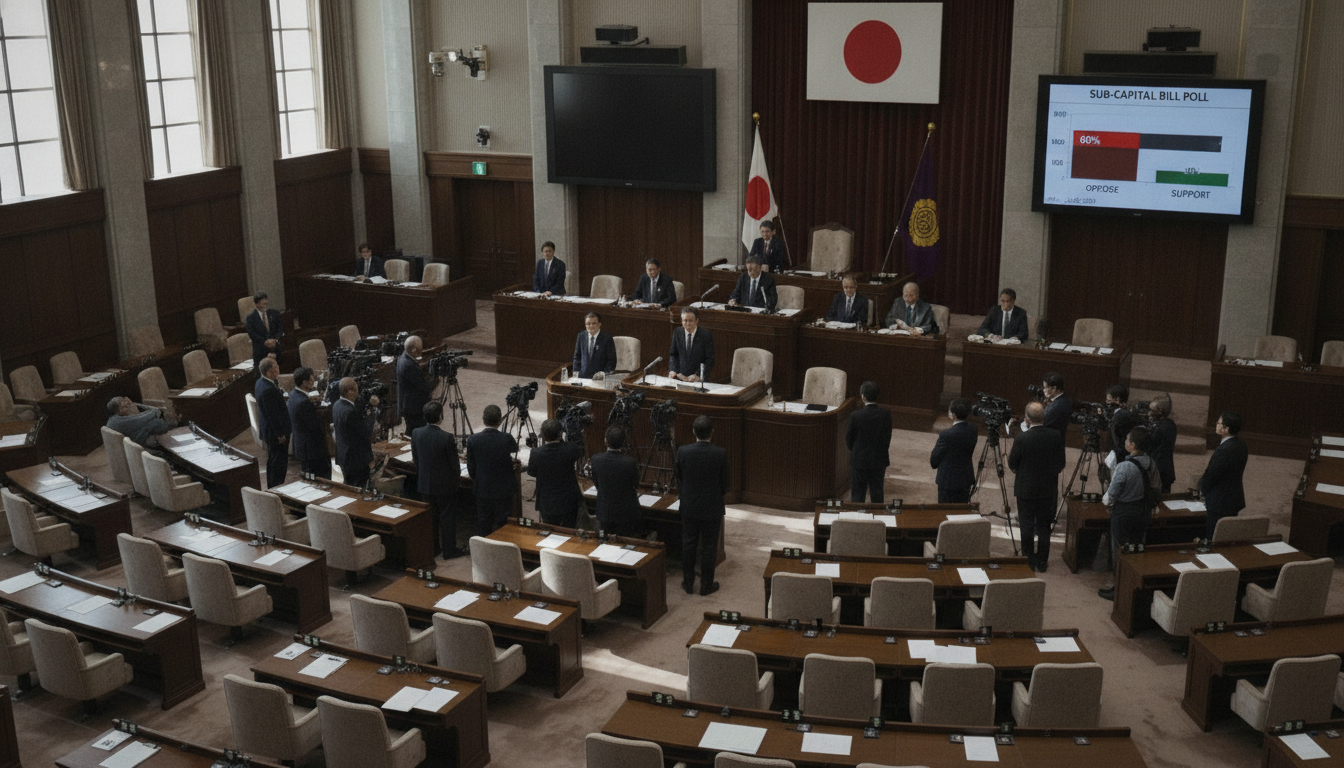
Sub-capital bill faces broad public resistance as 60% oppose rushing passage, poll shows
July 18–19 nationwide phone poll: 60% say it is unnecessary to rush passage of the sub-capital bill in the current Diet, while 26% favor immediate enactment.
A nationwide telephone poll conducted July 18–19, 2026, found clear public resistance to pressing the sub-capital bill through the current Diet session. Fifty-nine to sixty percent of respondents said there is no need to force passage now, while 26% said the bill should be enacted in this Diet. The survey highlights deep divisions between supporters of the ruling Liberal Democratic Party and the Japan Innovation Party, and shows even regional voters in Osaka are not overwhelmingly in favor.
Poll Shows 60% Oppose Immediate Passage
The poll asked whether the sub-capital bill should be passed in the current Diet, and 60% answered that passage in this session was unnecessary. Only 26% said it was necessary to secure enactment now, a result that underlines public reluctance to accelerate legislative action on the proposal.
Respondents were reached by telephone over two days, and the timing coincides with a coalition agreement that included the proposal. The margin between those wanting immediate action and those who do not suggests a significant political hurdle for proponents.
Supporter Split Within Coalition
Support for the sub-capital bill sharply diverged along party lines among those who identified with the coalition parties. Among Japan Innovation Party backers, roughly six in ten said the bill should be passed in the current Diet, indicating strong enthusiasm from that camp.
By contrast, only about three in ten supporters of the Liberal Democratic Party said immediate passage was necessary, while 57% of LDP supporters said it was not. That split within coalition supporters points to an internal imbalance in political momentum for the measure.
Osaka Voters More Supportive but Still Divided
In Osaka Prefecture, where the Japan Innovation Party has its political base, support for immediate passage was higher than in many other regions but still far from a majority. About 40% of Osaka respondents said the sub-capital bill should be enacted in this Diet, while approximately 50% said it should not.
The regional pattern indicates that even in areas perceived as sympathetic to the proposal there is substantial caution among residents. Local sentiment will complicate efforts to frame the bill as a broadly endorsed decentralization measure.
Content of the Sub-capital Proposal
The sub-capital bill would establish a secondary capital mechanism to shift some functions of the national government away from Tokyo and create a formal legal framework for a deputy capital. Proponents argue it will decentralize administrative roles and distribute infrastructure and decision-making beyond the capital.
Critics, however, warn that the measure could be used to enable specific local reforms, and some analysts have pointed to links with proposals such as the Osaka Metropolis plan. Details of the bill’s scope and practical implementation remain key points of contention in political debate.
Political Motives and Criticisms
The sub-capital measure was included in a coalition pact between the Liberal Democratic Party and the Japan Innovation Party, which set a goal of advancing related legislation during the current Diet session. Observers note that the Japan Innovation Party’s long-standing push for structural reform in Osaka could be a motivating factor behind the timetable.
Opponents of the accelerated schedule argue that the bill should be subject to broader public consultation and fuller parliamentary scrutiny. The poll results are likely to bolster calls from opposition parties and civic groups for a more measured legislative process.
Implications for the Diet Agenda
The public’s reluctance to see the sub-capital bill rushed through increases the political risk for coalition leaders trying to meet their timetable. With only about a quarter of the public in favor of immediate enactment, lawmakers face pressure to justify urgency or delay consideration until wider consensus is secured.
How the coalition responds will shape parliamentary debate in the coming weeks, including committee schedules and possible amendments. The balance between party agreements and public opinion will be a central theme as the Diet navigates competing priorities.
The poll’s findings underscore the fragile public mandate for rapid institutional change and set the stage for intensified political negotiations over whether and how the sub-capital bill should proceed.

