
Imperial Household Law revision seen as lacking public support, poll finds
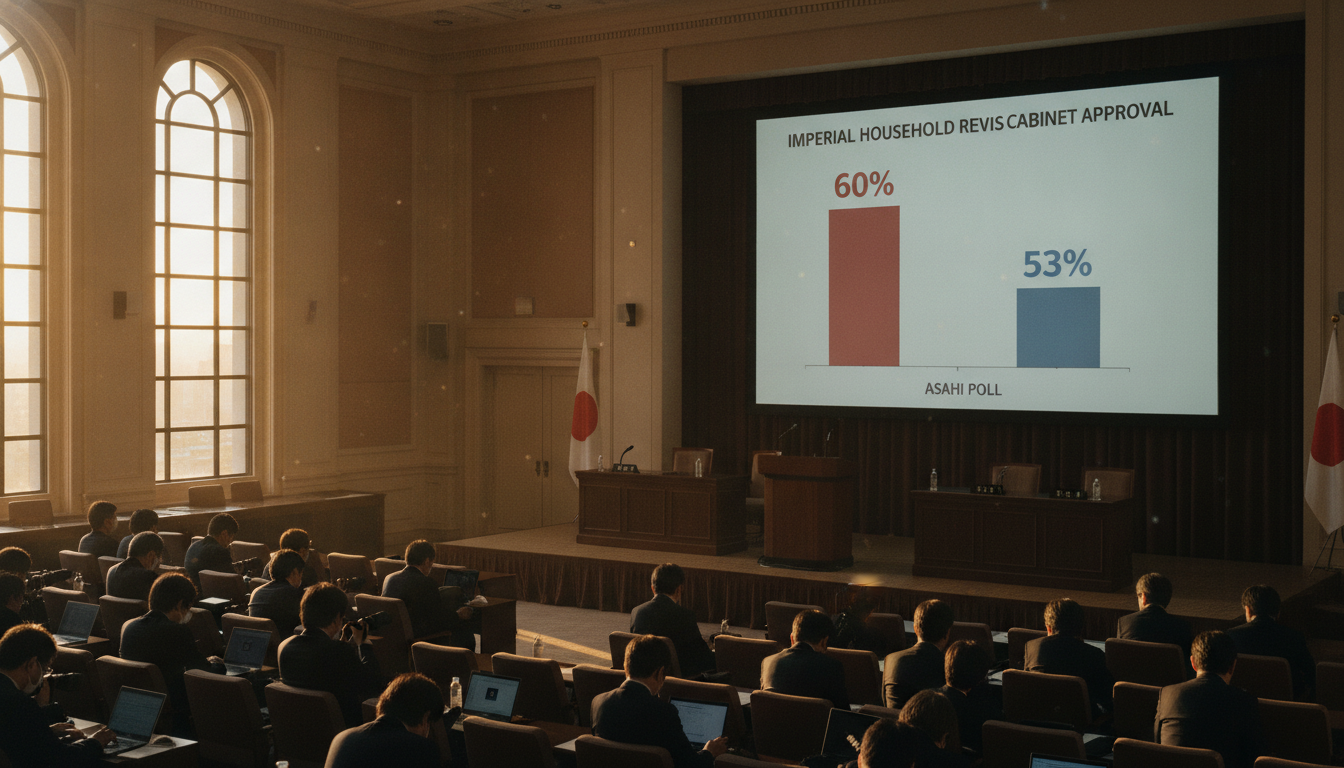
A July 18-19 national poll shows 60% believe the Imperial Household Law revision lacks public understanding; cabinet approval dropped to 53% nationwide.
The latest Asahi Shimbun telephone survey, conducted July 18–19, 2026, found a majority of respondents saying the Imperial Household Law revision has not secured public understanding. The poll asked whether the recent change to the law, intended to ensure the number of imperial family members, is comprehensible and acceptable to the public; 24% replied it was understood, while 60% said it was not.
Public concern over the amendment coincided with a notable decline in cabinet approval, which the survey placed at 53%. The results reflect a swift political reverberation following the Diet’s approval of the revision on July 18, 2026. Political leaders and policy makers are now facing heightened scrutiny over both the substance of the measure and the process by which it was passed.
Nationwide poll finds most respondents say revision lacks public understanding
The survey of adults across Japan registered clear skepticism about the Imperial Household Law revision’s social legitimacy. Sixty percent of those interviewed expressed the view that the change had not won broad public understanding, while fewer than a quarter felt it had.
Interviewers conducted the poll by telephone over two days, July 18 and 19, 2026, immediately after legislative approval, capturing public sentiment at a critical juncture. The timing intensified attention on how rapidly public opinion can shift following high-profile parliamentary decisions.
Cabinet approval rate falls to 53 percent after passage
The same Asahi poll recorded a cabinet approval rating of 53 percent, a decline attributed in part to public unease about the law change. Analysts and party officials noted that approval figures often reflect perceptions of government responsiveness and the clarity of policy explanations.
Government sources said officials are aware that the approval drop adds pressure to pursue public outreach and clearer explanations of why the amendment was deemed necessary. Opposition parties argued the decline underscores gaps in consultation and the need for broader civic dialogue.
Opposition lawmakers and constitutional scholars voice reservations
Opposition leaders seized on the poll results to question the mandate for the revision and to demand further debate on succession rules and related matters. Parties against the legislation argued the vote shows lawmakers misjudged public sentiment when moving the measure through the Diet.
Legal scholars interviewed by reporters emphasized that public trust in institutions depends not only on legal correctness but on perceived legitimacy. Several constitutional experts urged the government to engage in sustained public information campaigns and to consider mechanisms for greater transparency.
Public concerns focus on succession stability and transparency
Public commentary collected alongside the poll suggested concerns center on the amendment’s implications for imperial succession and on how decisions were presented to citizens. Many respondents said they felt the debate had been technical and rushed, leaving ordinary voters unsure of the consequences.
Observers say that securing the long-term stability of the imperial household is recognized as a policy objective by many, but that acceptance requires a clearer explanation of trade-offs and alternatives. Civil society groups called for forums and explanatory materials tailored to different age groups and regions.
Political implications for future legislation and outreach efforts
Political strategists warn the government that the poll’s findings could complicate efforts to advance related measures or broader institutional reforms. A sustained gap between policy action and public understanding may erode support for the administration on other issues as well.
Officials signaled plans to step up explanatory efforts, including public briefings and targeted communication, to address the questions revealed by the survey. Lawmakers on both sides of the Diet said they expect the public response to shape future discussion of imperial household policy.
The Asahi Shimbun poll conducted July 18–19, 2026, provides a snapshot of public sentiment in the immediate aftermath of the Diet’s approval of the Imperial Household Law revision. The results underscore a clear need for the government and lawmakers to bridge gaps in understanding if they are to secure broader public acceptance for changes affecting the imperial household.

