
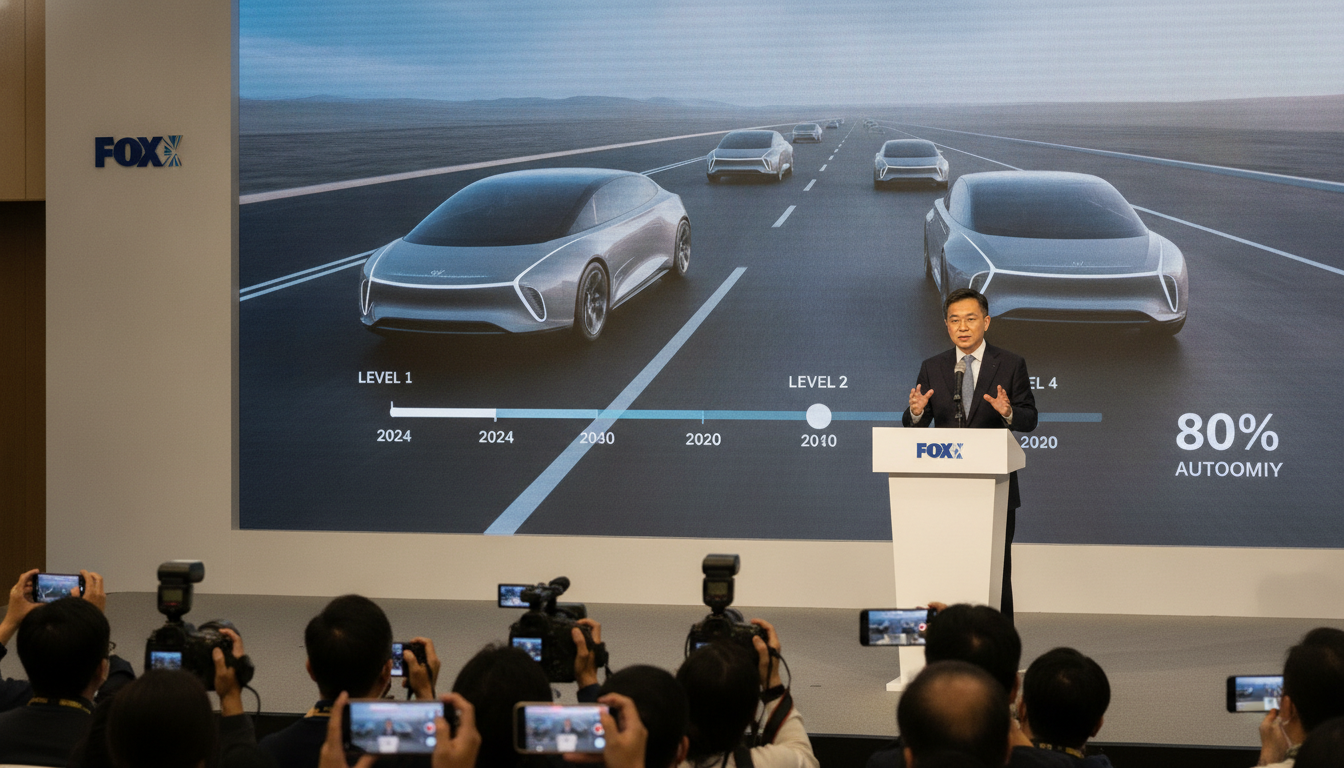
Foxconn Predicts More Than 80% of Vehicles Will Reach Level 4 Autonomous Driving by 2040
Jun Seki of Foxconn forecast at Nikkei’s Global Digital Summit that over 80% of vehicles will have Level 4 autonomous driving by 2040, saying AI will give EVs a decisive advantage globally.
Foxconn’s EV chief makes a bold forecast at Nikkei summit
Foxconn’s chief strategy officer for electric vehicles, Jun Seki, told attendees at Nikkei’s Global Digital Summit in Tokyo on July 21, 2026, that more than 80% of vehicles could be equipped with Level 4 or higher autonomous-driving systems by around 2040.
He argued that advances in artificial intelligence and autonomy will create a clear competitive edge for electric vehicles over hybrids, reshaping how cars are designed, sold and used.
AI and autonomy as a competitive lever for EVs
Seki said that AI-driven systems would shift the value proposition of vehicles from mechanical efficiency to software capabilities, with EVs better positioned to integrate the necessary sensors and compute.
Because electric architectures already centralize power electronics and thermal management, he suggested manufacturers will find it easier to embed the high-power sensors and processors that Level 4 autonomy requires.
Technology and investment needed to reach Level 4
Reaching Level 4 autonomy — where vehicles can operate without human intervention in defined conditions — will require substantial improvements in machine perception, real-time processing and redundancy.
Industry observers say the push will demand large-scale investment in lidar, radar, high-resolution mapping, edge compute and resilient software platforms, as well as collaboration across chipmakers, automakers and tier suppliers.
Implications for automakers and suppliers
If Seki’s projection holds, traditional automakers could face intensified pressure to partner with software and electronics firms or to accelerate in-house development of autonomous stacks.
Suppliers that specialize in sensors, semiconductors and domain controllers stand to gain, while those focused solely on conventional powertrain components may need to diversify toward software and systems integration.
Regulatory and infrastructure hurdles remain significant
Experts caution that technology alone will not guarantee adoption; regulatory frameworks, safety validation and liability rules must evolve in parallel.
Infrastructure such as high-definition mapping, reliable cellular coverage and urban road upgrades will also be required to support widespread Level 4 operation, particularly in mixed urban and rural environments.
Market adoption, cost and consumer acceptance
Cost remains a central barrier to rapid deployment: the sensors and compute required for Level 4 systems are expensive today, and making them affordable for mass-market vehicles will take time.
Consumer acceptance will hinge on demonstrable safety gains and clear service models, including whether autonomous features are sold as part of vehicle purchase, subscription services or fleet offerings.
Global timeline and strategic consequences
Seki’s 2040 timeline assumes sustained investment and regulatory progress across major markets, as well as steady advances in AI capability and hardware scalability.
For companies like Foxconn, which have been expanding beyond smartphone assembly into automotive manufacturing and electronics integration, the prospect of a software-driven vehicle market offers both opportunity and strategic urgency.
The move toward Level 4 autonomy could reorder competitive dynamics in the auto industry while accelerating the case for fully electric platforms that are built around software and sensors rather than internal combustion architectures.

