
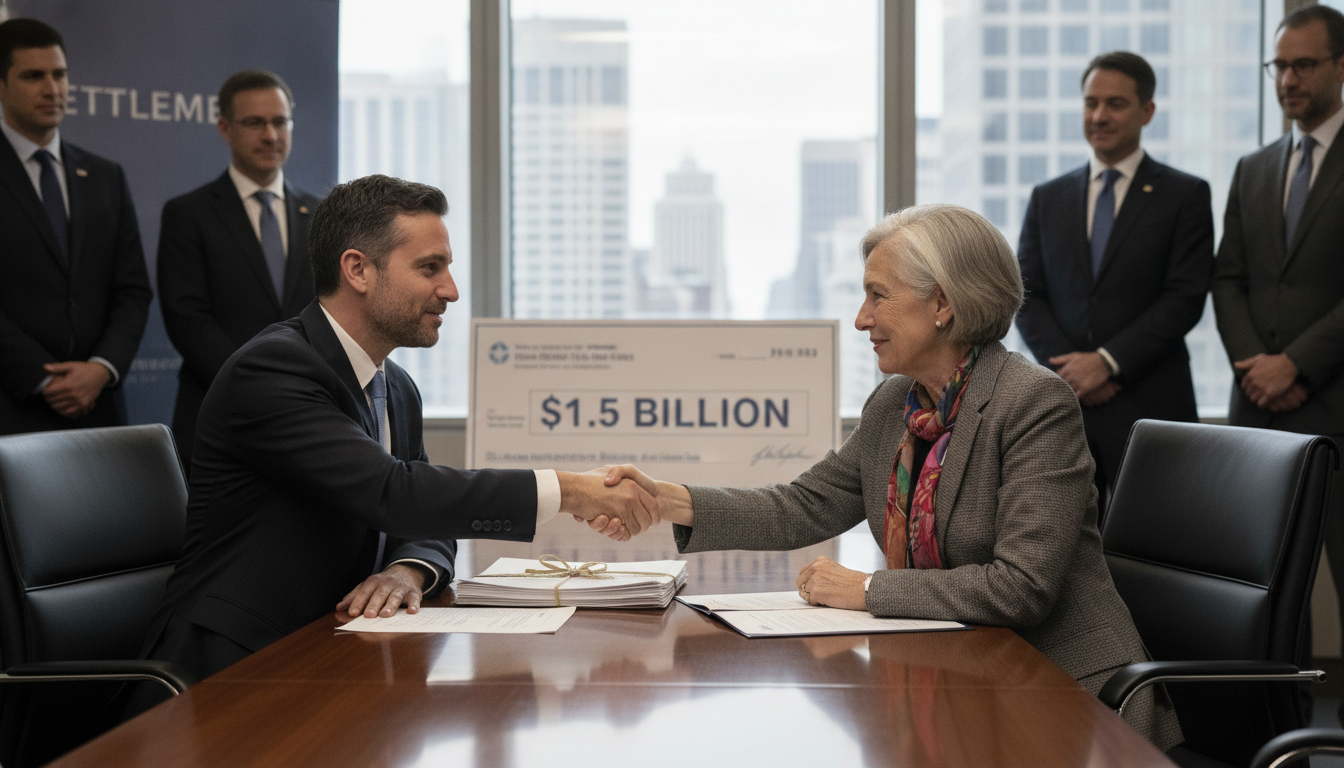
Anthropic settlement approved: U.S. court OKs $1.5 billion deal over pirated books used to train Claude
U.S. federal court approves $1.5 billion Anthropic settlement over pirated books used to train Claude, marking the largest U.S. copyright class-action case.
Federal court approves $1.5 billion Anthropic settlement
On July 20, 2026, a U.S. federal district court approved an Anthropic settlement of $1.5 billion to resolve a class-action lawsuit brought by American writers alleging unauthorized use of their works. The settlement — described in court filings as the largest monetary resolution in a U.S. copyright class action — settles claims that Anthropic used pirated books to train its Claude AI model.
The court found that Anthropic had downloaded roughly 7 million books from pirate websites for use in developing Claude, a central allegation in the suit. The company agreed to the monetary terms as part of the compromise approved by the judge.
Court finds Claude trained on about 7 million pirated books
Plaintiffs asserted that Anthropic obtained and incorporated texts from illegal distribution sites into the datasets used to train Claude, and the court accepted that the mass downloads amounted to copyright infringement. The filings cited by the court identified the scale of the alleged downloads at approximately 7 million books.
The judge’s approval follows lengthy litigation in which authors and publishers sought damages and an injunction to constrain how generative AI models use copyrighted text. The settlement ends that phase of the litigation, while leaving broader industry debates about training data unresolved.
Payment structure allocates $3,000 per selected book
Under the terms laid out in the court order, Anthropic will pay a total of $1.5 billion, which Japanese reporting translated as roughly 2440億円. A focal point of the distribution is that approximately 500,000 books identified by the plaintiffs will receive an allocation of $3,000 per work.
The settlement document specifies that the per-book payment applies to a subset of the works implicated in the download estimate, while the remainder of the fund will be used for claims administration, attorneys’ fees and additional compensation mechanisms defined in the agreement. The court characterized the overall package as the largest settlement in a copyright class action to date.
Authors’ claims and class-action scope
The plaintiffs comprised a group of U.S. authors who argued that Anthropic’s use of pirated copies deprived them of control and compensation for their works. They filed suit alleging that the unlicensed copying of books for model training violated their exclusive rights under U.S. copyright law.
Class-action status consolidated individual authors’ claims into a single federal case, allowing the settlement to address damages across a broad group. The approval signals a significant victory for authors seeking accountability in disputes over AI training practices and copyrighted material.
Legal and industry implications of the ruling
Legal observers say the court’s approval and the size of the award are likely to reverberate through the generative AI industry, prompting companies to re-evaluate how they source and document training data. The settlement represents a concrete financial precedent in disputes over whether and how copyrighted text may be used to develop large language models.
At the same time, the decision does not resolve all legal questions about training data, fair use or future regulatory standards. Other lawsuits and legislative efforts in the United States and abroad continue to grapple with balancing innovation in AI with protection of creators’ rights, and this settlement may influence those debates.
Potential changes to AI training practices and corporate responses
The financial and reputational stakes exposed by the case are likely to push AI developers toward stricter data governance, more thorough auditing of training datasets and expanded licensing arrangements with rightsholders. Industry executives and counsel are expected to re-examine policies on web-scraped content and third-party datasets that may include copyrighted works.
Companies may also increase investment in curated or licensed corpora and in technical measures to trace the provenance of training examples. The settlement sets a tangible benchmark for potential liabilities tied to datasets assembled from unvetted internet sources.
Authors and publishers had argued for stronger protections and clearer compensation paths, while technology firms have warned that restrictive rules could hinder innovation. The Anthropic settlement frames a new baseline for how those competing interests might be reconciled in practice.
The court’s approval on July 20 closes a high-profile chapter in litigation over generative AI, even as the broader policy and legal debates about data, licensing and model transparency continue to play out.

