
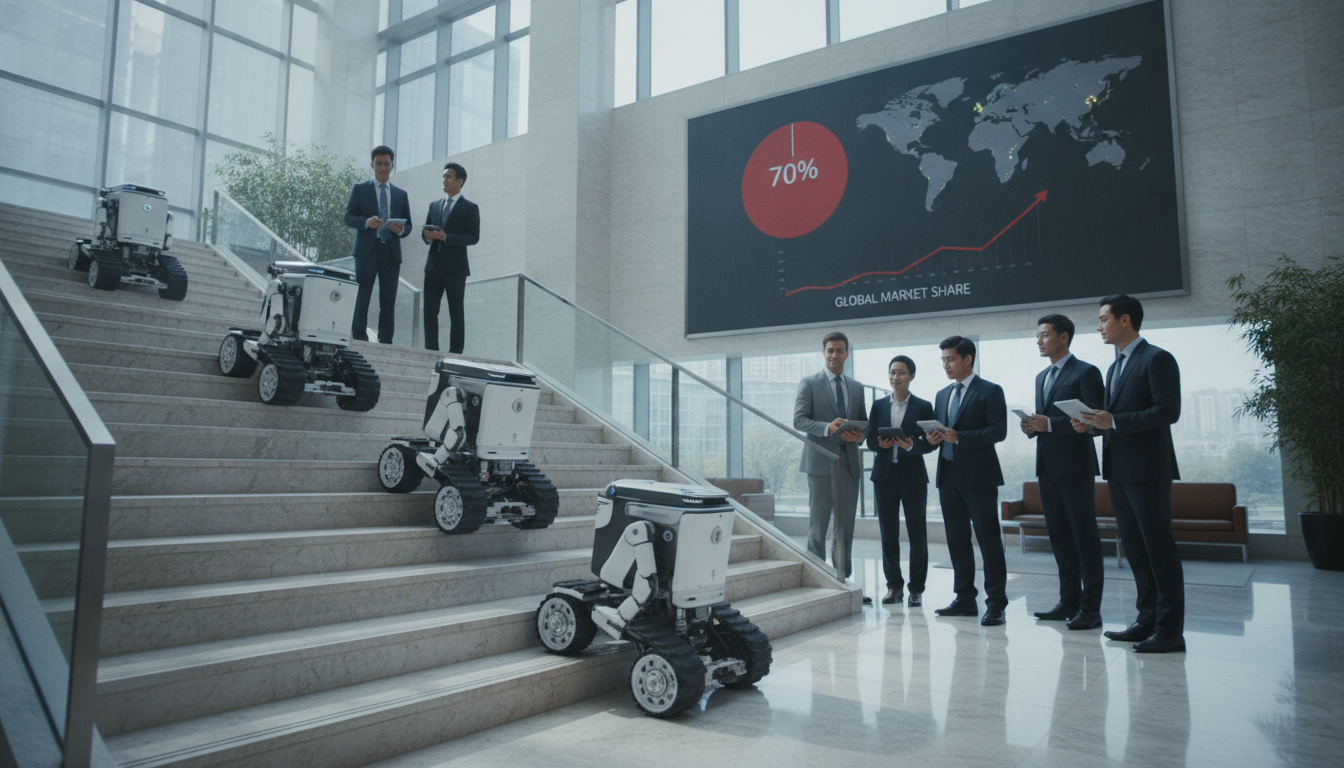
Chinese cleaning robots surge to 70% of global market as makers race to add stair-climbing and other advanced features
Chinese cleaning robots now account for roughly 70% of the global market as manufacturers shift from price competition to differentiating capabilities like stair‑climbing.
Chinese manufacturers of household cleaning robots have consolidated roughly 70% of the worldwide market, industry observers say, as the sector moves away from low‑cost battles and toward feature-led competition. The shift has prompted a wave of product development focused on advanced mobility, smarter navigation and new functions such as stair‑climbing that aim to justify higher prices and capture premium segments. Roborock’s Saros Rover, which is being developed to climb stairs, has become a visible example of how device makers are chasing novel abilities to stand out.
Market concentration among five major Chinese players
Chinese firms now dominate the production and export of robotic vacuum cleaners and multi‑function cleaning machines, with the five biggest companies together commanding about 70% of global shipments. That concentration reflects years of scale‑up in manufacturing, rapid product iteration and aggressive distribution into overseas retail channels. Analysts note the group includes both established brands and large OEM manufacturers that supply third parties, giving China broad influence over component sourcing and product design.
From price cuts to capability competition
Once driven primarily by price, competition in the cleaning‑robot market is increasingly focused on unique technical capabilities. Companies are investing in sensors, software and mechanical innovations to add value beyond simple suction and floor mopping. The result is fewer outright price wars and more marketing around specific features that address user pain points, such as multi‑floor homes, pet hair, and hands‑free maintenance.
Roborock’s stair‑climbing prototype and product implications
Roborock has highlighted a prototype called the Saros Rover intended to operate across stairways, a capability that would mark a major departure from current models that struggle with height differentials. Engineers say stair mobility would allow a single unit to service multi‑level homes without manual transfer, potentially changing consumer expectations for convenience. If successful at scale, such designs could spur competitors to prioritize mechanical agility and robust onboard vision systems.
Supply‑chain and manufacturing advantages in China
China’s dominance is underpinned by tightly integrated supply chains for motors, sensors, batteries and brush technologies, enabling faster development cycles and lower component lead times. Large domestic manufacturers also benefit from concentrated R&D clusters and contract factories that can move from prototype to mass production quickly. These factors have allowed Chinese companies to iterate on complex features such as LIDAR mapping, simultaneous localization and mapping (SLAM) software, and modular cleaning attachments more rapidly than many overseas rivals.
Pressure on overseas brands and retail partners
The shift toward capability‑driven products is placing pressure on foreign brands that previously competed on legacy reputations or premium pricing alone. Retailers in Asia, Europe and North America are rethinking assortments to include new multifunction units and stair‑capable models, while some incumbents pursue partnerships or licensing to access advanced modules. At the same time, consumer electronics chains and online platforms are adjusting marketing narratives to emphasize mobility, autonomy and integration with smart‑home ecosystems.
Consumer demand and adoption factors in Japan
In Japan, where many households have multilevel layouts and an aging population that values convenience, the appeal of robots that can operate without frequent human intervention is clear. Adoption patterns show willingness among buyers to pay more for proven reliability, quiet operation and maintenance features like auto‑empty docks. Local retailers may see opportunities to bundle services, warranties and installation help for higher‑end models that promise true multi‑floor autonomy.
Market watchers caution that technical hurdles remain, including safety around stair descent and ascent, battery life when negotiating vertical movement, and reliable obstacle recognition in complex home environments. Regulatory and consumer‑safety standards will likely evolve as stair‑capable robots move closer to commercial release, prompting manufacturers to provide transparent testing data and clear usage guidelines.
The move from competing on price to competing on distinctive features has shifted the calculus for consumers and sellers alike. Chinese firms’ hold on global shipments gives them leverage, but it also raises expectations for ongoing innovation and after‑sales support. As stair‑climbing prototypes like the Saros Rover progress toward market readiness, the cleaning‑robot sector appears set to enter a new phase where design ingenuity and system integration determine winners more than unit cost.
Longer term, success in this market will hinge on balancing advanced capabilities with proven reliability and clear consumer benefits. Manufacturers that can demonstrate safe, effective multi‑floor operation and integrate those capabilities into robust service networks are likely to solidify their positions.

