
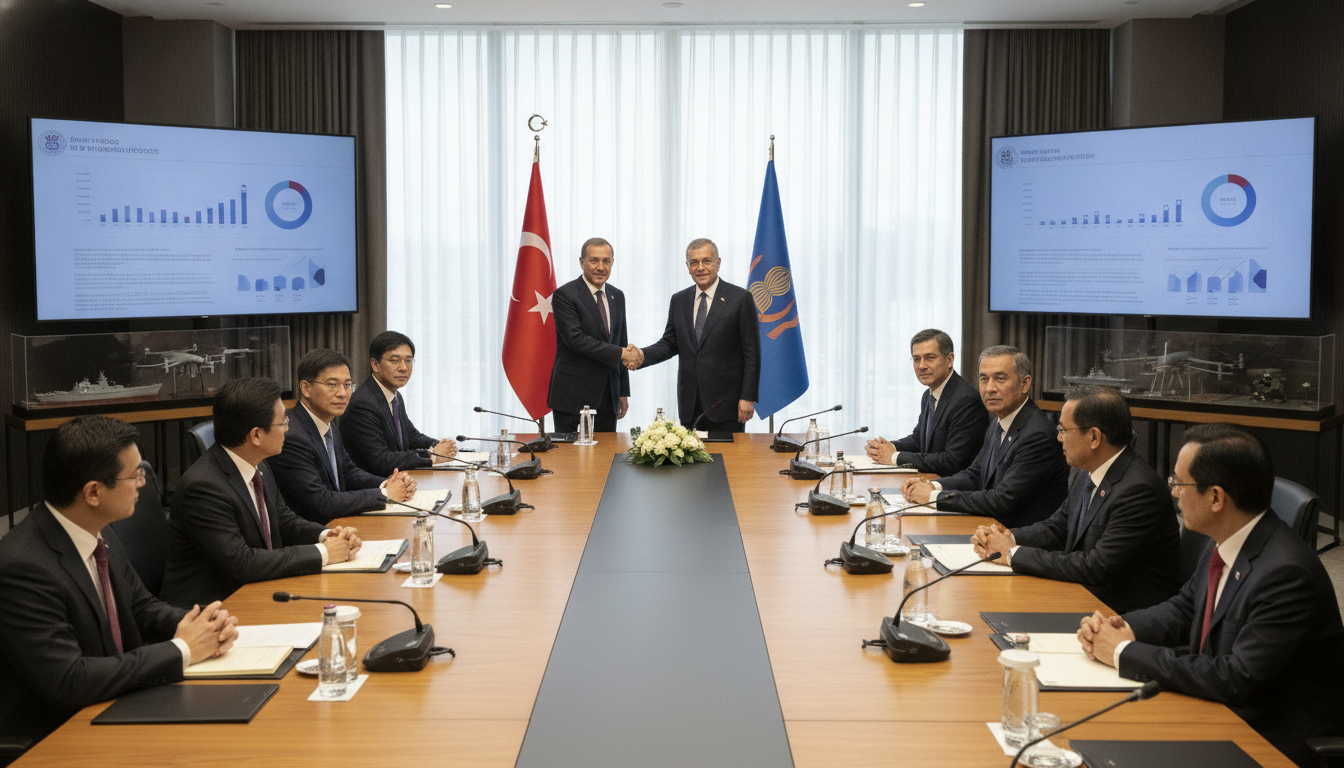
Turkey confirmed as ASEAN’s 12th dialogue partner amid growing defence and trade ties
ASEAN has admitted Turkey as its 12th dialogue partner, a move that spotlights Ankara’s expanding defence industry and deepening trade links with Southeast Asia in late July 2026.
CANAKKALE, Turkey — ASEAN’s formal decision this month to admit Turkey as its 12th dialogue partner underscores Ankara’s rising economic and strategic engagement with Southeast Asia. Turkey as ASEAN dialogue partner will deepen institutional ties at a time when its defence manufacturing and commercial links to the region are growing. The move was framed by meetings in Canakkale and follows high-level exchanges between Turkish and ASEAN officials in July 2026.
Details of the ASEAN decision
The bloc’s approval establishes a formal framework for political, economic and security consultations between Turkey and ASEAN members. Dialogue partner status typically enables regular ministerial-level meetings, working groups and sectoral cooperation, providing Ankara a structured channel into regional policy discussions. ASEAN officials signalled that the decision reflects both evolving trade patterns and a desire to broaden the bloc’s external partnerships.
Diplomatic context in Canakkale
Turkish officials used events in Canakkale in late July to present Ankara’s case for closer ASEAN ties, accompanied by delegations from several Southeast Asian countries. Turkish Deputy Foreign Minister Berris Ekinci met Philippine and ASEAN representatives on July 22, illustrating the diplomatic outreach behind the move. ASEAN’s Political-Security Community office participated in the exchanges, highlighting the decision’s political as well as economic dimension.
Economic and trade drivers
Turkey’s trade with Southeast Asia has expanded in recent years, driven by agricultural goods, manufactured products and investment flows. Business communities in both regions have pointed to growing demand for Turkish consumer and industrial goods across several ASEAN markets. Economic analysts say formal dialogue partner status is likely to accelerate regulatory cooperation, customs facilitation and initiatives to boost two-way investment.
Growth of Turkey’s defence industry
A key rationale cited by analysts for Ankara’s new standing with ASEAN is the maturation of Turkey’s defence sector and its export footprint. Turkish companies have increased sales of vehicles, electronic systems and unmanned platforms to partners beyond Europe, and defence ties are now a factor in diplomatic outreach. ASEAN members have varying defence procurement needs, and observers expect that technical and industrial cooperation discussions will form part of the new dialogue.
Balancing NATO membership with Asian engagement
Turkey’s accession to the dialogue partner list highlights its strategy of balancing long-standing Western alliances with deeper engagement in Asia. As a NATO member, Ankara maintains security commitments with the North Atlantic alliance while pursuing independent economic and diplomatic ties across Eurasia. Diplomats note that ASEAN partnership does not alter Turkey’s NATO obligations, but it does broaden Ankara’s multilateral footprint and offers additional venues for cooperation on regional security challenges.
Regional responses and potential hurdles
Reactions among ASEAN capitals were measured but generally receptive, with officials welcoming the prospect of enhanced trade and practical cooperation. Some analysts caution that substantive progress will depend on translating diplomatic access into concrete agreements on trade, standards and defence transparency. Differences in political systems and procurement practices across ASEAN could complicate rapid integration, underscoring the need for patient, rules-based engagement.
Practical issues such as tariff harmonization, certification standards and export controls will require dedicated working groups to ensure that commercial and security cooperation do not run afoul of existing commitments. Observers also expect civil-society and business consultations to play a role as the partnership moves from ceremonial recognition to programmatic activity.
The decision to deepen ties arrives amid a wider era of external outreach by both ASEAN and Ankara, each seeking diversified partners in a multipolar environment. Turkey as ASEAN dialogue partner is an expression of that mutual interest and a test of whether new channels can yield measurable economic and strategic dividends for both sides.
The immediate next steps will focus on establishing contact mechanisms, setting agendas for sectoral cooperation and scheduling the first formal meetings under the dialogue partner framework. Officials from Turkey and ASEAN are expected to outline priority areas in coming months, with trade facilitation, defence-industrial cooperation and cultural exchanges likely to receive early attention.
The admission of Turkey marks a notable expansion of ASEAN’s external partnerships and offers Ankara a reinforced presence in Southeast Asia that complements its ties to NATO and Europe. How effectively both sides convert expanded diplomatic access into tangible projects will determine whether this latest partnership reshapes trade patterns and security cooperation across the region.

