
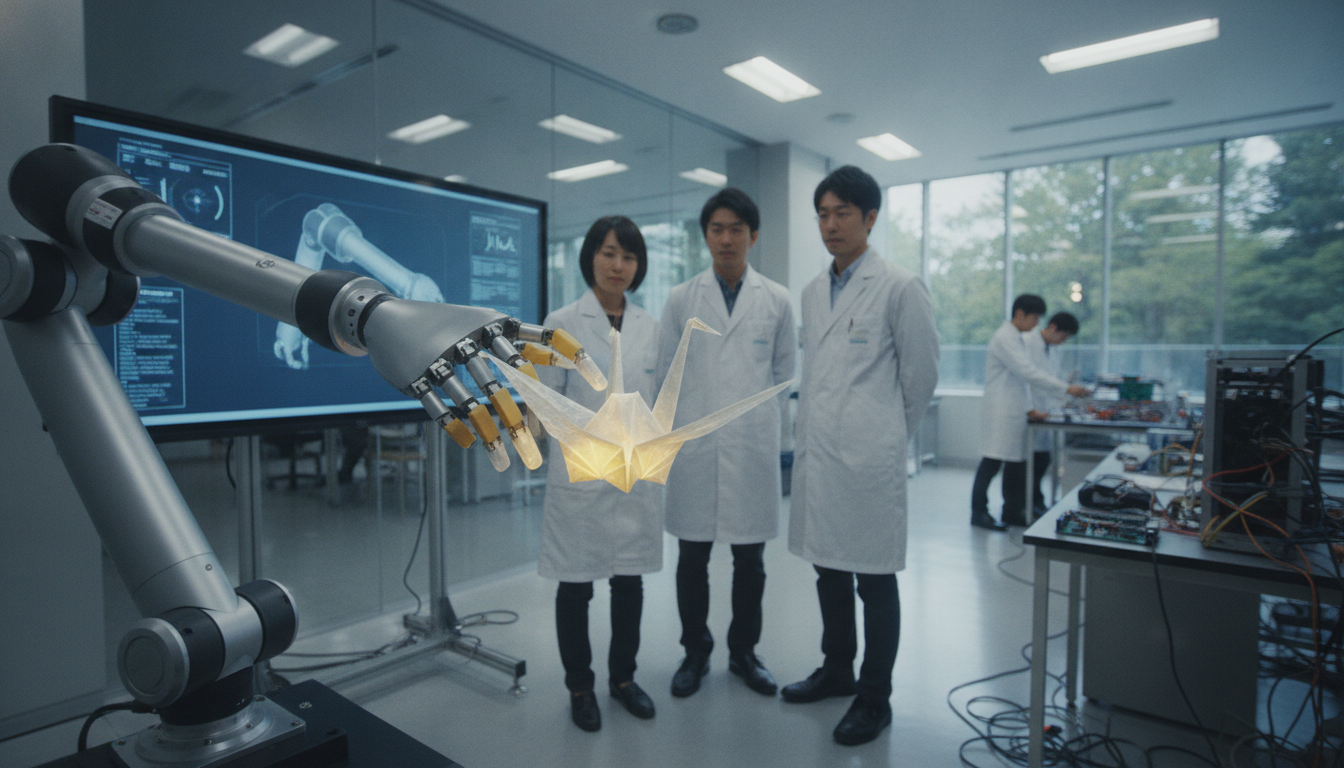
Japanese university startups push physical artificial intelligence into commercial use
Japanese university startups commercialize physical artificial intelligence for human-like robotic grasping, drawing Toyota interest to ease labour shortages.
Osaka-based research teams and spinouts are racing to commercialize physical artificial intelligence that enables robots to handle objects with human-like dexterity. The technology, developed in university labs, has drawn attention from major manufacturers including Toyota Motor for its potential to reduce manual labour in sectors from assembly to food service. Early demonstrations show robots performing delicate tasks such as holding sushi, signalling a shift from software-only AI to systems that combine tactile sensing, control algorithms and mechanical design.
University spinouts move from lab demonstrations to products
Japanese universities have long been centres of robotics research, and this wave of spinouts is focused on turning experimental rigs into market-ready devices. Founders typically emerge from graduate labs and secure seed funding to develop sensors and grippers that mimic the flexibility of human fingers. Their goal is not merely to automate fixed, repetitive motions but to provide adaptable, safe manipulation that can work alongside people in unpredictable settings.
Many teams emphasize that physical artificial intelligence requires integrated advances in hardware and software rather than improvements in algorithms alone. Developers are combining machine learning with novel tactile sensors, force-feedback control, and lightweight actuation to enable soft, compliant grasps. The result is a class of robots that can adjust grip strength and finger positioning in real time as an object is sensed and moved.
Demonstrations highlight delicate handling like food and consumer goods
Public demonstrations in Osaka and Tokyo have showcased robots picking up fragile items without crushing them and arranging irregularly shaped goods on conveyors. One well-publicized prototype delicately held a piece of sushi, illustrating how tactile sensing and adaptive control can protect soft surfaces. These demonstrations are designed to attract commercial partners by proving that the technology can meet the nuanced demands of food handling, retail logistics and small-part assembly.
Industry observers say such use cases are important because they involve complex contact dynamics that traditional automation struggles with. Unlike fixed tooling or strict fixture-based automation, grasping technology must cope with variations in size, texture, and orientation. Startups argue that once the robots can reliably perform in these contexts, adoption in other sectors should accelerate.
Toyota and manufacturers signal commercial interest
Several large manufacturers have engaged with university teams through pilot projects, licensing talks and strategic investments, according to people familiar with the discussions. Toyota Motor has been mentioned among companies exploring collaborations to integrate advanced grasping capabilities into their production lines. Corporate interest is driven by a need to supplement a shrinking workforce and to raise automation levels where conventional robotics cannot reach.
For manufacturers, the appeal lies in flexible automation that reduces dependency on bespoke fixtures and long changeover times. By deploying robots with human-like grasping, factories could handle mixed-model production and small-batch runs with fewer manual interventions. Early pilots are expected to focus on peripheral tasks adjacent to core assembly, allowing companies to evaluate reliability before broader rollouts.
Funding, partnerships and routes to market
To bridge the gap from prototype to product, startups are seeking partnerships with equipment makers, integrators and established automation vendors. Venture capital and corporate seed investments have supported rounds of development, while some teams have signed memoranda with industrial partners for joint testing. Founders say route-to-market strategies include offering grippers and sensing modules to integrators as retrofit packages as well as selling complete cobot systems.
Regulatory and standards work is also beginning as companies and partners consider safety certification and interoperability. Startups plan staged commercialisation: first selling to niche applications where human-like touch is essential, then expanding into broader manufacturing and service sectors as costs decline and reliability improves.
Technical and commercial hurdles remain
Despite rapid progress, researchers and executives acknowledge persistent challenges before widespread adoption. Tactile sensors must be robust over long duty cycles, control algorithms need to handle noisy real-world inputs, and systems must be economically competitive with existing automation. Integration with factory software, cyber-security protections, and maintenance ecosystems are additional practical hurdles for newcomers.
Workforce implications also complicate the picture, as companies and policymakers must design training and redeployment programmes for workers whose tasks are affected by new technology. Startups emphasise that their systems are intended to augment human labour — handling the most repetitive or ergonomically risky tasks — rather than replace skilled operators entirely.
Commercial pilots are underway in select plants and service operations, and the results will shape investor confidence and manufacturer adoption. Observers expect an incremental rollout over several years rather than instant transformation, with the pace depending on reliability improvements and cost reductions.
Physical artificial intelligence for manipulation represents a significant shift in how robots are conceived and used in industry. As Japanese university spinouts move from demonstrations to early commercial deals, they will test whether adaptive, touch-enabled robots can deliver on promises of flexibility and labour relief. The coming months of pilot deployments and corporate partnerships will be crucial for determining how quickly the technology moves from specialized niches into mainstream industrial practice.

