
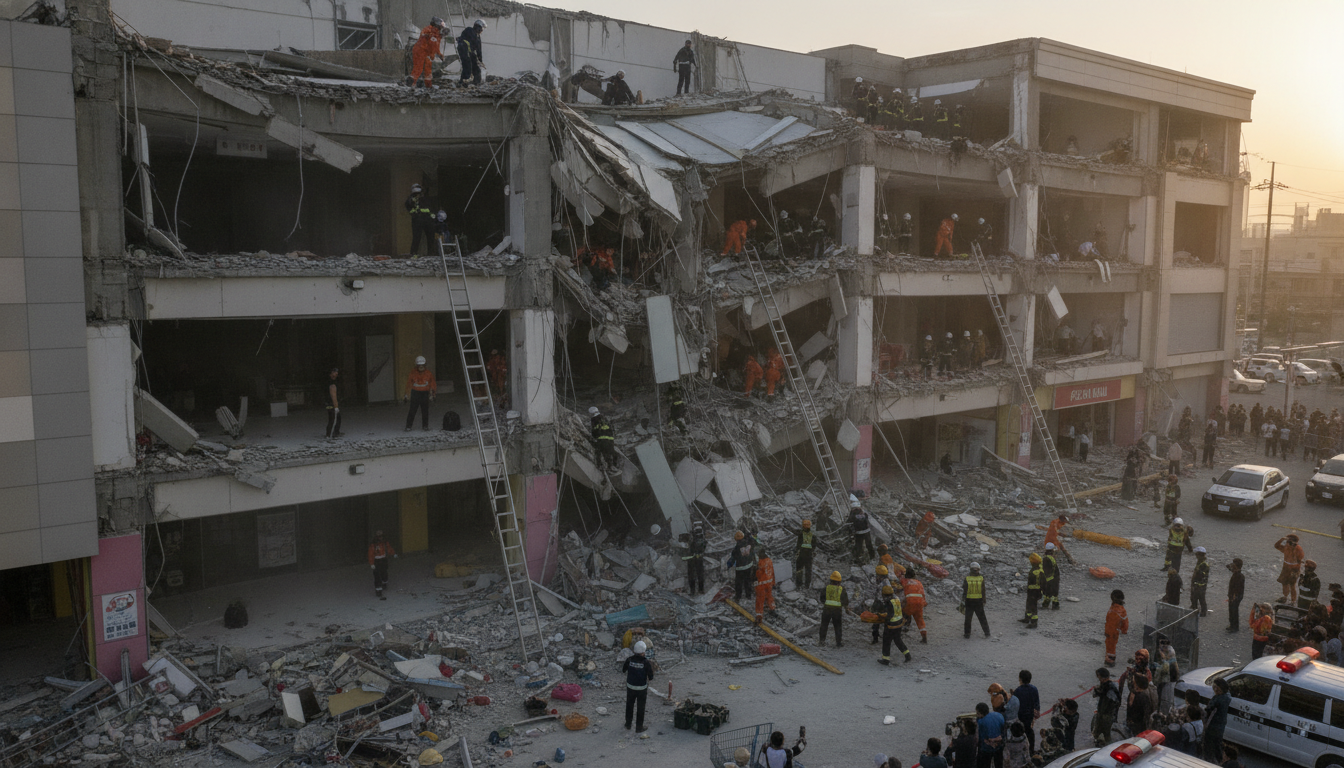
Kumamoto earthquake collapses Aeon Mall second floor; dozens trapped, search under way
Kumamoto earthquake July 28, 2026: Aeon Mall collapse left dozens trapped; search-and-rescue underway and tsunami advisory for Ariake Sea was briefly issued.
The Kumamoto earthquake struck on July 28, 2026 at about 4:30 p.m. JST, unleashing violent shaking across central Kumamoto Prefecture and causing major structural damage, including a partial collapse at Aeon Mall Kumamoto. Eyewitnesses and local officials reported explosions and multiple people trapped inside the shopping complex in Kashima (嘉島町). Emergency services mobilized immediately to begin search-and-rescue operations amid concerns about further collapses and aftershocks.
Collapse at Aeon Mall Kumamoto
The two-story section of Aeon Mall Kumamoto suffered a collapse on its second floor, with video and images showing rubble and heavy smoke rising from the site. Local broadcasters provided footage indicating an apparent explosion inside the mall that preceded or accompanied the structural failure.
Mall staff and customers described chaotic scenes as shoppers fled, and several people were reported to be trapped in the debris; precise casualty figures remained unconfirmed in initial reports. Rescue crews focused on stabilizing damaged areas and attempting to reach enclosed spaces where survivors may be located.
Search-and-rescue operations launched in Kashima
Firefighters, police and other emergency workers began coordinated searches after the quake, prioritizing the mall and other heavily affected buildings in Kashima and nearby towns. Teams used heavy equipment, search dogs and thermal imaging where possible to locate people buried under rubble.
Local authorities set up incident command points and issued evacuation guidance for residents near collapsed or damaged structures, while hospitals prepared to receive injured people. Officials warned that access to some areas was restricted for safety and urged the public to follow official instructions.
Tsunami advisory issued then lifted for Ariake Sea
Following the quake, meteorological authorities issued a tsunami advisory for the Ariake Sea and parts of the Yatsushiro Bay area, prompting coastal evacuations and warnings to avoid shorelines. The advisory was later lifted after monitoring showed no significant tsunami impact, but officials continued to caution residents to stay alert for changes.
Coastal communities were advised to remain prepared for possible sea-level disturbances, and port operations were temporarily suspended in affected zones pending inspections. The advisory sequence underscored the dual risks of land damage and potential sea hazards after large inland quakes.
Geological context points to Hinagu fault zone
Seismologists indicated that the tremor’s epicenter was in Kumamoto Prefecture and that the event likely involved the Hinagu fault zone, a known active fault line that has been monitored for years. Experts have long warned that stresses along linked fault segments, including extensions of faults responsible for earlier quakes, can produce large, damaging earthquakes.
The region’s seismic history, including major events a decade earlier, has informed preparedness efforts, but the new rupture highlights ongoing seismic risk and the importance of rapid assessments of fault movement and infrastructure vulnerability.
Widespread damage reported beyond the mall
In addition to the Aeon Mall collapse, reports from across Kumamoto included toppled chimneys, collapsed walls and damaged bridges, particularly in Yatsushiro and surrounding municipalities. Local broadcasters showed a leaning chimney and scattered debris, signaling significant impact to industrial and residential structures.
Authorities issued warnings about unstable buildings and utilities, and gas and fire services advised residents to shut off supplies if they detected leaks. Power outages and disrupted transportation further complicated rescue and relief operations in the immediate aftermath.
Officials caution against misinformation on social media
Local governments and broadcasters urged residents to rely on verified information from official channels as social media quickly circulated unconfirmed reports and rumors. Authorities emphasized that premature or false posts could hamper rescue efforts and stressed the need to verify messages before sharing.
Emergency hotlines and municipal websites were listed as primary sources for shelter locations, evacuation orders and safety guidance. Officials also sought cooperation from the public to report missing persons through designated numbers rather than through informal networks.
Rescue teams and local authorities continue to focus on reaching those trapped, securing damaged structures and restoring critical services as aftershocks and logistical challenges complicate operations. Emergency centers have been activated across Kumamoto Prefecture to coordinate relief, and residents are being advised to prepare for further tremors, follow evacuation instructions, and await updates from official sources.

