
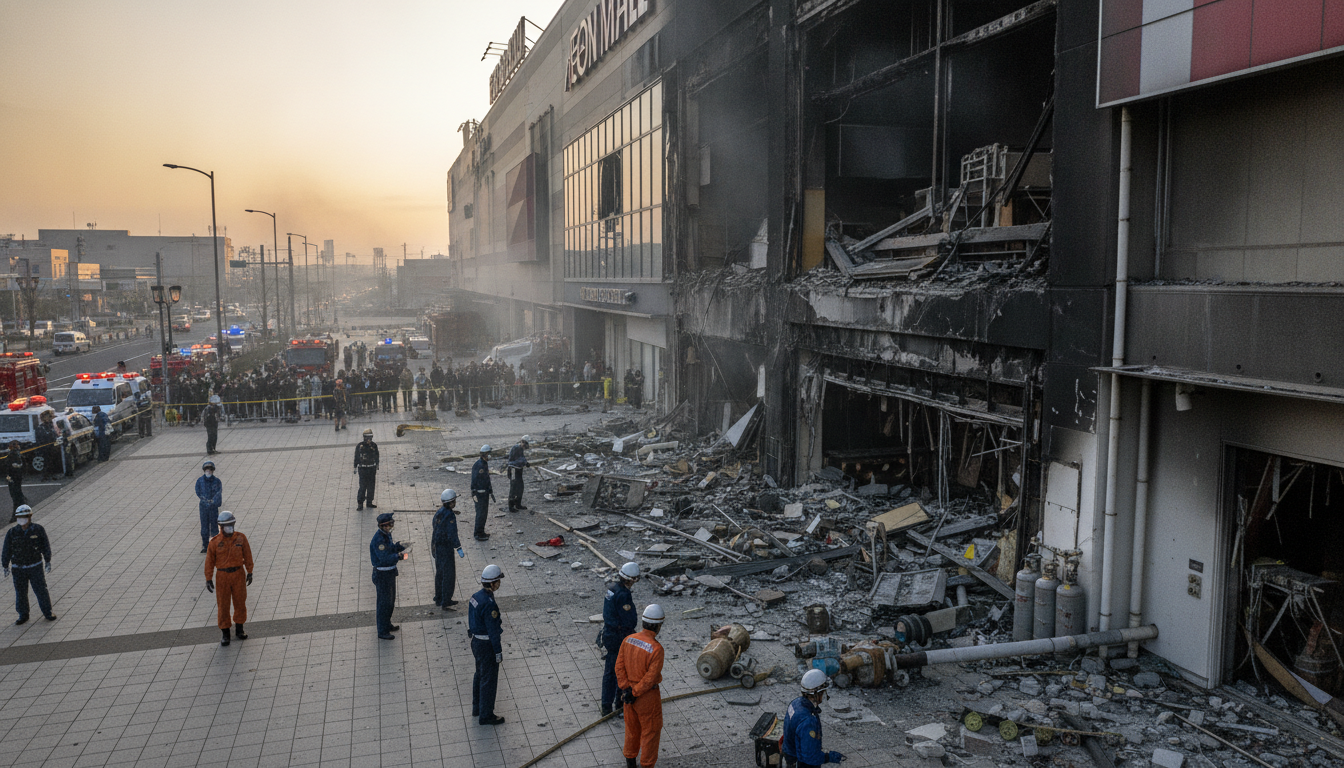
Aeon Mall Kumamoto explosion linked to suspected LP gas leak after July 28 earthquake
Explosion at Aeon Mall Kumamoto after July 28, 2026 earthquake likely from an LP gas leak; experts cite gas buildup, blast-driven wall collapse and investigations.
The Aeon Mall Kumamoto explosion occurred on July 28, 2026, following a powerful earthquake that struck Kumamoto Prefecture, causing a large blast that tore through part of the shopping complex. Government officials have said the blast may have been triggered by a leak of liquefied petroleum (LP) gas from building equipment, a theory that rescue teams and experts are examining. The incident left sections of the mall’s second floor and surrounding structures severely damaged and prompted an overnight search for survivors and an immediate safety response.
Damage pattern and building collapse
Initial on-site assessments showed the most extensive structural failure concentrated around the mall’s second-floor areas, where walls were blasted outward and interior fittings were heavily deformed. Investigators noted that windows and non-reinforced partitions had been shattered, while entire wall sections were knocked free, suggesting a powerful internal overpressure at the moment of ignition. Drone and police footage released to the media captured collapsed storefronts and debris fields extending into both the mall interior and adjacent outdoor areas.
Government statements and on-site actions
Senior administration figures publicly indicated that gas from the building’s equipment is a leading candidate cause, and government sources reported that responders entered the site only after the main gas valves were shut. Officials said gas had apparently accumulated within enclosed spaces of the structure, increasing the risk to both trapped people and rescue teams. AEON held a company briefing on July 29, 2026; company executives expressed deep regret over the casualties and damage and said they were cooperating with authorities during the investigation.
Expert view on gas accumulation and ignition
Toshio Motegi, a fire and explosion safety specialist at the University of Tokyo, said the pattern of damage is consistent with combustion of a flammable gas that had pooled in low or enclosed areas and then mixed with air. He explained that when combustible vapor lingers and an ignition source is present, the resulting deflagration or explosion can produce high internal pressures that destroy lightweight partitions and, in some cases, blow out entire wall panels. Motegi added that the absence of fragile window glazing or pressure-relief openings can allow internal pressure to build to a level that damages load-bearing elements, explaining why walls rather than isolated fixtures failed.
How mall architecture may have amplified the blast
The mall’s interior, featuring a two-story atrium and open sightlines between the first and second floors, appears to have influenced how blast pressure moved through the building. Experts suggest an explosion originating in a back-of-house or service corridor could have ruptured internal walls, allowing blast overpressure to propagate rapidly into retail areas and out through external facades. Structural engineers now examining the site are focusing on ventilation routes, service ducts and service-room layouts to determine where gas might have pooled and how shock waves traveled through the open-plan spaces.
Rescue, video evidence and public safety measures
Police and emergency crews conducted round-the-clock search operations after the blast, prioritizing life-saving rescues while monitoring for secondary hazards such as fire, lingering gas and aftershocks. Authorities released interior video footage from shortly after the explosion to aid the investigation and to build a clearer timeline of events. Local officials also established a perimeter around the site, ordered nearby evacuations where gas odor was reported, and advised residents to avoid the area until structural engineers and hazardous-material teams confirmed it was safe.
Investigations, regulatory scrutiny and next steps
Multiple agencies have launched inquiries into the cause of the Aeon Mall Kumamoto explosion, including prefectural fire authorities, police investigators and national safety regulators with jurisdiction over fuel installations. Inspectors are expected to examine LP gas piping, valves, storage and emergency shutoff systems, as well as maintenance records and compliance with seismic safety rules. Legal and regulatory consequences could follow if negligence, faulty equipment or lapses in inspection are identified; regulators have said they will publish findings as soon as evidence supports definitive conclusions.
Across Japan, the incident is likely to prompt renewed examination of LP gas use in commercial complexes, particularly in seismic-prone regions where ground motion can damage supply lines and valves. Building operators and local governments may face calls to accelerate installation of automatic seismic shutoff valves, improve ventilation in service spaces, and conduct more frequent emergency drills for tenants and staff. The case also underscores the challenge of managing multiple simultaneous hazards—earthquake, structural damage and fuel leaks—during large-scale rescues.
Authorities say it will take days to assemble a complete picture of what led to the blast, and they emphasize that key technical analyses remain under way. The emergency response continues, survivors are being supported by local services, and investigators have appealed for anyone with information or footage from the mall area on July 28, 2026 to come forward to assist efforts to determine the exact sequence of events.

