
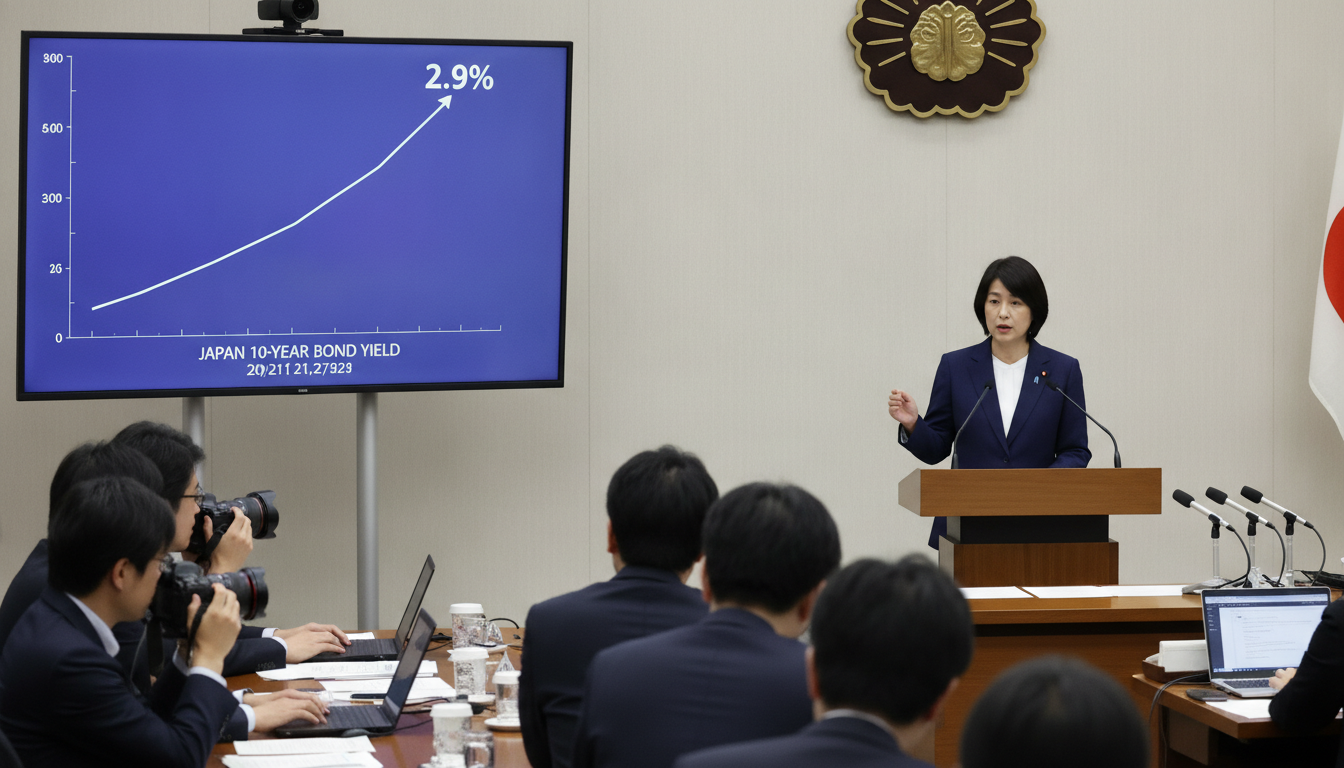
Long-term interest rates surge under Takaichi government amid planned food tax cut
Long-term interest rates have spiked under Prime Minister Sanae Takaichi; 10-year JGBs reached 2.90% and a food consumption tax cut is planned for April 2027.
The rise in long-term interest rates under Prime Minister Sanae Takaichi has accelerated sharply since her administration took office, with the 10-year Japanese government bond yield briefly touching 2.90% on July 9, 2026. Markets are reacting to a combination of fiscal signals from the new government and shifting investor expectations about future supply and policy, driving yields higher in a notably short span. Policymakers’ plans to cut the consumption tax on food to 1% from April 2027 have intensified scrutiny of Japan’s fiscal trajectory and the outlook for borrowing costs.
10-year JGB yield spike and recent market moves
On July 9, 2026, the yield on newly issued 10-year government bonds briefly climbed to 2.90%, a level not seen in roughly three decades. That jump represented more than a one percentage point increase since the start of the current administration, underscoring the speed of the market’s repricing. Traders and investors cited a reassessment of fiscal and policy risks as central drivers of the move.
Liquidity conditions and risk sentiment amplified the reaction, with demand for long-duration paper weakening as expectations for higher future issuance and looser fiscal discipline took hold. The rapid rise in yields has tightened financing costs for a range of borrowers and prompted renewed debate in financial circles about the sustainability of low long-term rates. Market participants now watch auction outcomes and swap spreads closely for signs of further repricing.
Planned food consumption tax cut and fiscal implications
The Takaichi cabinet is reported to be preparing a policy to cut the consumption tax on food to 1% beginning April 1, 2027, a measure intended to cushion households from living-cost pressures. While aimed at providing near-term relief, the cut would reduce central government revenues and could increase the need for additional bond issuance. That prospect has been a central factor in investors’ decisions to demand higher yields on long-term sovereign debt.
Analysts say the fiscal cost of a targeted tax reduction depends on offsets the government may identify, such as spending reductions or alternative revenue measures. Absent credible compensatory measures, markets tend to interpret a permanent or large temporary tax cut as a signal of looser fiscal policy. That interpretation raises the sovereign risk premium embedded in long-term interest rates.
How fiscal signals are transmitted to long-term interest rates
Long-term interest rates move when investors adjust expectations about future inflation, central-bank policy and government borrowing needs, all of which create a composite “term premium.” Announcements or credible signals of fiscal stimulus can push up the expected path of issuance and inflation, prompting a higher term premium. In Japan’s case, the confluence of a new administration and explicit tax-policy changes has shifted that calculation.
The speed of the current adjustment also reflects positioning and sentiment: once yields begin to move, leveraged players and foreign investors can amplify the trend through trading strategies and portfolio rebalancing. Market commentators have noted that supply concerns and the absence of an immediate, detailed financing plan can magnify the response of long-term interest rates to fiscal news.
Monetary policy expectations and central bank constraints
Expectations about future central-bank behavior influence long-term yields even when monetary policy has not officially shifted. If investors believe that fiscal looseness will eventually force tighter monetary policy to contain inflation, they will price that possibility into long yields today. The interplay between fiscal signals and anticipated monetary responses is therefore a key channel shaping the current move in long-term interest rates.
Officials and analysts caution that central banks face trade-offs when fiscal policy becomes more expansionary, as they must weigh credit conditions against growth and inflation risks. Market observers are monitoring any commentary from monetary authorities for clues on whether and when they may alter guidance or intervene in bond markets to stabilize rates.
Domestic and external risks to Japan’s sovereign financing outlook
A sustained uptick in long-term interest rates would raise borrowing costs for the government and could put pressure on public finances over the medium term. That dynamic elevates concerns about fiscal sustainability and could affect credit conditions for private borrowers and financial institutions. External developments—such as global rate cycles and currency movements—could further amplify domestic rate volatility.
Investors also flag the importance of transparent, credible fiscal planning in calming markets, including clear projections for revenue losses from tax measures and concrete offsetting steps. Absent such clarity, markets may continue to demand higher yields as a risk premium for uncertainty about future debt dynamics.
Policy clarity and market responses will determine whether the recent surge in long-term interest rates becomes a persistent shift or a temporary correction. The government’s next fiscal statements and bond-auction results will be closely watched by domestic and international investors.
The coming months will be decisive for Japan’s interest-rate outlook as policymakers balance social policy aims with fiscal discipline and financial stability concerns. Markets will be particularly attentive to detailed implementation plans for the April 2027 tax change and any signals from monetary authorities about their tolerance for higher long-term interest rates.

