
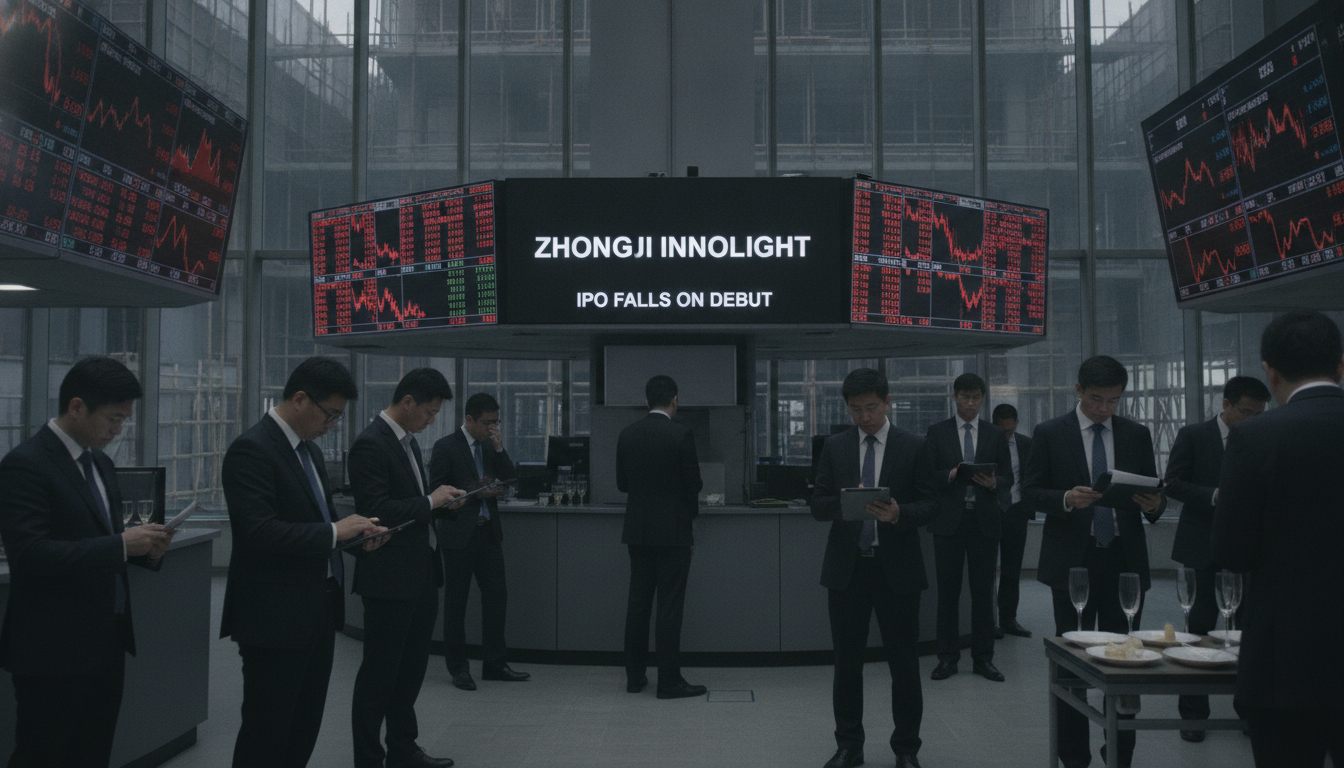
Zhongji Innolight IPO Falters as Shares Slip on Hong Kong Debut Despite HK$53.4 Billion Raise
Zhongji Innolight IPO raised HK$53.4 billion in Hong Kong, but shares fell on debut as investors worry AI tech buildout may exceed near-term demand overall.
Zhongji Innolight’s Hong Kong listing drew significant attention on July 30, 2026, after the optical parts maker completed one of Asia’s largest IPOs this year. The Zhongji Innolight IPO raised HK$53.4 billion, yet the share price slipped on its first day of trading, underscoring investor caution around the pace of AI-related technology expansion. Company executives marked the listing with a ceremony in Hong Kong, but early market reactions reflected concern about near-term demand for the hardware that underpins AI infrastructure.
Shares Slide on Hong Kong Debut
Shares in Zhongji Innolight fell in their opening session, weighing on what had been one of the year’s most prominent public offerings in Asia. The drop followed heavy initial demand in the subscription phase, suggesting some investors chose to cash in gains or rebalance exposure once trading began. Market participants said the price action highlighted the thin line between enthusiasm for AI-related stocks and sensitivity to short-term profit-taking.
The listing was closely watched because of its size and the company’s role in supplying components used in AI data centers. Company leadership, including Chairman and President Liu Sheng, attended the listing ceremony in Hong Kong on July 30, 2026, emphasizing the strategic importance of the market. Despite ceremonial fanfare, early trading suggested investors remain focused on fundamentals rather than headline fundraising figures.
Investors Cite Tech Buildout Concerns
Market commentary after the debut pointed to worries that rapid technology buildouts could outstrip immediate demand for optical modules and related gear. Analysts said investors are assessing how quickly hyperscale customers will convert AI model growth into sustained purchases of components. That timing mismatch—between long-term structural demand for AI infrastructure and near-term procurement cycles—helped explain the cautious reception.
Some portfolio managers also expressed sensitivity to valuation levels in the current IPO, arguing that large capital raises can magnify downside risk if revenue ramps slower than projected. Those concerns were compounded by broader market volatility and shifting liquidity conditions that often affect newly listed technology names.
Company Profile and AI-Related Products
Zhongji Innolight is known for manufacturing optical components and modules used in high-speed data transmission and AI computing centers. The company supplies parts that are integral to server-to-server communications and large-scale networking, positioning it as a supplier to hyperscalers and telecom equipment makers. Its products are widely regarded as part of the infrastructure enabling advanced AI workloads that require rapid, high-capacity data flows.
The firm’s market positioning as an AI-related equipment supplier was a central selling point in the IPO narrative, attracting demand from investors seeking exposure to the AI hardware ecosystem. However, the degree to which end-market customers accelerate procurement will be critical to turning that strategic positioning into steady revenue growth.
Proceeds and Strategic Priorities
The substantial proceeds from the Zhongji Innolight IPO provide the company with significant financial flexibility as it pursues capacity expansion and product development. Market observers noted that companies in the optical components space typically allocate funds to scale production, enhance research and development, and broaden geographic reach. For Zhongji Innolight, the capital infusion could support manufacturing upgrades and deepen its technology roadmap, analysts said.
At the same time, investors emphasized that the effective deployment of funds will be judged against execution and timing risks. If investments are made ahead of sustained customer orders, the company could face pressure on margins and returns, a dynamic that often underpins early stock volatility following large listings.
Hong Kong Market Context and Comparable Deals
The IPO ranks among Asia’s largest so far this year and underscores Hong Kong’s role as a leading listing venue for China-based technology firms. The city continues to attract major offerings from companies seeking international investor bases, regulatory familiarity, and deep capital pools. Zhongji Innolight’s deal was notable for its scale, drawing comparisons with other sizable tech listings that have tested investor appetite in 2026.
Still, the broader backdrop for IPOs has been mixed, with some recent entrants experiencing choppy beginnings amid changing macroeconomic signals. That environment has made investors more selective, particularly for capital-intensive businesses tied to cyclical hardware spending.
Analyst Perspectives on Near-Term Outlook
Analysts tracking Zhongji Innolight said the company’s mid- to long-term prospects remain tied to secular growth in AI computing and data-center traffic. Over several years, sustained adoption of large language models and other AI applications is expected to drive demand for high-speed optical transmission, which could favor well-positioned suppliers. However, near-term revenue trajectories will depend on order timing and the pace at which customers refresh or expand their infrastructure.
Policy shifts, supply-chain dynamics, and competitive moves also rank among the risks analysts flagged for the stock’s short-term performance. For now, market watchers expect elevated volatility as investors digest the company’s disclosures, capitalization, and the broader demand signal from cloud and telecom customers.
The Zhongji Innolight IPO underscores the complex interplay between investor enthusiasm for AI-related plays and the practical timing of hardware procurement, leaving the company’s next quarters under close scrutiny as markets assess whether the fundraising will translate quickly into durable revenue growth.

