
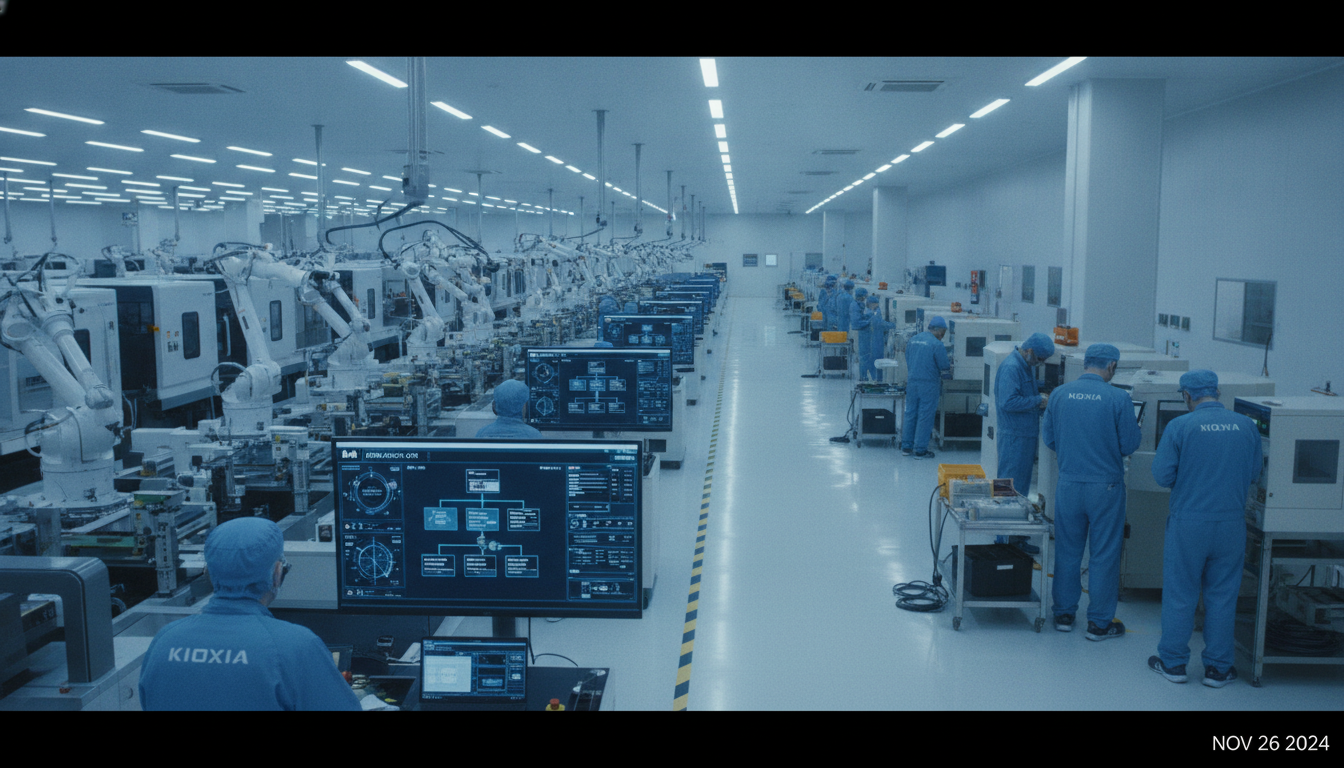
Memory manufacturers pour funds into new capacity as AI demand surges
Memory manufacturers ramp up capacity as AI spending from U.S. tech giants boosts demand, with Micron, SK Hynix, Samsung and Kioxia expanding production.
Memory manufacturers are accelerating large-scale capacity investments as a wave of artificial intelligence spending by U.S. tech giants lifts demand for memory chips. Companies including Micron, SK Hynix and Samsung have announced or signaled major expansion plans, while Kioxia is investing to catch up with rivals. The rush reflects a broader industry effort to secure supply for AI servers and accelerate production of DRAM and NAND memory used in data centers.
AI spending and the memory demand surge
The recent surge in AI development and deployment has pushed cloud providers and hyperscalers to buy more memory modules to support training and inference workloads. Memory manufacturers are responding by directing cash flows into new fabs, equipment and advanced process technologies to increase throughput and capacity. Industry analysts say the demand profile for high-bandwidth memory and server-grade DRAM has changed the near-term production priorities of major suppliers.
The shift in spending patterns has shortened the lead times for capacity decisions and prompted faster rollouts of new production lines. Suppliers are also prioritizing wafer starts and yield improvements for chips tailored to AI systems, which typically require larger memory pools and faster access speeds. These moves aim to prevent bottlenecks that could slow AI rollouts in 2026 and beyond.
Major suppliers expand production lines
Micron, SK Hynix and Samsung — the largest DRAM and NAND vendors — have each outlined expansion strategies to capture the rising AI-related market. These firms are increasing wafer fabrication, retooling existing lines, and accelerating deployment of next-generation memory technologies. The investments are intended to secure customer commitments from cloud providers and hardware makers that expect sustained growth in AI compute needs.
Production increases are being coordinated with equipment suppliers and chip assembly partners to manage ramp risks and maintain supply chain continuity. Companies are balancing near-term volume gains with longer-term transitions to more advanced nodes that promise higher performance per watt. That balance is critical as memory demand remains concentrated in high-performance server applications.
Kioxia accelerates to close the gap
Kioxia, a major Japanese memory vendor, is positioning itself to close a competitive gap after a period of underinvestment relative to global peers. The company has moved to expand capacity and catch up on development of new NAND processes to meet AI-driven requirements. Executives and industry observers say Kioxia’s strategy combines capital spending with partnerships to accelerate time to volume.
This catch-up is important for customers seeking diversified supply sources amid geopolitical concerns and shifting industrial policy. Kioxia’s investments aim to ensure it can serve both traditional client segments and the growing AI market without ceding long-term share to competitors. The company’s progress will be watched closely by regional governments and large enterprise buyers.
Supply dynamics and pricing outlook
The capacity investments are likely to reshape supply dynamics in the memory market, with potential impacts on pricing and inventory cycles. Increased production could ease shortages that previously pushed up prices, but the timing of new capacity coming online will determine whether supply outpaces demand. Market participants warn that a rapid expansion without matching end-user demand could lead to oversupply and price pressure.
Memory suppliers are therefore pacing rollouts to avoid sharp cyclical swings, while trying to capture premium segments tied to AI performance. The industry remains sensitive to demand volatility from cloud providers, who can swing ordering patterns rapidly as projects scale up or pause. For now, most suppliers appear confident that AI-driven growth will sustain demand for higher-performance memory products.
Policy, supply chains and regional considerations
Government industrial policy and supply-chain resilience are influencing investment decisions across the memory industry. Subsidies, export controls and local incentives in the U.S., Korea, Japan and other markets have factored into where and how companies deploy capital. These policy choices affect not only factory locations but also partnerships for equipment, testing and packaging capabilities.
Manufacturers are also restructuring supply chains to reduce single-country dependencies and to qualify alternate suppliers for critical inputs. That process can slow capacity ramps in the short term but aims to build more robust long-term production. Regional stakeholders, including national governments and large corporate customers, are increasingly engaged in planning expansion timelines and capacity commitments.
Market outlook and risks for manufacturers
Looking ahead, the memory market’s trajectory will hinge on sustained AI investment by cloud providers, enterprise adoption of on-premises AI, and the pace of technological change. Manufacturers face execution risks in scaling new fabs, achieving target yields and managing capital intensity. At the same time, rapid innovation in memory architectures and packaging could create new opportunities for vendors that move quickly.
Another risk is demand concentration: heavy reliance on a few hyperscale customers could expose suppliers to sudden order fluctuations. Companies are therefore diversifying product portfolios and pursuing long-term contracts to stabilize revenue streams. How well suppliers balance capacity growth, technology migration and price discipline will determine profitability in the next several years.
Memory manufacturers are now at the center of an industry reshaping driven by AI computing needs. The coming quarters will reveal whether the investment wave sustainably expands supply for data centers or creates new cycles of oversupply and consolidation. As suppliers invest and governments weigh strategic priorities, customers and policymakers will be watching the evolution of the global memory landscape.

