
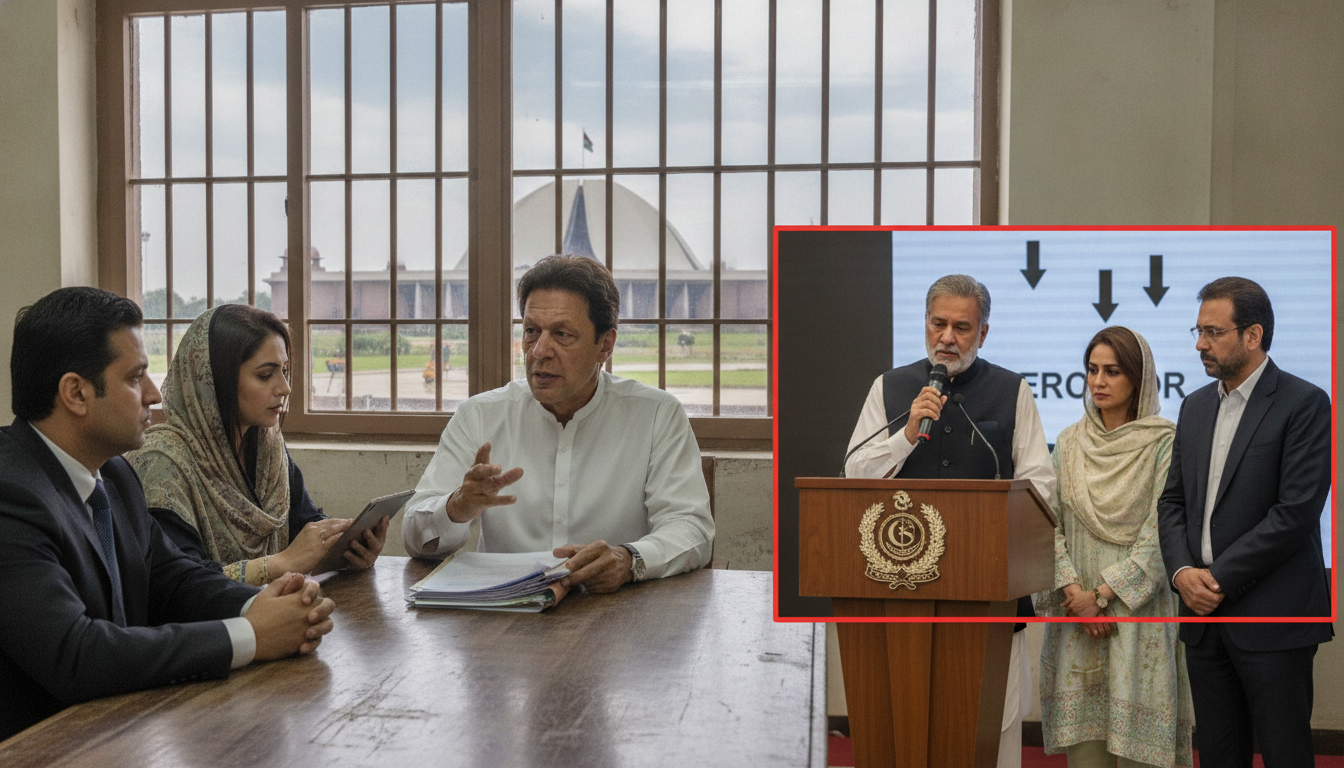
Imran Khan Maintains Opposition Leadership from Prison as Ruling Establishment Admits Miscalculation
Imran Khan continues to lead Pakistan’s opposition from prison, underscoring the ruling establishment’s misjudgment after three years of incarceration that has failed to neutralize his political influence.
Imran Khan has continued to exert influence over Pakistan’s political landscape despite being confined to prison for three years. His Pakistan Tehreek-e-Insaf (PTI) movement remains a focal point for protests, voter mobilization and public debate, illustrating the limits of detention as a tool to sideline a prominent political figure. Officials within the ruling camp now acknowledge that their expectations of Khan’s political eclipse have proved overly optimistic. The persistence of his supporters and the party’s organizational resilience have complicated plans for a smooth consolidation of power by rival forces.
Imran Khan Continues to Drive Opposition Messaging
Imran Khan’s statements, relayed via party spokespeople and released communications, have continued to set the tone for PTI’s agenda. Party operatives say he remains involved in strategic decisions, messaging and candidate endorsements despite physical separation from party headquarters. The ability to influence rallies, campaign themes and public narratives has kept Khan central to opposition activity nationwide.
Supporters and local leaders report that Khan’s directives are treated as binding, shaping protests, election tactics and negotiations. Observers note that the sustained media attention around his imprisonment has amplified his voice rather than muffled it, allowing his claims and criticisms of the government to circulate widely.
Ruling Establishment Acknowledges Miscalculation
Officials tied to the ruling establishment now concede that their expectation—that incarceration would weaken Khan’s hold—has not materialized as planned. Senior figures privately describe a reassessment of tactics as they confront a politically mobilized electorate that still views Khan as a figurehead. The miscalculation has prompted debates within the establishment over how to recalibrate engagement with opposition forces.
Analysts say the admission reflects both political reality and operational limits; jailing a leader can remove them from the public square but cannot erase a movement’s networks or its grievances. The ruling coalition’s challenge is to maintain legitimacy and public order while managing an opposition that continues to command attention and loyalty.
Street Protests and Party Organization Remain Active
Grassroots PTI activity has persisted across urban centers and rural districts, with regular demonstrations and local organizing reported by party officials. These mobilizations have underscored the depth of Khan’s grassroots reach and the organizational capacity of his supporters. In many instances, local leaders have assumed greater autonomy in coordinating events and maintaining momentum.
Public gatherings periodically draw attention in provincial capitals and border regions, testing law enforcement responses and political tolerance. The recurring protests have kept the PTI in public view and provided a platform for young activists and local politicians to advance the party’s priorities in the absence of direct access to their leader.
Legal Battles and Political Strategy Intersect
Khan’s detention has been accompanied by a series of court cases and legal proceedings that continue to shape his political options. Lawyers for PTI contend that sustained legal pressure is both politically motivated and strategically consequential, while opponents argue it reflects accountability for alleged wrongdoing. The interplay between courtroom developments and street-level politics has become a defining feature of Pakistan’s contemporary contest.
Legal setbacks for Khan could limit his formal role in politics, but court victories or delays can also be spun into political capital and rallying points. Parties across the spectrum are watching case timetables closely as they shape campaign calendars and coalition strategies ahead of upcoming electoral cycles.
Regional and International Attention Grows
Imran Khan’s imprisonment and the ensuing political turbulence have drawn attention from regional capitals and international observers. Diplomatic missions and foreign governments have occasionally issued statements urging restraint, due process and respect for political freedoms. The international spotlight has increased scrutiny of Pakistan’s institutions and raised questions about the stability of its democratic processes.
Economic and security partners are attentive to the domestic fallout, given Pakistan’s strategic importance in the region. Any prolonged period of political uncertainty could weigh on investor confidence and complicate cooperation on shared security challenges, prompting external actors to encourage dialogue among Pakistani stakeholders.
Electoral Calculus and Future Scenarios
Political strategists are recalculating prospects for the next national and provincial elections in light of Khan’s enduring influence. Some parties are seeking to capitalize on divisions within PTI ranks, while others are wary of provoking further public backlash. The unpredictability of legal outcomes, coupled with sustained street-level activism, leaves multiple electoral scenarios open.
Voters’ perceptions of legitimacy, governance and economic performance will likely determine whether Khan’s imprisonment remains a rallying cry or subsides into a long-term structural weakness for his movement. For now, the balance of political momentum appears unresolved, with both the ruling camp and the opposition adjusting tactics in anticipation of future contests.
The persistence of Imran Khan’s leadership from behind bars highlights the complex relationship between legal measures and political endurance, and it underscores how incarceration alone has not been sufficient to erase a prominent leader’s influence on Pakistan’s evolving political stage.

