
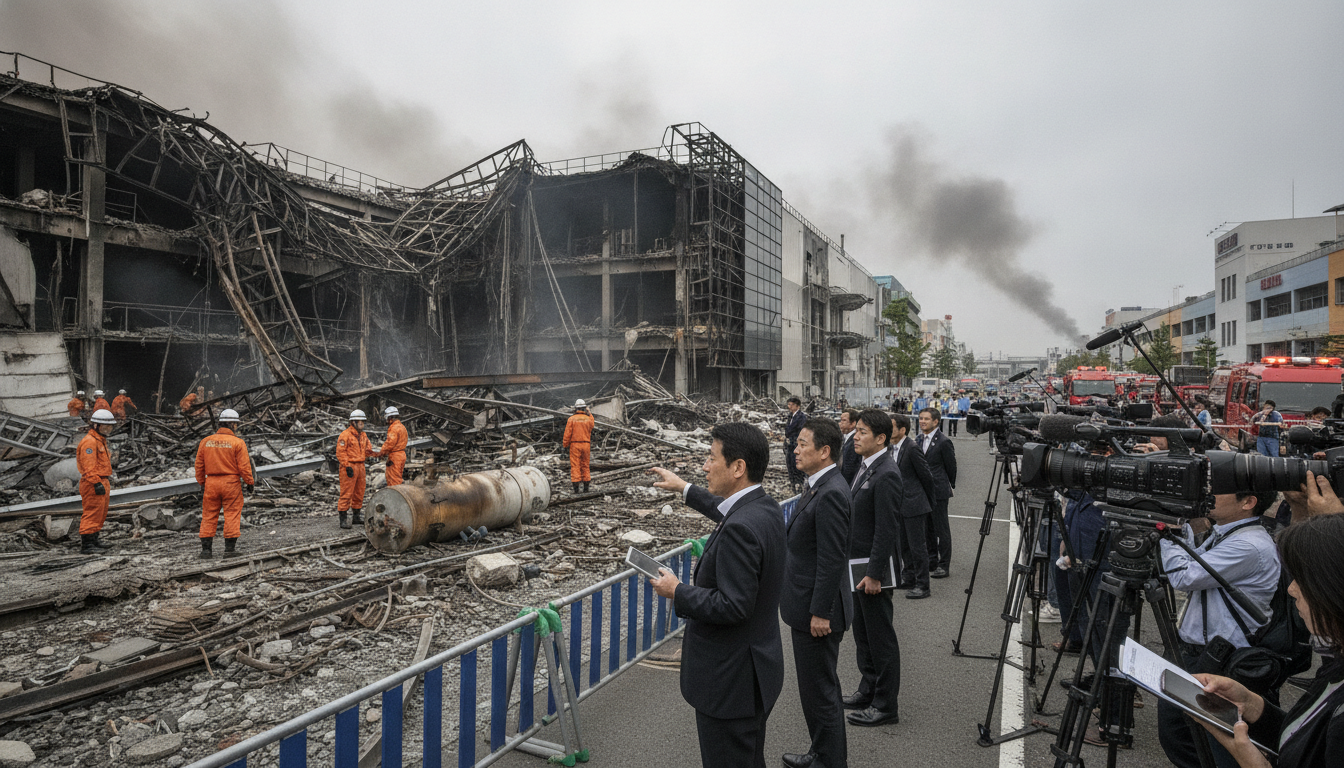
METI Says LP Gas Likely Caused Aeon Mall Kumamoto Explosion
METI says LP gas likely caused the Aeon Mall Kumamoto explosion on July 28; authorities are examining leak points, shutoff valves and compliance as part of the probe.
The Ministry of Economy, Trade and Industry (METI) announced on August 5 that liquefied petroleum (LP) gas is the most probable cause of the blast at Aeon Mall Kumamoto in Kashima, Kumamoto Prefecture. The statement follows joint on-site checks with police and fire authorities and a report filed through Kumamoto prefectural channels by the gas supplier. The agency said investigators will focus on leak locations, the operation of shutoff valves and whether statutory safety standards were violated.
Investigation Points to LP Gas
METI said its initial assessment, based on a field inspection with emergency services, points strongly toward LP gas as the ignition source for the explosion. Officials emphasized that the determination is preliminary and that a full technical analysis is under way to establish a definitive sequence of events. The ministry has signaled it will examine physical evidence, maintenance records and the configuration of gas installations at the mall.
METI received the report from the gas sales company on August 5 under mandatory reporting rules that require vendors to notify authorities when accidents occur. The ministry confirmed it will coordinate with local investigators and regulatory bodies to collect further data and to determine whether administrative or legal remedies are warranted.
On-site Confirmation by Police and Fire Authorities
Police and fire service teams joined METI inspectors at the Aeon Mall Kumamoto site as part of coordinated fact-finding efforts. Officials said their assessments at the scene were consistent with METI’s evaluation that LP gas played a central role in the explosion. Investigators are photographing, mapping and securing damaged areas to preserve evidence and to prevent secondary hazards during the examination.
Emergency responders are conducting systematic checks of piping runs, gas storage points and control valves to see whether automatic or manual shutoff systems functioned as intended after the earthquake. Authorities also plan to review inspection logs and communication records between the mall, the gas vendor and local safety officials.
Timeline of the Blast and Evacuation
The explosion occurred on July 28 at approximately 5:50 p.m., following a powerful earthquake that registered a maximum seismic intensity of 7. Mall management reported that evacuation of roughly 3,000 visitors was completed by about 5:00 p.m., prior to the blast. The timing has raised questions about how the explosion ignited after the main evacuation and what systems were in place to isolate fuel sources after the quake.
Investigators are reconstructing the timeline of the quake, the mall’s emergency response and the subsequent explosion to understand the interplay of seismic damage and gas system behavior. Officials are also interviewing employees and reviewing security and operational logs to trace when and how gas lines may have been compromised.
Casualties and Human Impact
Authorities confirmed that seven Aeon Mall employees died in the explosion, marking the incident as one of the deadliest post-quake commercial-site accidents in the recent disaster. Local hospitals and disaster-response teams continue to treat injured people and to offer support services for families affected by the blast. Community leaders and municipal officials have called for urgent measures to assist survivors and to address ongoing safety concerns in the area.
Victim advocacy groups and labor representatives have urged a transparent and swift investigation, saying that families and the public deserve clear answers about whether safety protocols were followed and whether regulatory lapses contributed to the tragedy. Municipal authorities are coordinating with national agencies to provide compensation guidance and mental health supports.
Regulatory Ramifications and Safety Measures Under Review
METI has stated that its investigation will scrutinize whether installations complied with existing safety standards and whether any breaches of law occurred. The agency will also look into the operation and maintenance of shutoff valves and whether automatic seismic isolation devices were present and functional. Depending on findings, METI and other regulators could recommend changes to inspection regimes, emergency shutdown requirements and on-site storage rules for LP gas at commercial facilities.
Industry groups and safety experts say the case may prompt a broader reassessment of gas safety in quake-prone areas, including stricter retrofit guidelines and clearer responsibilities for private operators. Local governments are expected to review building-by-building compliance and to consider temporary restrictions on similar installations pending the outcome of the probe.
METI has indicated it will publish further findings as the technical investigation progresses and as laboratory analyses of material samples are completed. The ministry also said it will coordinate with local authorities to translate investigative conclusions into concrete prevention steps for retailers and gas suppliers.
The government and municipal authorities have emphasized the need to balance rapid reopening of services in the disaster area with thorough safety checks to prevent further accidents, while continuing to support victims and their families as the probe proceeds.

