
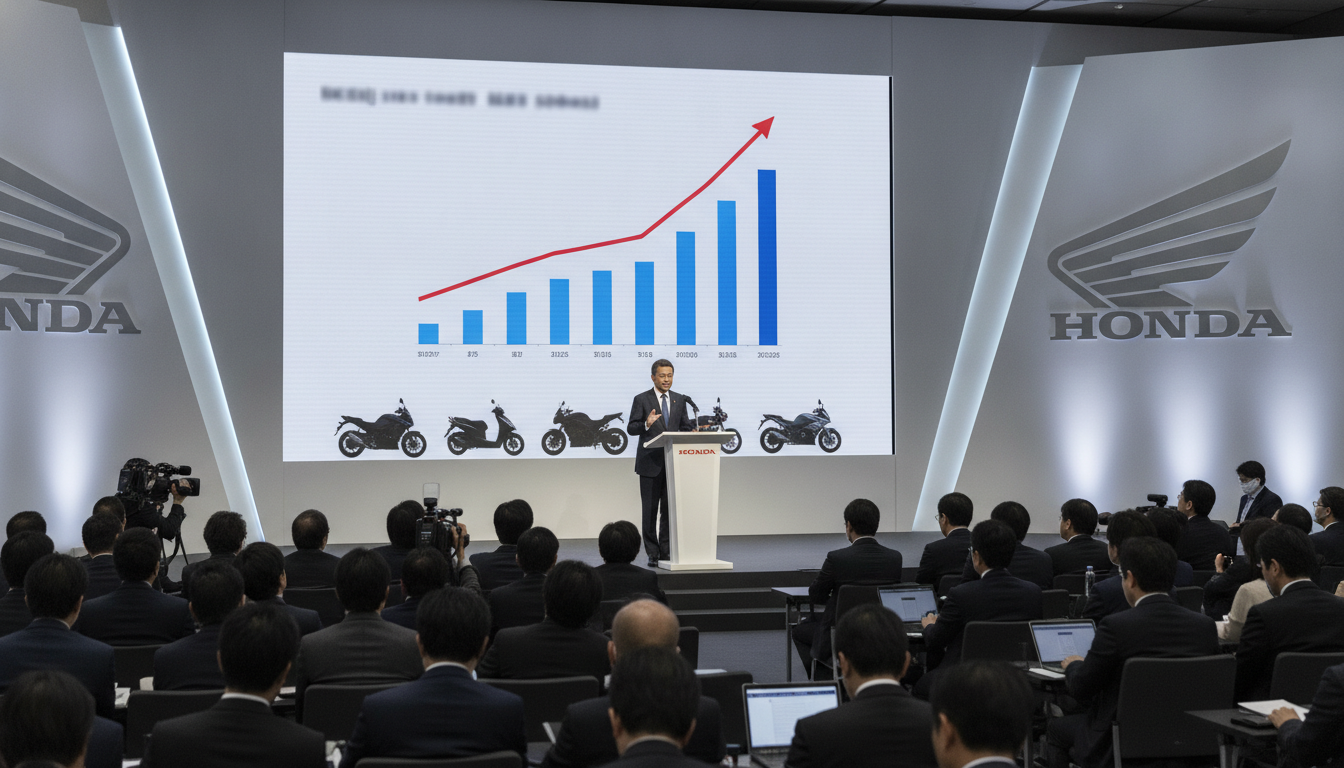
Honda Motor Raises Full-Year Profit Forecast to ¥400 Billion on Weak Yen and Strong Motorcycle Demand
Honda Motor expects ¥400 billion net profit for fiscal year ending March 31, 2027, reversing prior-year losses as currency and motorcycle sales boost earnings.
Revised full-year outlook
Honda Motor on Wednesday revised its profit forecast for the fiscal year ending March 31, 2027, projecting a net profit of 400 billion yen after recording a net loss of 423.9 billion yen in the previous fiscal year.
The company credited a weaker yen and robust demand for motorcycles as primary drivers behind the swing to profitability.
Honda said the upgraded outlook surpasses market expectations, signaling a faster-than-anticipated recovery across several of its core businesses.
Management framed the revision as the result of stronger operational performance and favorable currency translation effects.
April–June quarter performance
In the April–June quarter, Honda reported a year-on-year improvement in net profit, marking the company’s first sustained return to positive earnings after an extended downturn.
Although Honda did not disclose detailed segment-by-segment figures in its initial statement, the firm emphasized that motorcycle sales and currency gains contributed materially to the quarterly result.
The company noted that underlying sales volumes and pricing improvements in selected markets helped lift margins during the period.
Honda’s announcement also highlighted ongoing efforts to rein in costs and improve production efficiency as part of the turnaround.
Currency movements and earnings impact
A key factor behind the profit revision was the depreciation of the yen, which increased the yen value of revenue booked in stronger foreign currencies.
For Japan’s export-oriented automakers, such currency translation gains can have an immediate, visible effect on consolidated profit when converted back to yen.
Honda’s management pointed to these exchange-rate benefits while cautioning that currency markets remain volatile and could reverse at any time.
Analysts say the recent currency tailwind has amplified improvements from core operations but warned that sustained profitability will require stable operational gains.
Motorcycle demand and geographic drivers
Honda attributed much of the recovery to continued strength in its motorcycle unit, where demand remains resilient in several emerging markets.
The company’s long-standing presence in Asia, where two- and three-wheeler mobility is essential, helped underpin volume growth and margin recovery.
Honda also reported that improved supply chain conditions and targeted product launches supported sales momentum during the quarter.
Executives described the motorcycle business as a stabilizing cash generator while Honda steers heavier investments into the auto division’s electrification roadmap.
Automotive segment progress and electrification investment
While motorcycles drove a significant portion of the profit rebound, Honda’s automobile operations are showing signs of gradual improvement amid restructuring and cost-control measures.
The company continues to invest in battery-electric vehicle development and production capacity even as it tightens operational spending in legacy areas.
Honda framed the strategy as a two-track approach: defend near-term profitability through efficiency while allocating resources to longer-term EV competitiveness.
Management acknowledged that balancing these priorities will be crucial as global auto markets evolve and competition in EVs intensifies.
Risks and near-term outlook
Despite the brighter headline figures, Honda flagged several risks that could temper future results, including currency swings, raw material costs, and uneven demand across regions.
The company said it will monitor market conditions closely and update its guidance if material changes occur.
Investors and analysts will be watching whether operational improvements can be sustained in the absence of continued currency tailwinds.
Honda’s ability to convert improved earnings into consistent free cash flow and healthy balance-sheet metrics will be central to confidence in the recovery.
Investor and market implications
The upgraded profit forecast is likely to reassure stakeholders that Honda’s recovery plan is producing tangible results, especially after last year’s substantial loss.
For bondholders and equity investors, improved earnings reduce short-term downside risks and could create more flexibility for dividends or capital allocation decisions later in the fiscal year.
Market observers noted that the interplay between cyclical currency gains and structural business improvements will determine how durable the recovery is.
Ultimately, sustained improvement in vehicle sales, successful EV rollouts, and disciplined cost management will shape Honda’s financial trajectory.
Honda’s revised guidance marks a notable step away from the steep losses of the previous fiscal year, but company officials emphasized that vigilance is required as they pursue a broader, more sustainable recovery across both motorcycle and automobile businesses.

