
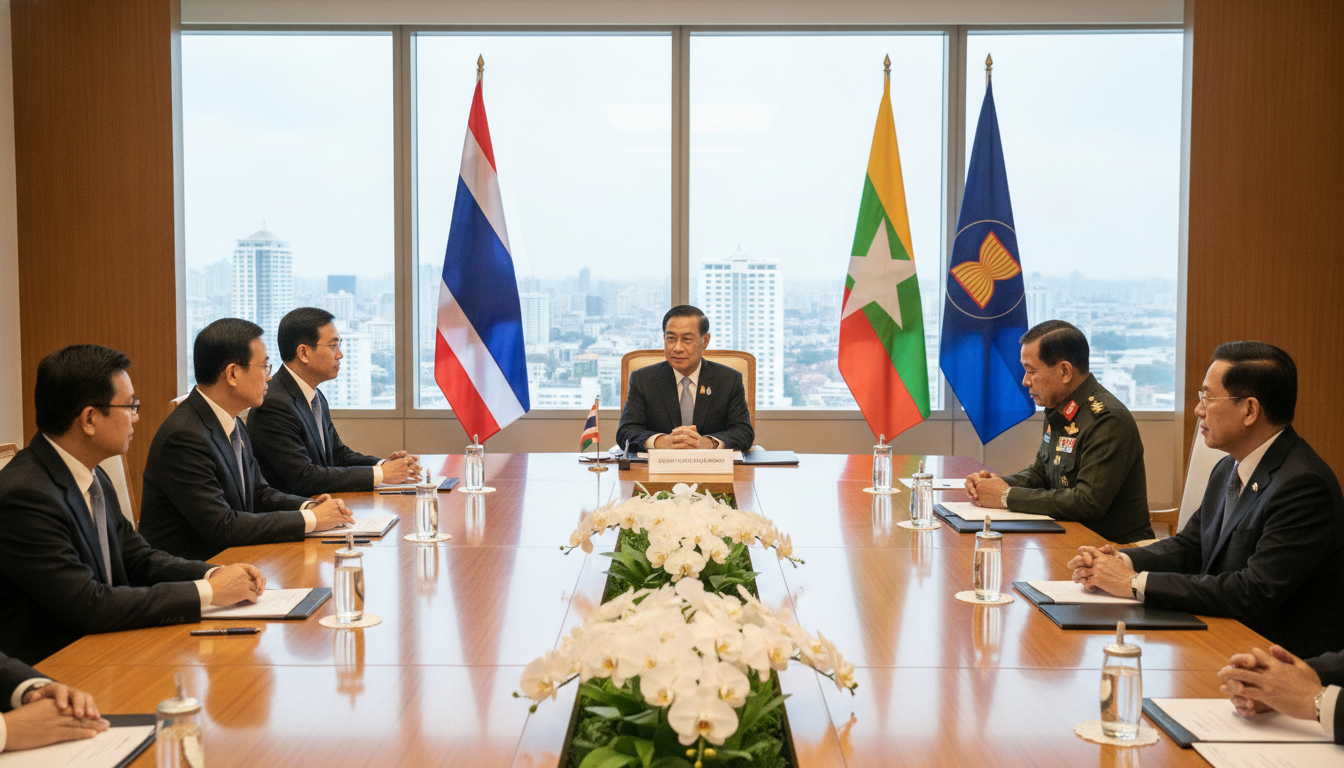
Min Aung Hlaing visit: Thailand offers red-carpet reception as diplomatic off-ramp in Bangkok
Thailand’s government hosted Myanmar’s President Min Aung Hlaing on August 6, 2026, presenting a red-carpet reception that signals a diplomatic off-ramp after five years of regional isolation. The Min Aung Hlaing visit in Bangkok saw Prime Minister Anutin Charnvirakul greet the former military leader at Government House. The gesture marks a measured shift in Thailand’s approach to Myanmar and raises questions about regional diplomacy and human rights accountability.
Reception at Government House
On August 6, Thai Prime Minister Anutin Charnvirakul formally received Min Aung Hlaing with an honor guard and a red-carpet arrival at Government House in central Bangkok. Photographs from the event showed an official welcoming ceremony that was both ceremonial and symbolic of a warmer bilateral posture. The reception broke the public ice after years in which the Myanmar leader faced limited engagement across much of Southeast Asia.
The public ceremony was brief but stage-managed, conveying a message of state-level recognition without signifying a full diplomatic rehabilitation. Thailand framed the visit as a practical engagement aimed at addressing cross-border concerns and restoring dialogue. Officials emphasized continuity of engagement while stressing the need for constructive steps on the ground in Myanmar.
Regional diplomatic recalibration
Thailand’s decision to host the Min Aung Hlaing visit reflects a broader recalibration in Southeast Asian diplomacy that balances pragmatism with principle. After roughly five years of limited interaction with Myanmar’s military leadership, some regional capitals have begun to weigh the risks of continued isolation against the potential benefits of dialogue. Bangkok’s move signals that at least one influential neighbor prefers engagement as a route to stability.
Diplomats say the region faces competing imperatives, including border security, refugee flows, and economic ties, that encourage direct contact. The visit therefore may be interpreted as a bid to re-establish communication channels and to incentivize concrete steps toward de-escalation. Observers will watch whether engagement produces measurable changes in behavior or simply normalizes a controversial actor.
Responses from ASEAN partners and global observers
Reactions across ASEAN and the international community were cautious and varied, reflecting longstanding divisions over how best to handle Myanmar. Some regional policymakers privately acknowledge the need for dialogue to manage transnational challenges, while others warn that early rapprochement risks undermining pressure for accountability and democratic restoration. This split shapes the diplomatic landscape in which the Min Aung Hlaing visit plays out.
Outside Asia, rights groups and Western governments have historically urged restraint and insisted that engagement not replace measures aimed at protecting civilians and promoting human rights. The visit is likely to prompt statements urging clarity on objectives and benchmarks for any widened engagement. How Thailand responds to those concerns will influence perceptions of its regional leadership role.
Thailand’s domestic calculations
Bangkok’s overture to Min Aung Hlaing appears rooted in concrete domestic and security priorities as much as in regional strategy. Thailand shares a porous border with Myanmar, and officials have long been concerned about cross-border crime, refugee movements, and the economic impact of instability. Re-establishing formal lines of communication can help Bangkok address these immediate policy challenges.
Economic considerations also play a role, with bilateral trade and energy ties presenting incentives for engagement. Thai leaders have signaled that practical cooperation on infrastructure, trade and humanitarian issues could be advanced through a more normalized relationship. At the same time, Prime Minister Anutin must balance these pragmatic aims with domestic political sensitivities and international scrutiny.
Implications for Myanmar’s international standing
The Min Aung Hlaing visit may mark an initial step toward partial reintegration of Myanmar’s leadership into regional diplomatic circuits. For Myanmar, such openings could relieve elements of the diplomatic isolation that followed the 2021 military takeover and subsequent sanctions and condemnations. However, reintegration without accountability risks legitimizing policies that many external actors find objectionable.
Analysts note that a key test will be whether engagement yields tangible improvements for civilians in Myanmar, including humanitarian access and reductions in violence. If those outcomes do not materialize, the visit could be viewed as merely cosmetic, increasing pressure on partners who favor stronger conditionality. The coming weeks of diplomacy will be critical in determining whether this is an off-ramp or a step toward normalization.
Possible next steps and stakes ahead
Following the Bangkok reception, officials are expected to pursue follow-up meetings and technical talks focused on migration, trade and border security. The Min Aung Hlaing visit may lead to working-level cooperation intended to manage immediate risks rather than to resolve deeper political crises. Bangkok has indicated it seeks practical results that can be measured and reported.
The broader stakes include ASEAN cohesion, the region’s ability to respond to humanitarian needs, and the international community’s leverage on Myanmar. If Thailand’s engagement prompts constructive behavior, it could foster a pattern other neighbors might emulate. Conversely, a lack of progress could deepen divisions and spark renewed calls for a tougher collective stance.
The Min Aung Hlaing visit in Bangkok on August 6 has opened a new chapter in Southeast Asian diplomacy, one that puts practical engagement at the forefront while leaving unresolved questions about accountability and long-term stability.

