
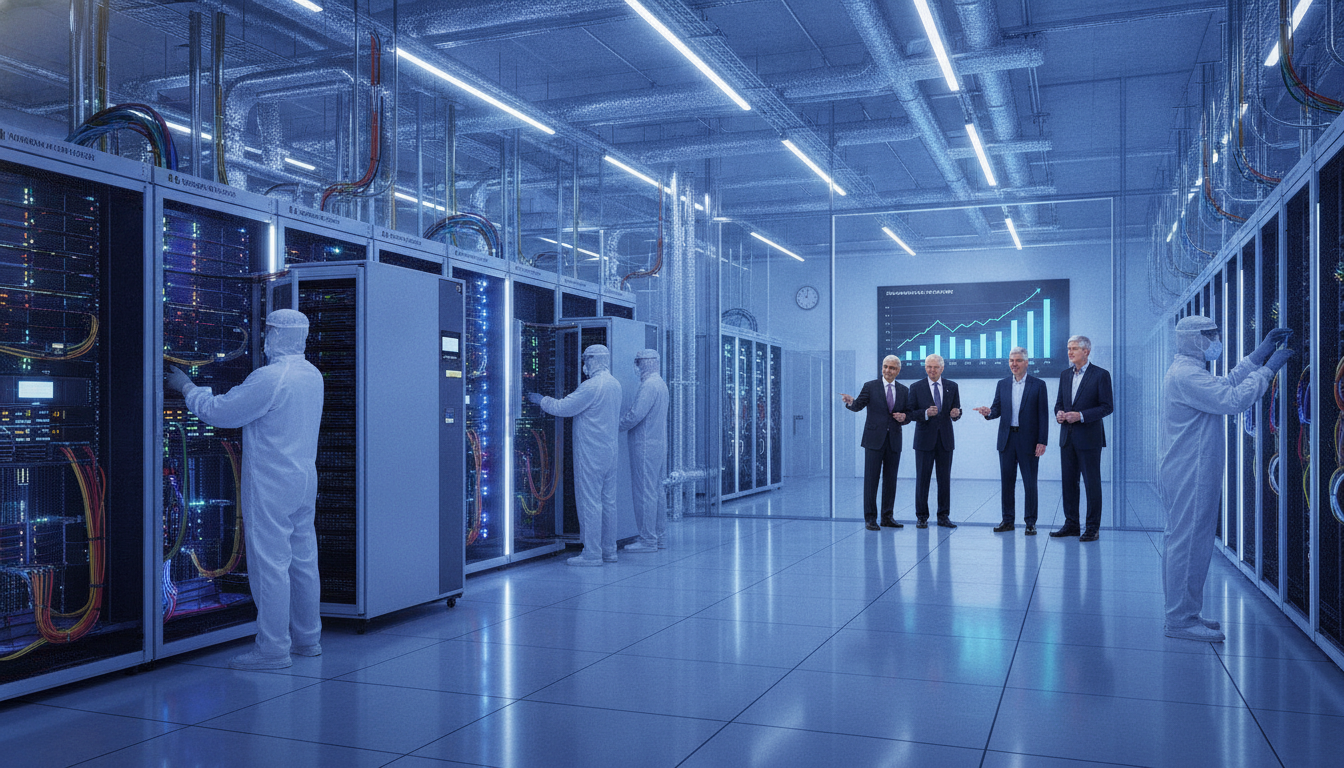
Tech giants’ property, plant and equipment surge 140% as AI spending fuels infrastructure build-out
Four U.S. tech giants’ property, plant and equipment rose 140% to $1.46 trillion in three years, reflecting a rapid shift toward AI-driven infrastructure investment.
LAS VEGAS, Nevada — The combined value of tech giants’ property, plant and equipment has soared, rising 140% over three years to $1.46 trillion as companies pour capital into the hardware and facilities that underpin artificial intelligence. The surge in property, plant and equipment — commonly abbreviated as PP&E — signals a structural change as formerly asset-light software firms build data centers, custom chip capacity and other long-lived assets. Market observers say the move transforms large technology companies into infrastructure owners with balance sheets that now resemble those of global energy firms.
U.S. tech giants’ property, plant and equipment jump 140%
The three-year increase in PP&E reflects accelerated capital spending tied to developing and operating generative AI models and cloud services. Companies are investing in servers, cooling systems, power distribution and real estate to host expanding data center fleets and edge facilities. That investment profile contrasts with the consumer-facing, software-focused image these firms held when most of their value sat in intangibles such as software, data and brands.
Spending patterns have shifted from variable operating expenses to sustained capital commitments that will be depreciated over many years. Finance teams must now manage higher fixed costs and longer asset lives, altering cash-flow dynamics and the metrics investors use to value these companies.
Amazon now largest by PP&E at $538.7 billion
Amazon accounted for a particularly large share of the expansion, with property, plant and equipment reaching $538.7 billion — roughly double the amount recorded three years earlier. The scale of Amazon’s tangible assets now makes it the single largest company by PP&E among its peers, reflecting investments across e-commerce logistics, cloud infrastructure and new data-center capacity. Those facilities support both retail operations and Amazon Web Services, which remains a critical revenue and margin driver.
The concentration of physical assets at Amazon highlights how diversified capital spending can be across business lines: fulfillment centers, network infrastructure and hyperscale data centers all contribute to the company’s elevated asset base. For investors, the mix complicates traditional comparisons that treat technology firms as uniformly asset-light.
Data centers and custom chips drive capital intensity
A primary component of the PP&E increase is the build-out of data centers and the purchase of high-performance computing equipment tailored for AI workloads. Leading cloud providers are adding thousands of rack units populated with GPUs and AI accelerators, and they are also investing in power and cooling systems designed to support sustained high utilization. In parallel, several firms have stepped up spending on custom silicon and assembly lines to reduce dependence on external suppliers while optimizing performance per watt.
These investments are capital intensive and require long planning horizons, from site selection and permitting to construction and commissioning. The shift toward owning more of the compute stack reflects a desire for greater control over cost, performance and supply-chain resilience.
Scale now rivals global energy companies
Analysts note that the size of these technology companies’ tangible asset bases is approaching levels historically associated with large energy producers and utilities. The comparison is not purely symbolic: both types of companies now manage sprawling physical infrastructure, long-term capital projects and significant energy consumption. That reality has implications for how regulators, investors and rating agencies assess operational risk and sustainability.
Large-scale infrastructure also brings new responsibilities, including grid impacts, emissions oversight and community relations where facilities are sited. Technology firms expanding their physical footprints face scrutiny over water use, local permitting and the environmental footprint of new data centers.
Investor accounting and valuation consequences
The expansion of property, plant and equipment alters key financial ratios and investment narratives. Higher PP&E increases depreciation charges and can compress free cash flow in the near term, even if investments are intended to drive future revenue growth. Equity analysts and corporate treasurers are recalibrating models to reflect longer asset lives and the capital intensity of AI-era operations.
Credit analysts likewise pay closer attention to leverage and interest coverage when a larger share of assets sits on the balance sheet. For some investors, the presence of significant tangible assets may reduce perceived risk; for others, it raises concerns about capital allocation discipline and cyclical exposure.
Supply-chain and geopolitical pressures accompany the build-out
The rapid scaling of data centers and chip capacity is intensifying demand for semiconductors, specialized cooling equipment and construction materials, placing additional stress on global supply chains. Companies are scrambling to secure components and engineering capacity amid competition from other industries also investing in electrification and infrastructure. That competition increases the importance of diversified sourcing strategies and localized manufacturing.
Geopolitical considerations are also shaping where and how firms expand. Concerns about data sovereignty, export controls on advanced chips and cross-border tensions influence site selection and procurement decisions. The intersection of technology infrastructure and geopolitics adds complexity to what might otherwise be straightforward capital projects.
The shift toward substantial holdings of property, plant and equipment marks a turning point in how major tech companies operate and how markets evaluate them. As AI workloads grow and infrastructure needs deepen, these firms are likely to remain significant physical-asset owners, prompting lasting changes in financial reporting, investor expectations and public policy oversight.

