
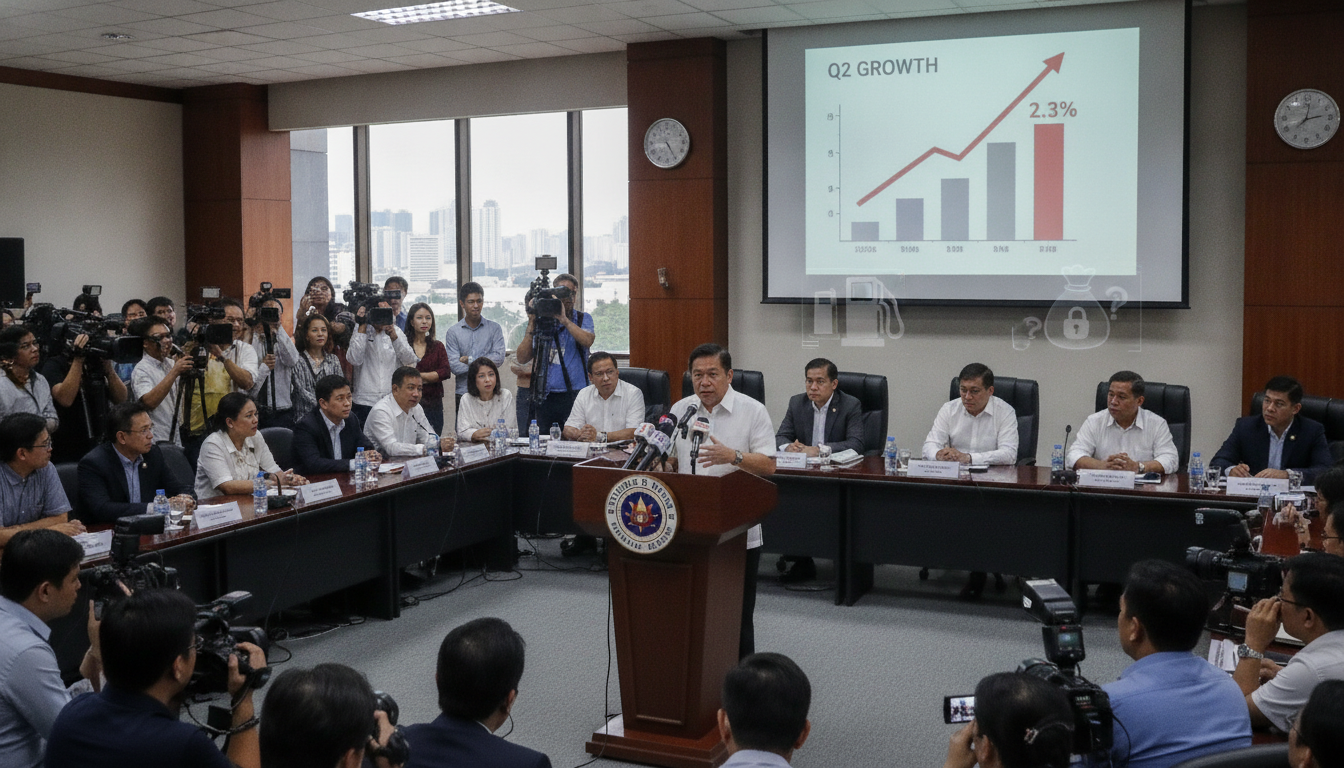
Philippine economy grows 2.3% in Q2 as fuel costs and spending cuts curb momentum
Philippine economy grew 2.3% in the second quarter as high fuel prices linked to the Iran war and reduced public spending after a corruption scandal weighed on growth, analysts say.
Growth slows to 2.3% in the second quarter
The Philippine economy recorded a 2.3% year‑on‑year expansion in the second quarter, according to official reporting. That pace marks a slowdown from the stronger gains seen when domestic demand and public investment were more robust. Policymakers and market observers characterized the result as the product of multiple headwinds converging at once.
Energy shock raises costs for households and businesses
A spike in global fuel prices after the Iran war has pushed up transport and utility costs across the archipelago. Higher energy bills have cut into household disposable income and pushed up operating costs for firms, undermining consumption and profit margins. The shock has been felt most acutely by low‑ and middle‑income families who rely heavily on cash wages and informal transport.
Public projects and spending constrained by scandal fallout
Government spending, once a principal driver of growth, has been pared back following revelations of a high‑profile corruption scandal. Several planned projects were delayed or re‑scoped while investigations and procurement reviews proceeded, reducing the usual fiscal impulse to the economy. Officials report tighter controls are intended to restore public confidence, but the near‑term effect has been a notable drag on activity.
Consumer demand, the economy’s backbone, shows strain
Private consumption, which accounts for the bulk of economic activity, weakened as living costs rose and public support eased. Retail sales and everyday services faced slower footfall and lower discretionary spending as households prioritized essentials. The combination of higher prices and constrained public demand created a more cautious spending environment than in previous quarters.
Businesses adopt cautious stance amid uncertainty
Companies from small vendors to larger manufacturers signalled a more conservative approach to hiring and investment as margins tightened. Some firms postponed expansion plans and scaled back inventories to manage cash flow against higher transport and input costs. Foreign investors and exporters are watching policy responses closely, with the business community urging quicker clarity on infrastructure and procurement timelines.
Policymakers face limited but targeted options
Authorities are balancing the need to restore fiscal integrity with measures that could support growth, including targeted subsidies and safeguards for vulnerable households. Monetary policymakers may monitor inflationary pressures stemming from fuel costs while guarding financial stability and credit conditions. Analysts say short‑term relief measures, coupled with credible medium‑term reforms, would help rebuild confidence without undermining governance objectives.
The second‑quarter result highlights how external shocks and domestic governance challenges can intersect to slow momentum in an otherwise consumption‑driven economy. Looking ahead, a combination of easing energy costs, resumed public investment, and targeted household support will be central to any pickup in growth.

