
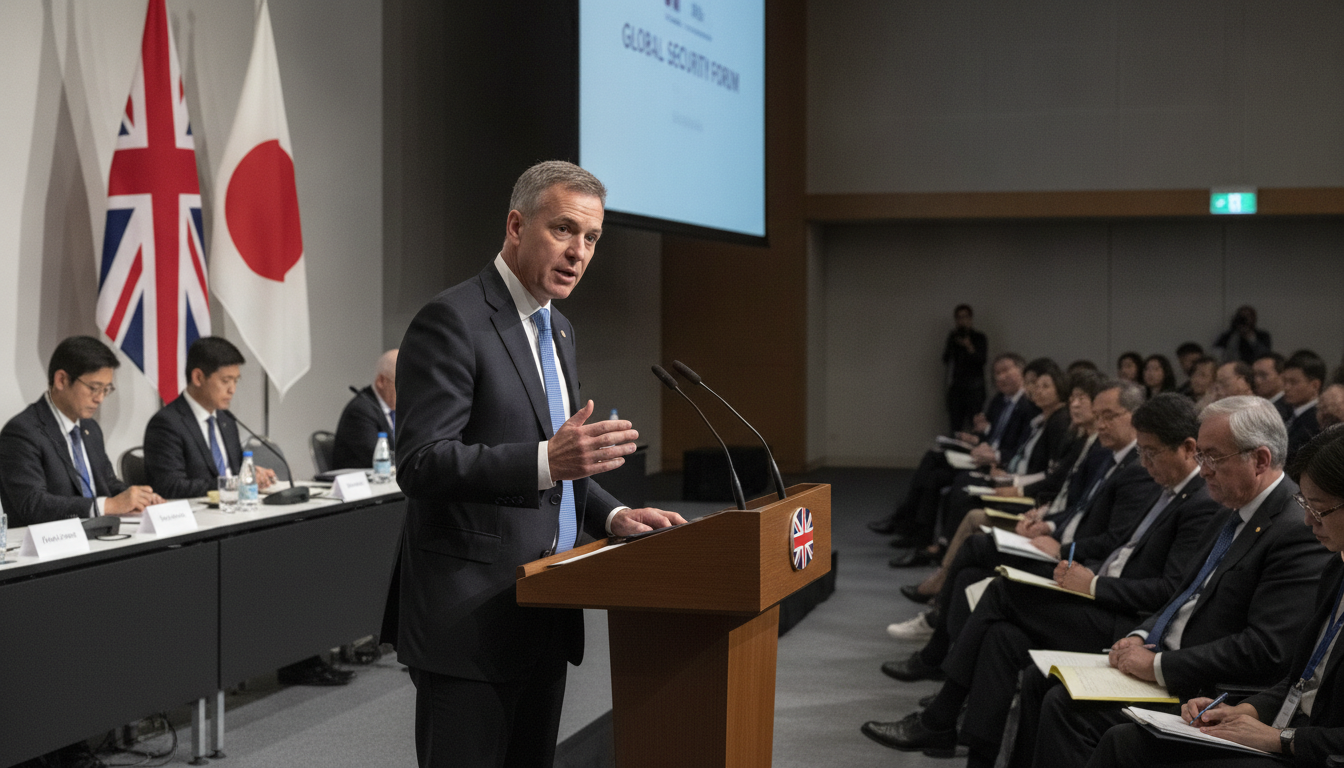
Richard Moore urges deeper UK-Japan partnership and outlines stance on China, Russia
Richard Moore praises UK-Japan ties, outlines his approach to China and Russia, and urges expanded intelligence, defence and economic cooperation with partners.
Richard Moore, the former head of Britain’s MI6, used a recent interview to make a case for strengthening the strategic relationship between the United Kingdom and Japan. He described the two countries as natural partners, citing shared cultural affinities and a broadly similar view of global security challenges. Moore also set out his thinking on China and Russia, calling for a combination of deterrence and diplomatic engagement.
Moore frames UK-Japan relationship as strategically natural
Richard Moore emphasized that the United Kingdom and Japan already possess the foundations for a robust strategic partnership. He pointed to long-standing cultural exchanges, mutual respect for the rule of law, and parallel approaches to trade and security as reasons the two nations can work closely together. Moore argued that these affinities make cooperation on defence, technology and intelligence both practical and politically durable.
Moore said that closer ties should not be limited to diplomatic gestures but involve clear, operational cooperation. He suggested joint planning in areas such as cyber security, supply-chain resilience and critical-technology safeguards. For Moore, turning goodwill into concrete programmes would bolster deterrence and provide practical benefits for both economies.
Cultural ties underpin Tokyo-London cooperation, Moore says
In the interview, Moore highlighted cultural and educational links as an often overlooked asset in foreign policy. He noted student exchanges, business partnerships and shared institutional values as elements that make coordination smoother in crisis moments. These soft ties, according to Moore, create trust that can be converted into faster policy alignment on urgent issues.
Moore urged policymakers in both capitals to invest in people-to-people programmes alongside defence initiatives. He argued that long-term relationships between civil servants, military officers and industry leaders reduce friction when rapid collective action is required. Strengthening these networks would, he said, make strategic collaboration more resilient.
Approach to China: competition with calibrated engagement
On China, Moore articulated a stance built around competition, deterrence and selective engagement. He warned that China’s expanding economic and military reach presents a complex challenge that cannot be met by confrontation alone. Instead, Moore advocated for a sustained Western response that combined clear defence postures with targeted cooperation where mutual interests exist.
Moore cautioned against simplistic binaries and urged nuanced policy instruments. He recommended enhancing economic security measures, protecting critical infrastructure and deepening alliances in the Indo-Pacific to discourage coercive behaviour. At the same time, he suggested preserving diplomatic channels for issues like climate cooperation and global health.
Assessing Russia: deterrence, sanctions and pragmatic diplomacy
Regarding Russia, Moore described Moscow as a persistent security threat in Europe that also projects influence beyond its borders. He emphasized the importance of deterrence, including coordinated sanctions and intelligence sharing, to counter hybrid and kinetic threats. Moore underscored that the West must maintain readiness while keeping diplomatic avenues open where possible.
Moore said that intelligence cooperation with allied partners had been crucial in exposing malign activities and informing policy responses. He argued that a credible deterrent combined with economic pressure and legal accountability sends a consistent message about unacceptable behaviour. For Moore, precise messaging and unity among partners remain crucial in handling Russia’s actions.
Intelligence cooperation and defence links merit expansion
A consistent thread in Moore’s remarks was the need to deepen intelligence collaboration between London and Tokyo. He described enhanced information-sharing arrangements, joint threat assessments, and coordinated cyber-defence initiatives as practical steps that would deliver rapid returns. Moore called for institutional mechanisms that allow faster operational cooperation during crises.
Beyond intelligence, Moore pointed to defence linkages such as joint exercises and interoperable systems as areas where investment would strengthen deterrence. He urged governments to prioritise procurement and training that enhance combined capabilities. Moore also highlighted the role of private-sector partnerships in advancing secure supply chains for emerging technologies.
Public persona and post-service influence
Moore reflected on his public-facing decisions while in office, noting unconventional touches that aimed to modernise the service’s image without compromising secrecy. He recalled that symbolic gestures can sometimes open constructive public dialogue about intelligence work and national security priorities. Moore suggested that greater transparency on certain topics helps build public trust in complex policy choices.
Looking ahead, Moore described his post-service role as one of advocacy and quiet diplomacy rather than frontline policy-making. He emphasised the need for sustained political will and institutional investment to translate strategic consensus into lasting programmes. Moore urged both governments to pursue initiatives that are operationally meaningful and politically sustainable.
The former MI6 head’s intervention is a clear call for action: deepen UK-Japan ties across intelligence, defence and economic lines while pursuing a measured, joined-up approach to China and Russia. His comments frame the partnership as practical and strategic rather than symbolic, underscoring the diplomatic and operational work that would be required to make that vision a reality.

