
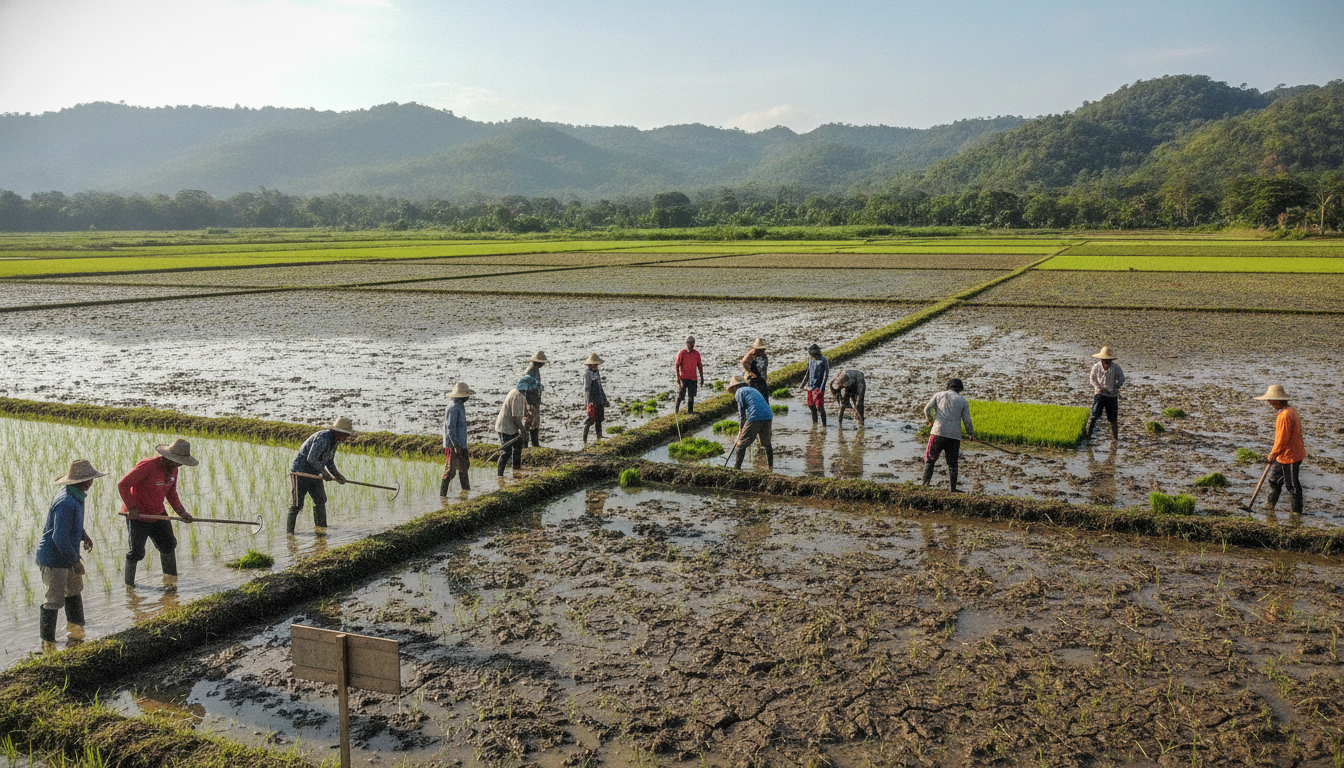
Philippine Farmer’s Success with Alternate Wetting and Drying Cuts Methane from Rice Paddies
Philippine farmer Merriam Saba adopted alternate wetting and drying nine years ago, demonstrating how alternate wetting and drying can reduce methane emissions from rice paddies while preserving yields and saving water. The technique, which interrupts continuous flooding of fields, is gaining attention as policymakers and scientists consider wider promotion across Southeast Asia. Local experience is now feeding national conversations about climate-friendly rice cultivation and rural livelihoods.
Merriam Saba’s experience in Los Baños
Merriam Saba converted her Los Baños paddy to alternate wetting and drying nearly a decade ago after seeking ways to cut costs and cope with unpredictable water. She found that managing irrigation cycles by allowing fields to dry intermittently reduced standing water without harming her crop. Her farm has since been showcased by local extension workers as an example of practical, low-cost adaptation.
How alternate wetting and drying reduces methane
Alternate wetting and drying reduces the anaerobic conditions that produce methane by letting soil oxygenate between irrigation events. Microbial processes that emit methane thrive under prolonged submersion, so periodic drying breaks that chain and lowers greenhouse gas output. Farmers and agronomists report measurable drops in methane release where the method is applied, making it an attractive mitigation measure for a region where rice paddies are a major source of emissions.
Impacts on yields, water use and costs
Farmers who switch to alternate wetting and drying generally report stable or improved yields while using less irrigation water and cutting fuel or pumping costs. The technique can be implemented with modest changes to field timing and irrigation management rather than expensive infrastructure. For smallholders facing rising input prices and water stress, the balance of lower costs and maintained productivity is a compelling reason to try the practice.
Barriers to scaling up adoption
Despite promising results on individual farms, several barriers slow broader uptake of alternate wetting and drying, including fragmented irrigation systems and limited access to reliable water control. Many small rice plots lack field-level gates or canal management that allow precise drying cycles, and farmers often need training and monitoring support. Behavioral inertia and perceived risk also deter adoption when farmers fear potential yield loss from experimental changes.
Policy responses and market incentives
Governments, research institutes and development agencies have started pilot programs and training to promote alternate wetting and drying as part of climate and water strategies. Some initiatives pair technical assistance with improvements to irrigation governance and demonstration plots to build farmer confidence. Carbon finance and sustainability certification schemes are also being explored as potential incentives that could reward reduced methane emissions from rice production.
Farm-level findings are now informing national discussions about how to reconcile food security with climate goals, and advocates argue that well-designed programs could unlock benefits at scale. As rice remains a staple and a major livelihood source across the region, policies that address irrigation infrastructure, extension services and market signals will be critical to wider adoption. The experience of farmers like Saba highlights practical gains but also underscores the need for coordinated public and private action to turn isolated successes into a regional shift toward lower-emission rice.

