
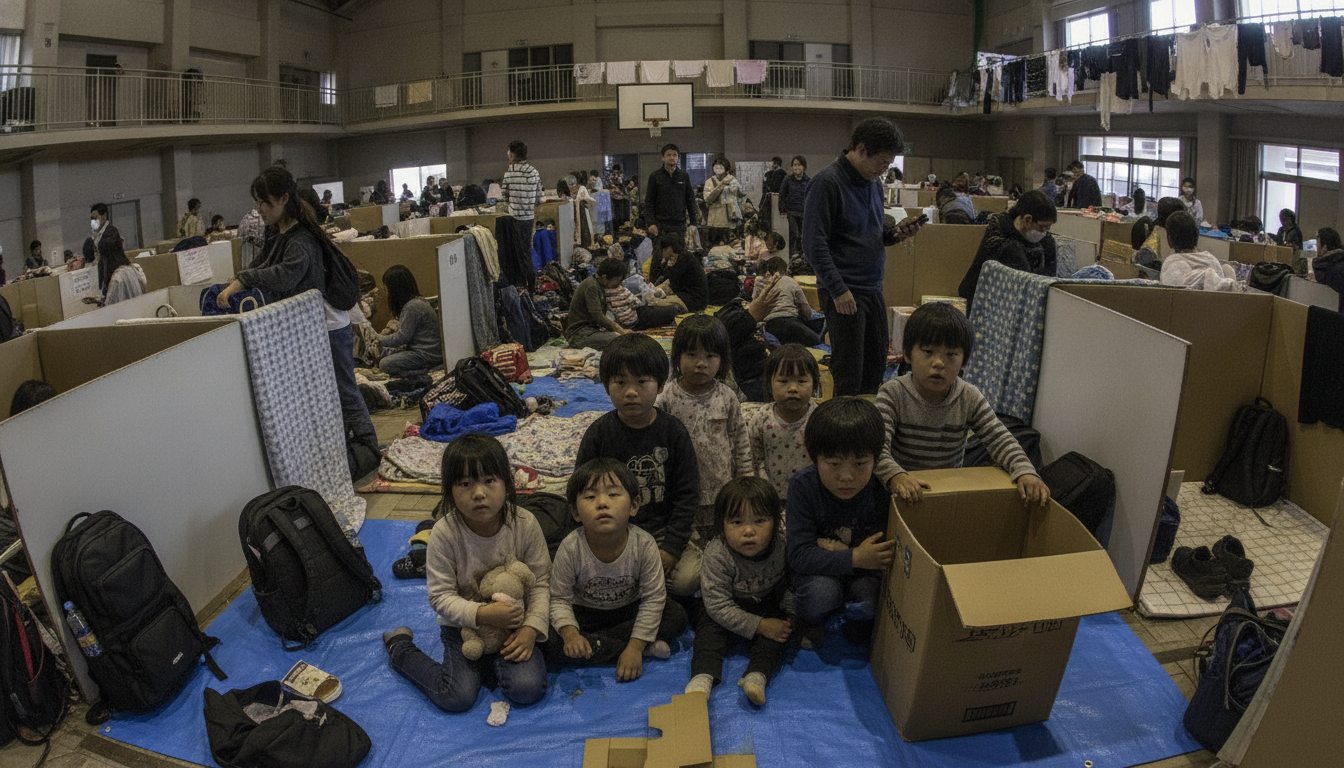
Kumamoto earthquake children’s shelter: kids left in corners as parents juggle work and closed nurseries
At evacuation centers after the Kumamoto earthquake, children have few supervised places to stay, leaving many to play on smartphones while parents struggle to balance work and childcare.
Shelter conditions at Yatsushiro Municipal Dai-ni Junior High
The gymnasium of Yatsushiro Municipal Dai-ni Junior High School, which recorded a seismic intensity of upper 6, was converted into an evacuation center on August 6, 2026. Inside, elderly evacuees rested on cardboard beds and thin mats laid on the floor, while temporary toilets were placed outside and queues formed at water distribution points. On the stage of the gym, a group of fifth-grade girls huddled over a smartphone, a scene that underlined the limited options for organized child activities at the site.
At the shelter, basic needs were being met unevenly: some services like drinking water and sanitation were visible, but dedicated spaces and staff for children were sparse. The contrast between quiet adults trying to rest and the restless presence of children was apparent throughout the facility. These conditions reflect immediate logistical pressures in the first days after a major quake, particularly for households with young children.
Children left to the corners of evacuation life
Many children found themselves confined to the fringes of communal life at the shelter, occupying corners or the stage rather than dedicated activity areas. With little structured programming, electronic devices became a primary source of distraction and comfort for older children. The lack of supervised, age-appropriate spaces risks elevating stress for both children and caregivers during a time when routines and familiar supports are disrupted.
Observers at the center reported young evacuees spending long stretches on screens with limited interaction, a coping response that also reduces visibility for shelter staff trying to monitor wellbeing. In the intense days following the earthquake, ensuring safe places for play and rest is crucial to prevent accidents, reduce anxiety, and support mental health among the youngest evacuees.
Parents face work and childcare conflicts
Several parents said they were unable to remain at the shelter full time because of work obligations, leaving children under intermittent supervision. In one example, a father was working during the day while the mother remained occupied caring for a three-year-old sister because the local nursery had not fully reopened. This split of responsibilities created gaps in oversight for older siblings, who ended up spending hours alone in shelter spaces.
The situation has forced families to make difficult trade-offs between earning a living and providing continuous childcare, exposing the fragility of existing disaster-response arrangements for households with young children. When daycares and preschools are partially out of service, working parents encounter immediate pressure that can drive unsafe or unsuitable arrangements.
Temporary child spaces exist but do not meet demand
Authorities and some volunteer groups have set up small designated areas intended for children, but capacity and staffing shortfalls limited their effectiveness. Even where a child-friendly corner was created, families reported that it filled quickly or lacked the trained personnel needed to manage energetic groups of young evacuees. A notable account described a four-year-old who slept in a car overnight, telling caregivers, “I’ll sleep in the car again today,” underscoring how makeshift arrangements persist despite available spaces.
The constraints on physical space, qualified childcare staff, and materials for play and care are common in early disaster response, yet they have immediate consequences for child safety and parental stress. Without rapid scaling of child-specific services, evacuation centers risk becoming environments where the youngest are sidelined rather than actively supported.
Policy gaps and calls for child-centered planning
Local officials and child welfare advocates are emphasizing the need to incorporate child-centered provisions into disaster preparedness and shelter management plans. Suggested measures include pre-arranged partnerships with childcare professionals, mobile play units, and designated family-support tents equipped with cribs, mats, and age-appropriate supplies. Advocates argue that such systems should be activated automatically after high-magnitude events to prevent children from becoming an afterthought in resource allocation.
Experts point out that preparing for child needs requires both infrastructure and human resources, from stocked supplies to trained staff who can manage supervision, psychosocial support, and infection control. Integrating these elements into municipal emergency plans would help ensure that children receive timely care and that caregivers can attend to work or recovery tasks without compromising child safety.
Immediate responses and volunteer efforts on the ground
Volunteer groups and some municipal teams mobilized quickly to deliver basic relief and informal child activities, attempting to plug gaps while official systems scaled up. Makeshift play corners, handed-out snack packs, and brief supervised sessions helped, but organizers cautioned that these measures are temporary and unevenly distributed across shelters. Coordination challenges, especially in the critical first days, limited the reach of such grassroots initiatives.
Authorities have indicated plans to expand child-focused support as logistics stabilize, but the pace of recovery and the reopening of childcare facilities will determine how quickly families regain normalcy. In the interim, families with young children face prolonged uncertainty about where and how their children can be cared for safely while daily life resumes.
Evacuees and child welfare advocates alike say this earthquake has highlighted longstanding weak points in disaster preparedness: when shelters are converted overnight, children’s needs cannot be taken for granted and require concrete systems to be in place before disaster strikes.

