
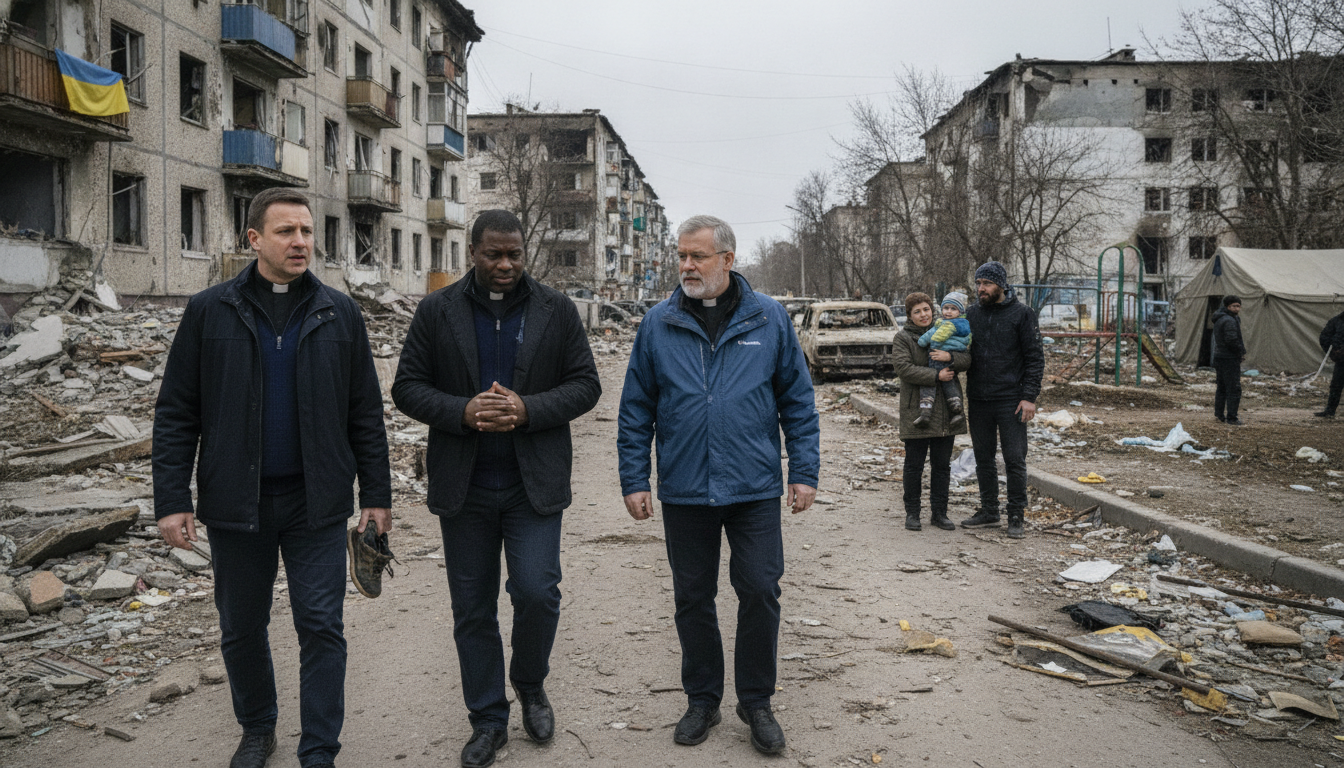
American pastors in Ukraine shift views after witnessing war’s human cost
American pastors in Ukraine say witnessing civilian suffering changed views on Russia, as faith delegations report trauma, solidarity and renewed advocacy.
Confession in Odesa
Mark Burns, an American pastor, told a packed conference hall in Odesa in late May, “I was wrong,” acknowledging public statements he had made about the conflict. His remark, delivered with the force of a public apology, captured a trend among visiting U.S. clergy who say direct exposure to destruction and displaced civilians has reshaped their perspectives.
The visit to Odesa followed a series of faith-based delegations that travelled across front-line and front-line-adjacent cities. Delegation members described meetings with residents, visits to medical facilities and encounters with refugees that they said made the war’s toll unmistakably personal.
Visiting sites and civilians
Delegates reported seeing damaged apartment blocks, improvised shelters and hospitals treating both civilians and combatants. Firsthand accounts from Ukrainians who lost family members or homes appeared to have a strong emotional effect on visitors who earlier voiced skepticism about Ukraine’s position.
Religious leaders said that witnessing scenes of civilian suffering — long conveyed by international media but often experienced secondhand in the United States — produced a different response than reading reports or watching footage. Several visitors told local hosts they felt compelled to change their public messaging as a result.
From private sympathy to public statements
Some American faith figures who previously expressed ambivalence or were critical of Ukrainian officials have begun to issue more sympathetic public statements. Those shifts have been visible in speeches, sermons and social media posts shared after return trips to the United States.
Observers note that the transformation is not uniform across faith communities, and doctrine, political alignment and constituency pressures continue to shape how leaders frame the conflict. Nevertheless, the number of prominent voices signaling revised views has risen in recent trips, according to participants.
Political connections and religious diplomacy
High-profile religious leaders often travel in contexts tied to broader U.S. political networks. Photographs from past U.S. events show American faith figures alongside political leaders, underscoring the overlap between religious outreach and political influence in Washington. That entanglement has raised questions about the role of faith delegations in shaping foreign policy debates at home.
Ukrainian officials and civil society actors have welcomed American religious delegations while urging clarity about the purpose of the visits. For many Ukrainians, the immediate value lies in moral support and attention that may translate into humanitarian aid or political pressure.
Local reception and survivor testimony
In meetings with survivors, delegates listened to accounts of displacement, disrupted education and long-term psychological trauma. Contributors from Ukraine’s local churches and charities often accompanied visitors to provide context and facilitate conversations with affected families.
These contacts offered delegates what many described as incontrovertible evidence of civilian harm, changing the tone of subsequent communications. Delegation members said they returned with names and faces that personalized the conflict in ways statistics could not.
Implications for U.S. faith communities
The reported shift among some visiting pastors may influence debates within U.S. religious communities about engagement with international crises. Faith leaders who return from the region often face congregants who expect clear guidance on moral and political questions, including humanitarian aid and positions on military assistance.
Some clergy argue that witnessing suffering imposes a pastoral obligation to advocate for protection of civilians and increased relief. Others urge caution, warning that religious actors entering geopolitical arenas can be co-opted by partisan narratives.
The altered messaging from visiting pastors is likely to reverberate in denominational networks and in public discourse, where faith-based endorsements can affect lawmakers and voters. Whether these changes lead to sustained advocacy or remain episodic responses to travel and testimony remains to be seen.
Across U.S. congregations, discussions that began with images and news reports are now being informed by returned visitors’ firsthand testimonies, prompting new partnerships and fundraising efforts. The long-term impact of these shifts will depend on how sustained the engagement is and whether political currents reinforce or counter the new tone articulated by clergy after their visits.

