
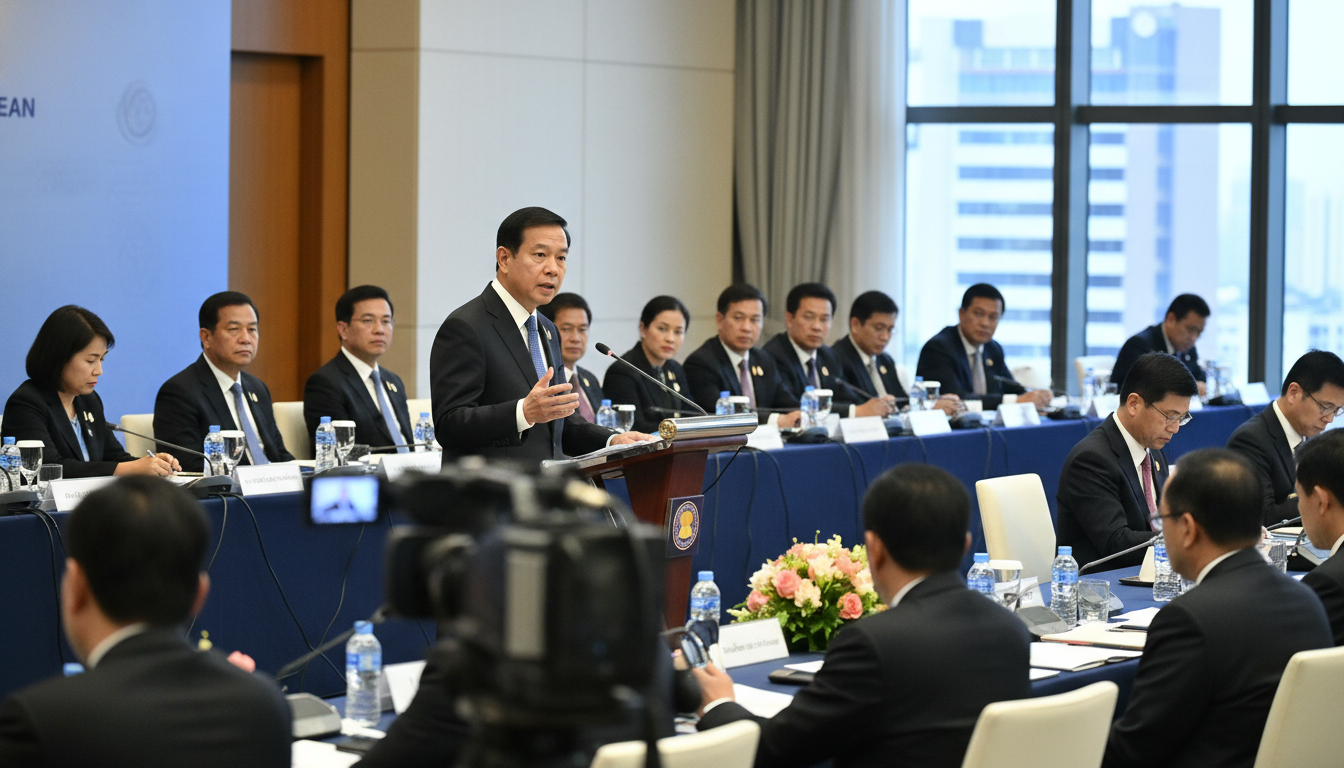
Abhisit Vejjajiva urges ASEAN to act with solidarity over U.S.-Iran war disruptions
Former Thai premier Abhisit Vejjajiva urges ASEAN and middle powers to act together to mitigate economic and security fallout from the U.S.-Iran war now.
BANGKOK — Former Thai prime minister Abhisit Vejjajiva on April 3 called on ASEAN and like-minded middle powers to take a more proactive, united role in addressing the wide-ranging disruptions from the U.S.-Iran war. He warned that the conflict’s repercussions are already affecting trade, energy markets and regional stability, and urged coordinated diplomatic and practical measures. Abhisit said ASEAN must demonstrate solidarity to protect member states’ economic and security interests as global tensions persist.
Abhisit frames ASEAN’s role as a stabilizer
Abhisit Vejjajiva argued that ASEAN’s traditional emphasis on consensus and non-interference must be complemented by visible solidarity when regional stability is at stake. He noted that silence or fragmented responses will weaken the bloc’s ability to shield its members from spillover effects.
He emphasized that moral leadership and coordinated policy signals can reduce uncertainty in markets and reassure investors and trading partners. Abhisit framed proactive engagement as both a political necessity and a pragmatic economic strategy.
Middle powers should coordinate responses
Abhisit urged middle powers across Asia and beyond to form working coalitions that can present alternatives to binary alignments between major powers. He said such coalitions could coordinate humanitarian assistance, mediations and shared logistics to mitigate supply-chain shocks.
He recommended regular consultations among foreign ministers and senior officials to map vulnerabilities and design joint contingency plans. For Abhisit, practical cooperation among middle powers could preserve room for diplomacy and reduce incentives for escalation.
Trade and supply-chain vulnerabilities highlighted
The former prime minister highlighted concrete economic channels through which the U.S.-Iran war is already causing disruption, including shipping routes, insurance costs and energy price volatility. He warned that Southeast Asian exporters and importers are particularly exposed to higher freight costs and insurance premiums.
Abhisit recommended that ASEAN members conduct rapid assessments of critical supply chains, prioritize diversification where feasible, and consider temporary corridor arrangements to keep essential goods moving. He stressed that market confidence depends on both policy clarity and operational continuity.
Security implications and regional risk management
Abhisit pointed to rising military activity in littoral waters and the risk of miscalculation as a driver of regional insecurity. He urged ASEAN to amplify confidence-building measures and to support de-escalatory channels among concerned parties.
He also called for enhanced intelligence sharing on nontraditional security threats, such as disruptions to commercial traffic and cyber incidents linked to the conflict. Abhisit said risk management should combine diplomatic outreach with concrete steps to protect civilian infrastructure.
Practical steps proposed by Abhisit
In the interview, Abhisit proposed a set of practical measures including a regional emergency taskforce, expedited diplomatic backchannels, and a joint ASEAN–middle powers forum on energy security. He suggested the taskforce could coordinate temporary support for countries facing acute import or fuel shortages.
He further recommended that ASEAN develop a rapid-response economic toolkit—measures like temporary tariff relief, loan guarantees, or pooled procurement—to stabilize markets during acute shocks. Abhisit said such instruments would demonstrate solidarity while minimizing long-term fiscal strain.
Political challenges within ASEAN noted
While advocating for stronger unity, Abhisit acknowledged the political constraints ASEAN faces given its diversity of systems and external partnerships. He warned that differing threat perceptions and economic ties with major powers could complicate consensus-building.
Nevertheless, he argued that focused, interest-based initiatives—rather than broad, all-encompassing declarations—could secure quicker agreement among members. Abhisit urged leaders to prioritize actionable, time-bound steps that protect livelihoods and preserve the region’s strategic autonomy.
Several ASEAN capitals have yet to issue a joint, forceful statement addressing the wider geopolitical and economic fallout from the U.S.-Iran war, and Abhisit’s recommendations highlight the gap between rhetoric and operational readiness. He urged leaders to close that gap with concrete deadlines and measurable deliverables.
The former prime minister concluded that the crisis presents an opportunity for ASEAN to demonstrate relevance by protecting regional stability and economic resilience. He said that measured leadership now could reduce the need for externally led interventions later.
As diplomatic and economic leaders in Southeast Asia consider Abhisit Vejjajiva’s proposals, the coming weeks will test whether ASEAN can translate calls for solidarity into coordinated action that eases the immediate pressures of the conflict.

