
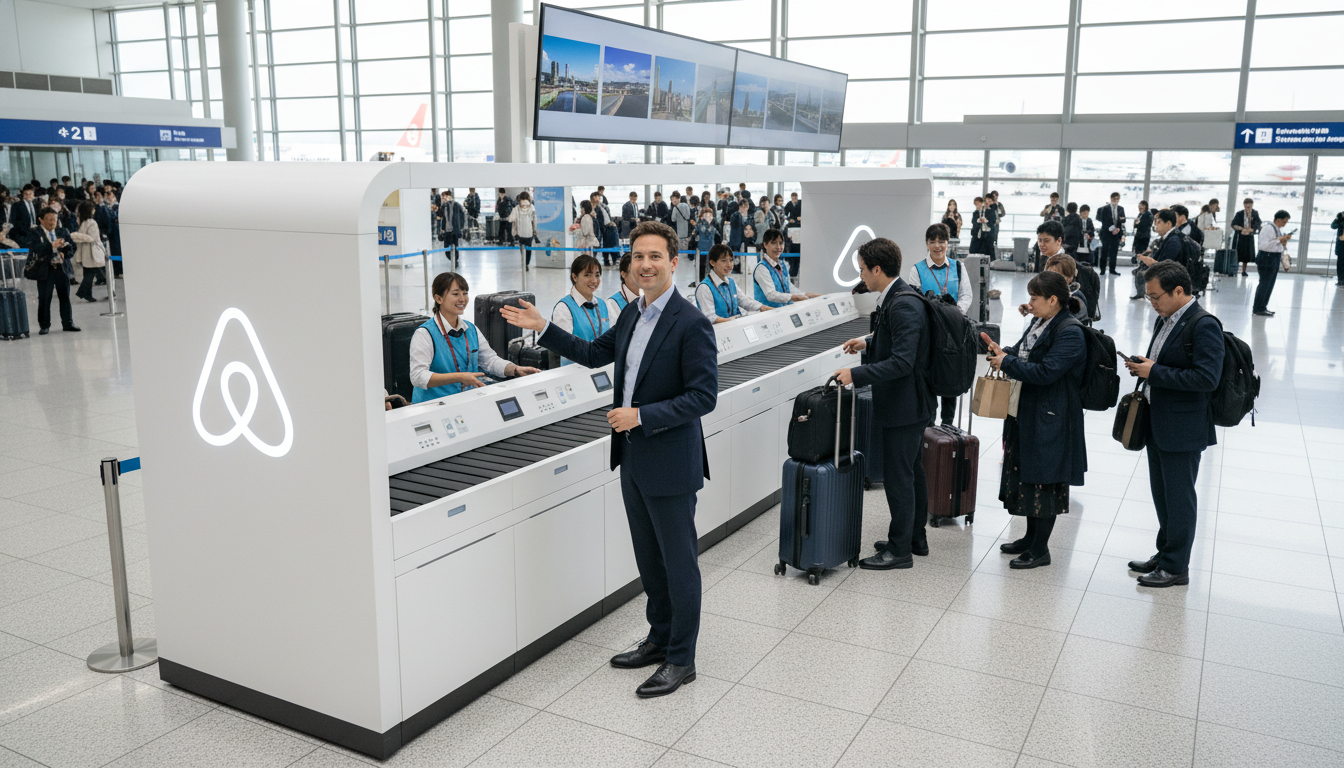
Airbnb luggage storage debuts in Tokyo in 2026 as company broadens services
Airbnb luggage storage will launch in Tokyo in 2026, broadening services beyond rentals as the company plans a global rollout to 175 cities through its app.
Airbnb luggage storage will roll out in Tokyo later in 2026, the company’s chief executive Brian Chesky and chief strategy officer Nathan Blecharczyk told Nikkei in May. The move marks a strategic expansion beyond the company’s core short-term rental marketplace and is being positioned to meet demand in one of the world’s busiest tourism hubs. Airbnb has said the service will be delivered via its app and is part of a broader plan to offer travelers convenience beyond booking accommodation.
Airbnb to debut luggage storage in Tokyo in 2026
Airbnb confirmed the Tokyo launch in interviews with Japanese media in May 2026, naming the capital as the initial market for the luggage storage service this year. The company framed the rollout as a response to strong inbound travel demand and a way to make short visits and transit through the city easier for international and domestic travelers alike. Executives described the product as a complement to stays booked on the platform rather than a replacement for existing accommodation services.
Company outlines 175-city expansion plan
Alongside the Tokyo announcement, Airbnb disclosed an ambition to expand the luggage storage offering to 175 cities worldwide over time. The company did not publish a full timeline for every market, but said Tokyo would be among the first to receive the feature in 2026 before the wider global roll-out. This scale of expansion signals a push to make the service a standard part of Airbnb’s travel ecosystem and to capture ancillary revenue from short-term trips and day visits.
Move seen as diversification beyond vacation rentals
Executives framed the luggage storage initiative as part of a deliberate strategy to diversify Airbnb’s revenue streams beyond vacation rentals. The company has been broadening its product set in recent years, adding experiences, concierge-style services and tools for longer stays, and luggage storage fits within that diversification playbook. Company leaders also described new services as a hedge against technological and market shifts, positioning the firm to offer tangible, location-based conveniences that are harder to replicate solely with automated systems.
Service delivery through app and local partners
Airbnb said the luggage storage product will be integrated directly into its mobile application, allowing users to locate, reserve and pay for storage through the same booking flow they use for stays. The company indicated it will work with a mix of hosts, local businesses and professional operators to provide secure, insured locations, leveraging its local network to scale quickly. For travelers, the app-based model promises a single interface for planning, from check-in times to short-term storage and onward transportation.
Potential impact on Tokyo tourism and travelers
Tokyo’s dense transport network and high visitor numbers make a luggage storage service an attractive convenience, particularly for travelers with long layovers or those between check-out and late departures. By easing the burden of carrying bags across transit hubs and tourist sites, the service could increase flexibility in day-trip itineraries and encourage shorter, more frequent stays. Local businesses that partner with Airbnb may also see incremental foot traffic, though the effects will depend on the final partner mix and pricing structure.
Challenges: regulation and competition in last-mile services
Rolling out a new urban logistics product at scale will expose Airbnb to regulatory scrutiny and competitive pressures in each market it enters. Luggage storage operations must comply with local safety, insurance and zoning rules, and Airbnb will need to navigate those frameworks city by city to avoid operational disruptions. The company will also face established local and international operators already active in short-term storage, requiring competitive pricing, quality control and a reliable asset-light partner model to win market share.
The launch of Airbnb luggage storage in Tokyo and the plan to reach 175 cities underscores the company’s strategy to knit together travel services around the booking experience. By embedding storage into its app and leveraging local partners, Airbnb aims to convert one-off conveniences into recurring revenue streams and deeper user engagement across markets.

